-
The Future of CCBHCs: From Program Expansion to System Transformation
As policymakers search for solutions to the nation's mental health and substance use crisis, Certified Community Behavioral Health Clinics (CCBHCs) represent one of the most promising opportunities for meaningful system change. CCBHCs were established through the Protecting Access to Medicare Act...
-
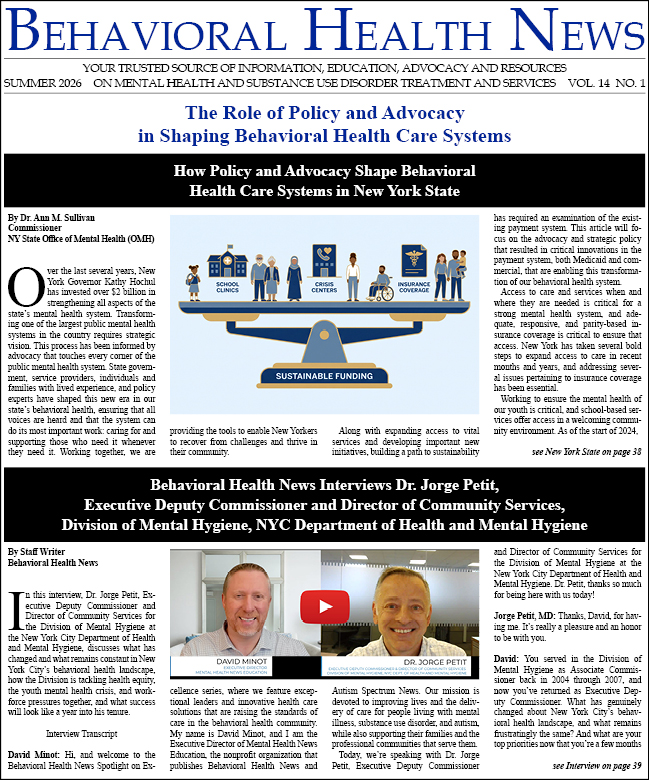
How Policy and Advocacy Shape Behavioral Health Care Systems in New York State
Over the last several years, New York Governor Kathy Hochul has invested over $2 billion in strengthening all aspects of the state's mental health system. Transforming one of the largest public mental health systems in the country requires strategic vision. This process has been informed by...
-
My Autistic Brother Nearly Died Waiting. Now They Want to Cut What Saved Him.
He stood over me and his companion Steve on the steps leading into the Senate building and prayed, "God, give me the words today." It was March 24, 2026, and my 30-year-old autistic brother Stephen was invited to Capitol Hill to meet with Congressional staffers and share his experience living with...
-
Advocacy Through Data: Making the Case for Community Behavioral Health Under Value-Based Payment
Most behavioral health policy arguments still run on stories. A person who was in and out of the hospital for years, then found a community program, got stable, went back to work. The stories are true and they matter. But a recovery story does not hold up well in a budget hearing or a payer...
-
A Call to Amend New York’s Constitution on Mental Health
For decades, New York has been a national leader in advancing mental health policy. Legislators, advocates, providers, and families have fought tirelessly to secure access to treatment, improve insurance coverage, and reduce the stigma surrounding mental illness. Yet despite these efforts, a...
-
Child Welfare and Behavioral Health: Foster Care, Family Court, and the Policy Intersection
Behavioral Health and Trauma Impacts Behavioral health is not a side issue in the child welfare system but rather is a system pressure that is likely to bring families into court in the first place (CDC, 2026). Research indicates that this is a concern. In a systematic review, Engler et al. (2022)...
-
A Brief History of Peer Support and its “Integration” into Behavioral Healthcare: The Uneasiest of Bedfellows
The proliferation of peer services throughout the behavioral healthcare and social welfare systems has transformed them in ways their progenitors might not have anticipated. The peer support and recovery movements originated in eighteenth-century France under the auspices of Phillipe Pinel and...
-
An Epidemic of Anxiety and Depression Requires a Reevaluation of Conventional Treatment
The field of psychiatry has been governed by a medical model of illness in recent decades. This model posits behavioral health conditions, including anxiety and depression, are manifestations of biological abnormalities that may be corrected through interventions commonly employed in other branches...
-
From Silence to Support: How Doula Care Can Destigmatize Maternal Mental Health
Motherhood is often framed using this narrative of a “strong mother”—of self-sacrifice, resilience, perseverance, and unwavering devotion. They are expected to give endlessly, to find joy in every sleepless night, and to cope quietly with the unexpected realities of their new identity. While...
-
Findings from New York State’s Report on Postpartum Depression Screening
Postpartum depression (PPD)—the most common perinatal mood and anxiety disorder—is a debilitating condition affecting at least one in eight people who give birth. PPD is more than just the “baby blues.” It is a more severe mood disorder that can last for many months. PPD may impair a...