-
Strengthening New York’s I/DD System Through Collaboration, Innovation, and Alignment
At a moment when New York's intellectual and developmental disabilities (I/DD) system faces significant challenges, one network chose not to wait for change but to lead it. On March 31, 2026, the New York Integrated Network (NYIN) convened its 13 provider agencies, advocacy partners, and...
-
Advocacy: The Power of the Collective Voice
Policy-making can solve systemic problems, but we can only achieve true behavioral healthcare reform with adequate financial resources. Advocating for public support for mental healthcare takes time, persistence, and a group effort. One of the most successful examples of collaboration in New...
-
Building the Missing Middle: How Advocacy Helped Create a New Behavioral Health Intervention for New Yorkers With Serious Mental Illness
For decades, our behavioral health systems have faced the growing challenge of meeting the needs of people with serious mental illness (SMI). In New York, where the Institute for Community Living (ICL) operates, and most places in the country, demand for services far exceeds supply. Furthermore,...
-
Medication-Assisted Treatment on the Ground: How Federal Policy Shifts Are Reshaping Outreach in Brooklyn
Opioid use remains a significant public health threat in the United States, with nearly 80,000 opioid‑involved overdoses reported in 2023—accounting for 76% of all overdoses that year (Centers for Disease Control and Prevention, 2025). As Substance Use Disorder (SUD) continues to affect more...
-
Advocacy’s Strange Bedfellows: How New York’s Landmark Behavioral Health Budget Came to Be
Governor Hochul's Executive Budget for Fiscal Year 2023-2024 (FY 2024) included unprecedented investments in behavioral healthcare and related services for the most vulnerable residents of New York. This emerged in response to widespread homelessness, rapidly rising rates of suicide, and epidemics...
-
How New CMS Remote Therapeutic Monitoring Policy Is Expanding Access and What It Means for Your Practice
Therapy clients don't live their lives in sessions; they live them in the hours and days in between. The most beneficial work can happen during this in-between time: responding to triggers, practicing coping skills, completing valuable homework and exercises. But it is also when clients are most...
-
Advocacy Through Awareness: Why Patients Need to Know TMS Exists
There is a moment many mental health patients know all too well. It's the moment after another medication change. Another follow-up appointment. Another hopeful start that doesn't provide the relief they need to survive. By the time some patients reach that point, they are exhausted by their...
-
Future-Proofing Behavioral Health: Why New York Providers Need Partners Who Can Pivot
New York's behavioral health system moves quickly, and providers feel that pace every day as programs, requirements, and expectations continue to shift. Even when policy changes are designed to improve care or expand access, the process of adjusting to them can place real pressure on program...
-
Behavioral Health News Spotlight on Excellence: An Interview With Dr. Jorge Petit, Executive Deputy Commissioner and Director of Community Services, Division of Mental Hygiene, NYC Department of Health and Mental Hygiene
Overview In this interview, Dr. Jorge Petit, Executive Deputy Commissioner and Director of Community Services for the Division of Mental Hygiene at the New York City Department of Health and Mental Hygiene, discusses what has changed and what remains constant in New York City's behavioral health...
-
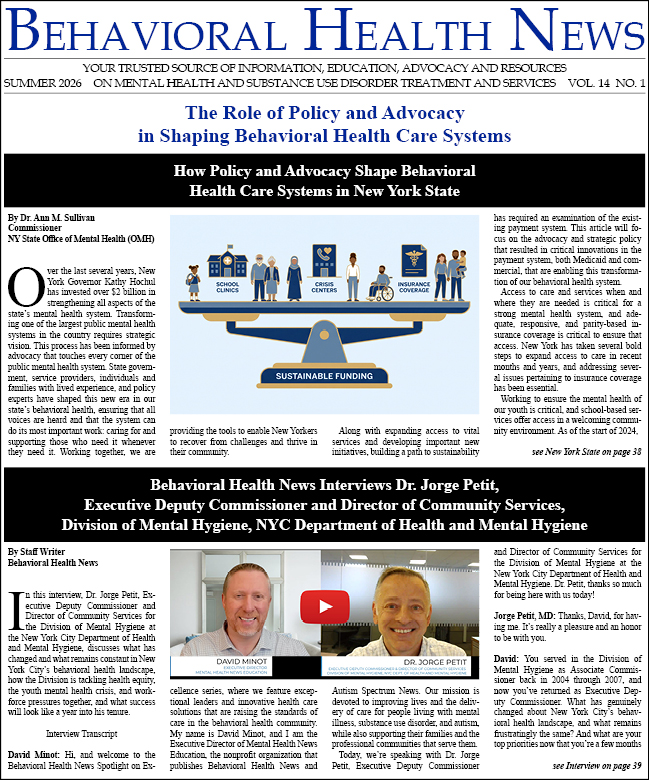
How Policy and Advocacy Shape Behavioral Health Care Systems in New York State
Over the last several years, New York Governor Kathy Hochul has invested over $2 billion in strengthening all aspects of the state's mental health system. Transforming one of the largest public mental health systems in the country requires strategic vision. This process has been informed by...