Behavioral Health and Trauma Impacts
Behavioral health is not a side issue in the child welfare system but rather is a system pressure that is likely to bring families into court in the first place (CDC, 2026). Research indicates that this is a concern. In a systematic review, Engler et al. (2022) showed that the mental health burden of children in foster care is significantly greater than that of children in the general population. Previous studies also showed that transitioning youth from foster care had a higher risk of lifetime and/or past-year mental health problems and that needs for mental health services were lower when they were most likely to need services (Havlicek et al., 2013). Also, it is not only diagnosis that is an issue for children in foster care; they also have poorer mental and physical health, as found by Turney and Wildeman (2016). Pecora et al. (2009) found services for mental health in foster care were described as “fractured” and “inconsistent” with a heavy focus on referral and not coordinated services. All of these studies indicate a system of high need and high complexity with too often only a partial service response (Engler et al., 2022; Havlicek et al., 2013; Pecora et al., 2009; Turney & Wildeman, 2016).
Out-of-place trauma is one of the factors contributing to this. Fratto (2016) estimated that between 80 and 90% of foster care children have suffered from a child traumatic event and almost half have suffered from four or more types of child traumatic events. This pattern is clinically significant as complex trauma is not likely to be expressed as one symptom. It may manifest itself as aggression, withdrawal, school refusal, sleep difficulties, self-harm, anxiety, hypervigilance, and a lack of trust in adults. If those behaviors are seen as “not complying,” then the system could punish, disrupt, and escalate without treating the behavior. The evidence thus suggests that the standard approach should be to go with trauma-informed care. Based on a meta-analysis, trauma-informed interventions for the child welfare system population have been shown to be promising, but their effect sizes vary depending on the type of intervention and how well it is designed and implemented (Fratto, 2016; Zhang et al., 2021).
Inability to place leads to poorer behavioral health. Instability in foster placements has been linked to emotional and behavioral issues, and it can exacerbate issues by breaking up school continuity, relationships, and daily routines (Maguire et al., 2024). This is why fostering care policy should not take any of these factors into account individually, but all of them together (Maguire et al., 2024; Turney & Wildeman, 2016).
Family court is in the middle of these decisions. The National Council of Juvenile and Family Court Judges (NCJFCJ) points out that courts may not necessarily be aware of the impact of trauma and are unlikely to be able to change environments, policies, and practices in ways that would prevent the exacerbation of trauma (NCJFCJ, 2024). The Children’s Bureau is also clear that federal laws mandate judicial oversight and a role in child welfare cases and that the funding from the Court Improvement Program (CIP) is designed to enhance court proceedings and outcomes for safety, well-being, and permanency (Administration for Children and Families [ACF], 2020). Although courts must remain neutral decision-makers, their actions and timelines can significantly influence child welfare outcomes. It is a system actor which can either promote recovery processes or extend harm processes in a timely, appropriate manner with credibility and orders. Hearings and delays in hearings, a lack of permanency, and services not coordinated are all components of the child’s instability (ACF, 2020).
A key component to the policy intersection is Medicaid. Early and Periodic Screening, Diagnostic, and Treatment (EPSDT) is the federal benefit that ensures children under 21 enrolled in Medicaid receive comprehensive preventive treatment services, and directly, Centers for Medicare & Medicaid Services (CMS) states, it is a critical component to accessing appropriate preventive, dental, mental health, and specialty services (CMS, 2026). In other words, no single system can address a child’s behavioral health needs — financing and delivery systems for pediatric care must work in concert with the court and agency system (CMS, 2026).
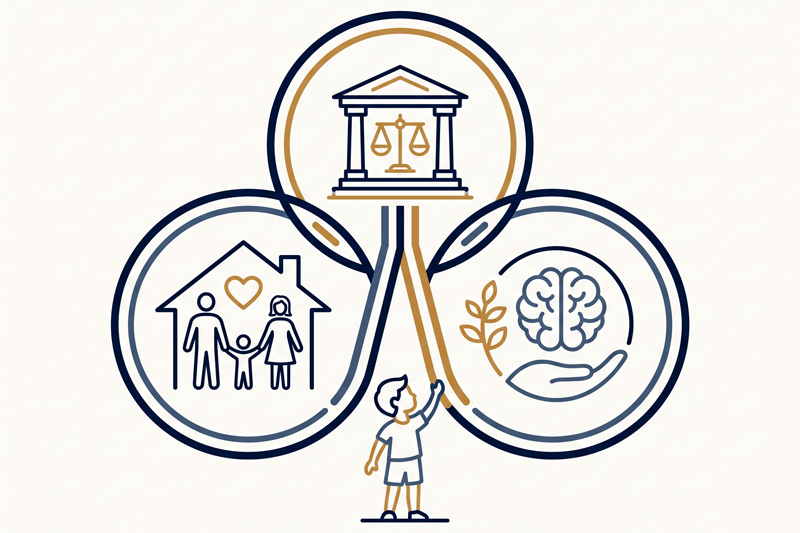
The best systems are thus a mixture of legal and trauma-informed care and coordinated services. Children’s Bureau court and judicial guidance indicates that the legal and judicial system are woven into the child welfare system and play an important role in outcomes related to family connections, timely permanency, education (ACF, 2020), mental health, and behavioral health, as well as quality legal representation (CFYC, 2020). In one sentence, that’s the policy intersection: Courts are not just about deciding what to do; they’re about how to get to treatment, how to get into the family, how to stay in the family, how to get to being it a permanent. Timely hearings, competent and independent attorneys, knowledge of trauma, and preservation of family relationships whenever safe (ACF, 2020) are better for children.
Implementation Priorities for Practice and Policy
The vast majority of child welfare reforms succeed or fail in their implementation. A policy may be sound in theory but have mediocre results when agencies lack resources to implement it, resources are unavailable, or the agreements and service arrays required to support the policy are not in place.
One of the first things that will need to be done is earlier and more regular behavioral health screening. The needs of many children are not recognized at the point of referral and/or the appropriate level of care is not provided. Screening should thus be routine, developmentally appropriate, and tied to a warm “handoff” instead of a “passive” referral (CMS, 2026a).
Secondly, placement stability is important (Maguire et al., 2024). Placement decisions should address caregiver preparation, sibling continuity, cultural ties, and behavioral health fit, rather than just the availability of beds, as unstable placements are associated with greater emotional and behavioral concerns (Maguire et al., 2024).
The third priority is to work collaboratively on the family courts. The CIP model acknowledges that judges, attorneys, court administrators, and child welfare agencies have to work together for hearings to be a tool to promote safety, permanency, and well-being. Better outcomes can be achieved by ensuring that hearings are conducted in a timely fashion, the plan for service is clear, children can participate meaningfully in the plan, and the plan allows for child-appropriate communication (Children’s Bureau, 2024).
The fourth priority is youth participation. Young people in care are very often the best source of information as to what is working, what is not, and what sort of support they require. Lived-experience approaches are important as they enhance the design of practices and help minimize the gap between policy “intent” and practice (Child Welfare Information Gateway, 2024).
Equity is another consideration. It is not the same system pressures that impact all families, and policy designs can either decrease or increase disparity. Child welfare systems should thus consider whether they are producing unequal outcomes for children by race, ethnicity, geography, disability, language, and/or family structure in their screening, court processes, placement decisions, and access to services (Child Welfare Information Gateway, 2024).
Conclusion
The policy intermingling of child welfare, family court, and behavioral health is clearly evident. Trauma and mental health must be integrated into foster care; placement stability and legal coordination cannot be viewed without mental health treatment; and treatment and coordination of the child’s service systems cannot be discussed in family court without the understanding of placement stability and mental health treatment. The data from the literature consistently indicate that children in foster care have significant behavioral health needs, that instability increases adverse outcomes, and that a policy that is trauma-informed, coordinated, and prevention-oriented is more effective than a crisis-oriented, fragmented policy (Engler et al., 2022; Maguire et al., 2024; Pecora et al., 2009; Turney & Wildeman, 2016).

Temitope Fabayo, BA, MBA, is President of DMC HomeCare.
References
Administration for Children and Families. (2020). CFSR Round 3 report for legal and judicial communities. U.S. Department of Health and Human Services. https://www.cfsrportal.acf.hhs.gov/document/download/OqlvYJ
Black Child Legacy Campaign. (2024). Racial disproportionality and disparity in child welfare. U.S. Department of Health and Human Services. https://blackchildlegacy.org/wp-content/uploads/2017/04/racialdisproportionality-and-dispraity-in-child-welfare.pdf
Centers for Disease Control and Prevention. (2026, March 2). About adverse childhood experiences. https://www.cdc.gov/aces/about/index.html
Centers for Medicare & Medicaid Services. (2026). Early and periodic screening, diagnostic, and treatment (EPSDT). https://www.medicaid.gov/medicaid/benefits/early-and-periodic-screening-diagnostic-and-treatment
Centers for Medicare & Medicaid Services. (2026a). Early and periodic screening, diagnostic, and treatment (EPSDT). https://www.medicaid.gov/medicaid/benefits/early-and-periodic-screening-diagnostic-and-treatment
Centers for Medicare & Medicaid Services. (2026b). InCK (Integrated Care for Kids) Model. https://www.cms.gov/priorities/innovation/innovation-models/inck
Child Welfare Information Gateway. (2023). Youth engagement. U.S. Department of Health and Human Services. https://www.childwelfare.gov/topics/youth/?top=107
Children’s Bureau. (2024). Court Improvement Program (CIP). U.S. Department of Health and Human Services. https://www.acf.hhs.gov/cb/grant-funding/court-improvement-program
Engler, A. D., Sarpong, K. O., Van Horne, B. S., Greeley, C. S., & Keefe, R. J. (2022). A systematic review of mental health disorders of children in foster care. Trauma, Violence, & Abuse, 23(1), 255–264. https://doi.org/10.1177/1524838020941197
Fratto, C. M. (2016). Trauma-informed care for youth in foster care. Archives of Psychiatric Nursing, 30(3), 439–446. https://pubmed.ncbi.nlm.nih.gov/27256954/
Havlicek, J. R., Garcia, A. R., & Smith, D. C. (2013). Mental health and substance use disorders among foster youth transitioning to adulthood: Past research and future directions. Children and Youth Services Review, 35(1), 194–203. https://experts.illinois.edu/en/publications/mental-health-and-substance-use-disorders-among-foster-youth-tran/
Maguire, D., May, K., McCormack, D., & Fosker, T. (2024). A systematic review of the impact of placement instability on emotional and behavioural outcomes among children in foster care. Journal of Child & Adolescent Trauma, 17, 641–655. https://doi.org/10.1007/s40653-023-00606-1
Maguire, D., May, K., McCormack, D., & Fosker, T. (2024). A systematic review of the impact of placement instability on emotional and behavioural outcomes among children in foster care. Journal of Child & Adolescent Trauma, 17, 641–655. https://doi.org/10.1007/s40653-023-00606-1
National Council of Juvenile and Family Court Judges. (2024). Trauma-informed courts. https://www.ncjfcj.org/child-welfare-and-juvenile-law/trauma-informed-courts/
Pecora, P. J., Jensen, P. S., Romanelli, L. H., Jackson, L. J., & Ortiz, A. (2009). Mental health services for children placed in foster care: An overview of current challenges. Child Welfare, 88(1), 5–26. https://pubmed.ncbi.nlm.nih.gov/19653451/
Turney, K., & Wildeman, C. (2016). Mental and physical health of children in foster care. Pediatrics, 138(5), e20161118. https://pubmed.ncbi.nlm.nih.gov/27940775/
Zhang, S., Conner, A., Lim, Y., & Lefmann, T. (2021). Trauma-informed care for children involved with the child welfare system: A meta-analysis. Child Abuse & Neglect, 122, 105296. https://doi.org/10.1016/j.chiabu.2021.105296