Over the last several years, New York Governor Kathy Hochul has invested over $2 billion in strengthening all aspects of the state’s mental health system. Transforming one of the largest public mental health systems in the country requires strategic vision. This process has been informed by advocacy that touches every corner of the public mental health system. State government, service providers, individuals and families with lived experience, and policy experts have shaped this new era in our state’s behavioral health, ensuring that all voices are heard and that the system can do its most important work: caring for and supporting those who need it whenever they need it. Working together, we are providing the tools to enable New Yorkers to recover from challenges and thrive in their community.
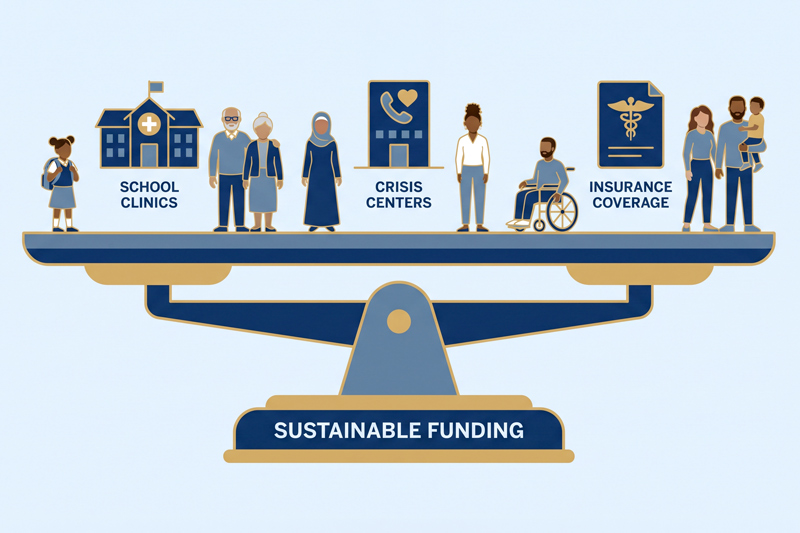
Along with expanding access to vital services and developing important new initiatives, building a path to sustainability has required an examination of the existing payment system. This article will focus on the advocacy and strategic policy that resulted in critical innovations in the payment system, both Medicaid and commercial, that are enabling this transformation of our behavioral health system.
Access to care and services when and where they are needed is critical for a strong mental health system, and adequate, responsive, and parity-based insurance coverage is critical to ensure that access. New York has taken several bold steps to expand access to care in recent months and years, and addressing several issues pertaining to insurance coverage has been essential.
Working to ensure the mental health of our youth is critical, and school-based services offer access in a welcoming community environment. As of the start of 2024, commercial insurers must cover school-based mental health clinics and provide reimbursement at Medicaid rates or higher. Supporting students and their families, these school-based clinics offer the chance to meet with a licensed mental health provider in a familiar, stigma-free setting on campus. We now support more than 1,300 of these clinics, up from 872 in 2020, dramatically reducing what had been a barrier to care for many young people and their families. Because of this important preventive step, families and children can visit a supportive, familiar environment to address mental health issues as they arise and before they worsen.
In addition, as a result of advocacy and policy that focused on parity and fairness, recent amendments to the state’s insurance laws now require commercial insurers to cover most outpatient services provided by participating Office of Mental Health and Office of Addiction Services and Supports (OASAS) licensed and certified providers at the Medicaid rate or higher. It is important to remember that the Medicaid rate is cost-based, and therefore, the minimum payment needed to provide the service. Previously, commercial insurers often paid less than the Medicaid rate, causing some providers to not accept some commercial insurance, limiting access. In the future, commercial insurers will also be required to cover services like Assertive Community Treatment, mobile crisis, and residential programs such as crisis residences and those offering treatment for eating disorders.
Also, new network adequacy and timeliness-of-service requirements are aimed at making a range of behavioral health care services more widely available, which is the goal of the state’s “Real Care, Real Access” awareness campaign. In recent months, you may have seen social media posts, signs and banners on public transport, broadcast announcements, and even a dedicated website promoting New York’s new insurance network adequacy rules. These changes took effect in July of 2025, and they speak directly to the links between access to care and stronger mental health. They guarantee that an individual can see a behavioral health care provider for outpatient mental health or substance use disorder care within 10 business days for an initial visit, and seven calendar days for a follow-up appointment after discharge from a hospital or emergency room.
These mandates, which involve multiple state agencies working together, also require insurers to have dedicated staff to help find an in-network provider and to make contact information for providers readily available. If an appointment is not available within the required timeframe, individuals can file an access complaint, and if an appointment is still unavailable within network, insurers must offer out-of-network care at in-network costs. CHAMP, the Community Health Access to Addiction and Mental Healthcare Project, is the state’s behavioral health ombudsman program that assists anyone having difficulty accessing care from their insurer and can be reached by calling 888-614-5400. As part of the new state budget, Governor Hochul is also taking additional steps to improve patient care, redoubling efforts to make certain that the need for prior authorizations does not hinder the delivery of treatment by providers. While all of these facets help ensure that individuals can access high-quality care, they also create financial stability for providers and maintain an environment where those in need of care can continue to receive it.
New York’s robust behavioral health crisis response system serves as urgent access for all New Yorkers, and we are in the process of ensuring funding for these services by both Medicaid and commercial insurers as well as subsidies by the state. Across the nation, states are developing ways to ensure the financial stability of crisis systems. New York is investing in a full range of care options that offer flexible support, from Mobile Crisis services to Home-Based Crisis Intervention, Comprehensive Psychiatric Emergency Programs (CPEPs), Crisis Residences, and Crisis Stabilization Centers — which offer immediate care to anyone walking in, 24/7 for up to a day. Law enforcement and emergency responders can utilize these Crisis Stabilization Centers as an alternative to emergency rooms, dropping off individuals and diverting them from higher levels of care. By building up the infrastructure to address mental health crises in communities around the state, we can help individuals avoid trips to hospital emergency rooms or unnecessary interactions with law enforcement, stabilizing the situation and connecting them with ongoing services. OMH is continuing to create sustainable reimbursement methods for these crisis programs, including Medicaid and commercial insurance coverage. At this time, crisis programs are covered by Medicaid, with the exception of Home-Based Crisis Intervention services, which are fully funded through state aid. Commercial insurers must currently cover crisis stabilization services, with other crisis service coverage requirements pending.
The Office of Mental Health (OMH) has been celebrating groundbreaking and grand openings of several of these new crisis support facilities recently — including another five in the past five months. Late last year, I attended one such gathering on Long Island, where the new CN Guidance & Counseling’s Community Crisis Center — jointly licensed with OASAS — provides urgent treatment to New Yorkers experiencing a mental health or substance use crisis. This facility alone will serve 2,000 individuals a year and can support up to 24 people per day with peer and recovery-oriented services and referrals. While visiting the facility, I got to meet the dedicated local staff who make places like this work. They were to begin services the following day and were eager to make use of the new space. Three Supportive and six Intensive Crisis Stabilization Centers are now operating around the state, with several more in the pipeline — demonstrating how state and local partners are responding to community needs with tailored programs and new investments. These centers are jointly licensed by OMH and OASAS, and services are reimbursed by both Medicaid and commercial insurers, promoting financial sustainability.
In other ways, our advocacy requires strong communication and adaptability. It is clear that New York must continue to focus on maintaining insurance benefits for as many New Yorkers as possible as the federal government makes changes to Medicaid. This year, OMH and other state agencies have endeavored to educate the public about new work requirement rules that could impact Supplemental Nutrition Assistance Program, or food stamps, and/or health benefits for able-bodied adults without dependents. There are obviously strong links between having health insurance and healthy foods with overall wellbeing, especially mental health, and we must raise awareness about these hurdles and offer assistance to mitigate them.
As I have been emphasizing, adequate insurance coverage is one of the pillars of ensuring access to care. Imminent changes, stemming from the federal H.R.1 law, which establishes new eligibility and renewal standards and new work, volunteer, and job training requirements for some Medicaid recipients to retain their coverage, will severely impact many of New York’s most vulnerable populations. While it is important to know that New Yorkers on disability SSI-D will not be affected by these rules, thousands of New Yorkers may have their benefits at risk. Work requirements do not apply to everyone. Please contact your provider or insurer or CHAMP if you have questions. These rules and changes are complicated, and as described below, OMH will be providing guidance and assistance as we move forward to ensure that all New Yorkers who are eligible can maintain or gain their coverage.
State government has been laser-focused on mitigating these effects and raising awareness about their impacts on the individuals and families who receive mental health services. OMH is standing up a new webpage focused on federal impacts, outlining the changes in plain language. We are communicating regularly with providers to educate them and the people they serve about what to expect. And we are tapping a network of trusted, dedicated mental health advocates to amplify this outreach. We are also relying on existing structures, such as our programs that work with individuals to recertify their coverage and our supported employment services programs. OMH funds several programs that help individuals develop skills and attain employment; our evidence-based Individual Placement and Support model helps those living with behavioral health conditions to work at competitive jobs of their choice. And remember, these changes are effective January of 2027.
For us, this represents the nexus of advocacy, policy, and financing. A strong behavioral health system must include high-quality services, true access to those services, the ability of providers to treat individuals in need in a timely manner, and a mechanism to sustainably pay for those services. This means that all insurers — Medicaid and commercial — are critical to sustaining our system of care and must work together to ensure access. The policy changes that have enhanced the commercial system’s commitment to behavioral health services are critical as we move forward in these challenging times.
Dr. Ann M. Sullivan is Commissioner of the New York State Office of Mental Health