The proliferation of peer services throughout the behavioral healthcare and social welfare systems has transformed them in ways their progenitors might not have anticipated. The peer support and recovery movements originated in eighteenth-century France under the auspices of Phillipe Pinel and Jean-Baptiste Pussin who sought to rectify countless injustices leveled upon individuals with mental illness (Davidson et al., 2012). The psychiatric and mental health professions emerged under ignoble and exceptionally cruel practices that dehumanized the subjects of their “care” and often exacerbated their conditions. Such practices, some of which were borne of noble but misguided intent, were predicated on a false belief that individuals with mental illness were incurable and disposed to inexorable deterioration and death. Pinel, chief physician of a psychiatric hospital, and Pussin, a former patient, espoused more progressive attitudes than their contemporaries and collaborated in enacting essential reforms. Their efforts augured the arrival of the “Moral Treatment” movement whose reforms included the deployment of former patients as caregivers (Davidson et al., 2011).
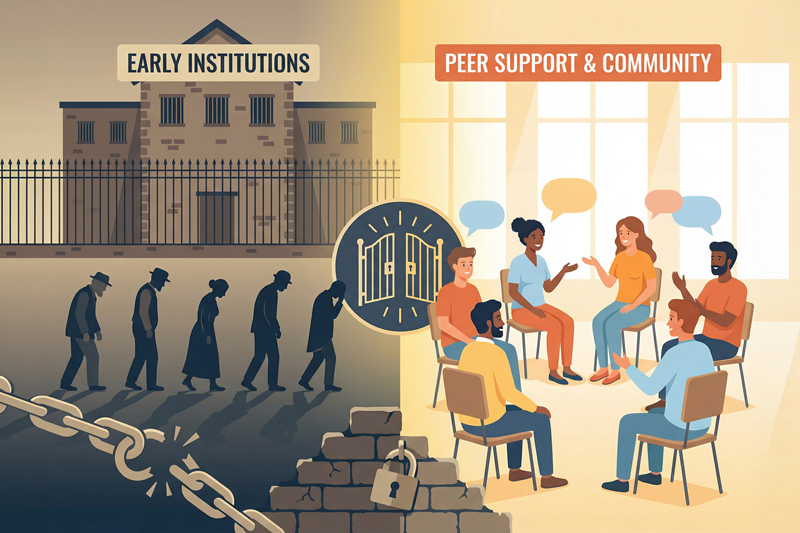
Moral Treatment reformed but did not upend existing standards of care, whereas subsequent developments in the peer support and recovery movements departed radically from their predecessors and entailed militant critiques of the status quo. The recovery movement in the United States was aligned with and inspired by the civil rights movement of the mid-20th Century that found common cause among oppressed and stigmatized populations. Efforts to end segregation and to advance the rights of racial minorities, women, gay and lesbian, and other marginalized communities coincided with commensurate changes in the paradigm that had governed psychiatric care since its inception. In one of his last official acts before his assassination in November 1963, President Kennedy signed the Community Mental Health Center Act — a watershed moment in the evolution of our treatment of individuals with mental illness that heralded decades of deinstitutionalization and the development of community-based services (Kennedy, 1979). A burgeoning concern for civil liberties coupled with emerging opportunities for individuals with mental illness to enjoy opportunities for community participation provided fertile ground for the rapid expansion of the peer support and recovery movements.
These movements entailed distinct coalitions that shared certain overarching objectives but diverged in significant respects. Patients who had suffered abuse during episodes of treatment remained skeptical of measures that merely aimed to reform a system they deemed inherently oppressive and dehumanizing. Members of the Psychiatric Inmates Liberation Movement of the 1960s were overwhelmingly opposed to conventional psychiatry and its underpinning medical model of mental illness (Chamberlin, 1990). They advocated for reforms regarded as radical for their time that included prohibitions on involuntary commitment and other coercive measures. Some of these reforms gained currency among behavioral healthcare professionals who recognized deficiencies inherent in existing standards of care. Such self-described “Radical Therapists” challenged a system that perpetuated power imbalances between patients and practitioners and cycles of disempowerment that undermined the recovery process (Talbott, 1974). These practitioners were among the first to identify a leading liability in a medical model of care that encouraged individuals’ adjustment to oppressive social and economic conditions. In this respect they were united with champions of the Liberation Movement who sought to liberate individuals from structural oppression. Both Radical Therapists and Liberators recognized that existing models of care were prone to pathologize normative responses to abnormal conditions.
Members of the Liberation Movement and others who railed against psychiatry’s abuses promoted alternative models of care similar to the “self-help” approaches that had been employed in the realm of substance use. Some believed these approaches were more effective than conventional models, and many regarded them as emancipatory inasmuch as they liberated their participants from psychiatry and its practitioner-centric and paternalistic proclivities (Chamberlin, 1990). Sherry Mead, a leading theoretician and pioneer of the Intentional Peer Support (IPS) model, championed an approach that honored the peer movement’s commitment to social change and reconceptualized both the definition and leading objectives of “helping” relationships (Mead, 2010). She espoused a principle of mutuality wherein partners in a relationship would engage in the joint pursuit of knowledge unencumbered by the imperative to interpret or to analyze topics of dialogue. Mutuality eliminates power imbalances and encourages creativity that is too often constrained within hierarchical and outcome-based orthodoxies (Mead, 2010). IPS has become the philosophical foundation of peer support and is widely employed by Certified Peer Specialists.
As the peer support movement matures it faces exciting opportunities and existential threats. These seemingly contradictory trends are inextricably linked and must be successfully navigated if the movement is to deliver on its dual promises. The movement aims to offer effective alternatives to traditional care and to advance social changes that empower individuals and communities to overcome enduring stigma and marginalization, but its continuing expansion is dependent on larger systems in which it is now embedded. It is therefore subject to practices and constraints antithetical to its philosophical underpinnings. Medicaid, the predominant payer for mental health services in the United States, now offers reimbursement for peer services in at least 35 states (Copeland Center for Wellness and Recovery, 2022). This has undoubtedly fostered a rapid expansion of peer services and ensured their availability to individuals in need. Nevertheless, practitioners with even a cursory knowledge of Medicaid regulations understand its reimbursement entails adherence to an exceedingly complex body of regulations and the fulfillment of onerous administrative requirements. Furthermore, mainstream facilities and organizations serving individuals with behavioral health conditions, most of which rely heavily on Medicaid to sustain their operations, are subject to other constraints that militate against the better angels of the recovery movement. These include but are by no means limited to institutional hierarchies; adherence to innumerable regulatory standards; and the sharp delineation of roles and responsibilities between “peers” and “professionals.” Practitioners of peer support who wish to apply it in a manner consistent with its theoretical, philosophical, and historical underpinnings must proceed with caution lest they be utterly coopted by the deeply entrenched systems that promise merely to “integrate” them.

Ashley Brody, MPA, CPRP, is Chief Executive Officer of Search for Change, Inc.. He may be reached at (914) 428-5600 (x9228) or [email protected].
References
Chamberlin, J. (1990). The ex-patients’ movement: where we’ve been and where we’re going. Journal of Mind and Behavior, 11(3/4), 323-336. https://www.jstor.org/stable/43854095
Copeland Center for Wellness and Recovery. (2022). How are peer support services paid for by the state? What specific Medicaid waivers are used, if any? https://www.copelandcenter.com/peer-specialists
Davidson, L., Bellamy C., Guy, K., & Miller, R. (2012). Peer support among persons with severe mental illnesses: a review of evidence and experience. World Psychiatry, 11(2), 123-128. https://doi.org/10.1016/j.wpsyc.2012.05.009
Davidson, L., Rakfeldt, J., & Strauss, J. (2011). The roots of the recovery movement in psychiatry: lessons learned. Wiley-Blackwell.
Kennedy, E. M. (1979). Community mental health care: new services from old systems. The Millbank Memorial Fund Quarterly. Health and Society, 57(4), 480-484. https://doi.org/10.2307/3349723
Mead, S. (2010). Defining peer support. https://intentionalpeersupport.org/articles
Mead, S. (2010). Intentional peer support as social change. https://intentionalpeersupport.org/articles
Talbott, J. (1974). Radical psychiatry: an examination of the issues. American Journal of Psychiatry, 131(2), 121-128. https://doi.org/10.1176/ajp.131.2.121