For decades, New York has been a national leader in advancing mental health policy. Legislators, advocates, providers, and families have fought tirelessly to secure access to treatment, improve insurance coverage, and reduce the stigma surrounding mental illness. Yet despite these efforts, a fundamental contradiction remains embedded in New York’s highest governing document: the New York State Constitution.
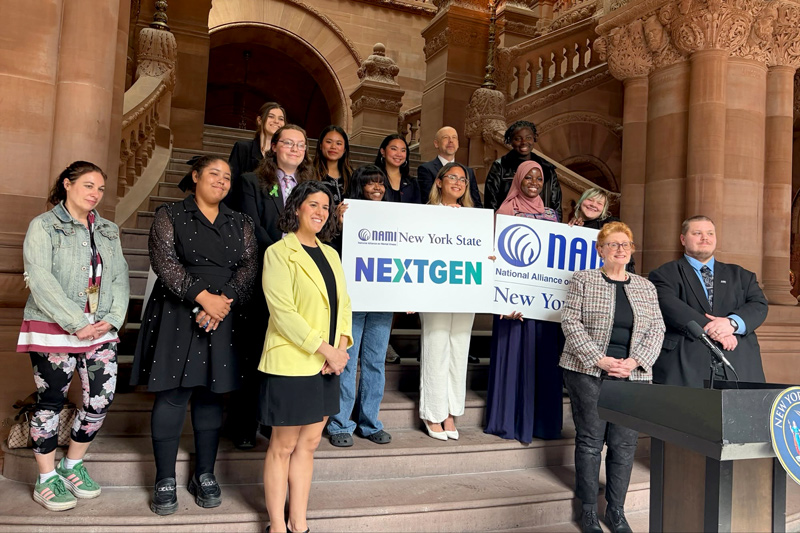
NAMI NYS Next Gen Advocacy Day press conference on the million dollar staircase
The roots of this contradiction can be traced to the 1938 Constitutional Convention. Sections 3 and 4 of Article XVII of the New York State Constitution outline provisions regarding public health and mental health. While the Constitution declares health to be “a matter of public concern,” it says only that “…the protection of the mental health of the inhabitants of the state may be provided by state and local authorities….” The existing language reveals a striking disparity. Section 3 of Article XVII mandates that provisions for public health be made by the state. The language is clear and affirmative. Health is a public responsibility, while mental health is optional.
Arguably, this disparity finds its origin in one word in Section 4: “May.” This “May” vs. “Shall” contradiction is key to understanding the state constitution, and especially how mental health is treated in it. Shall is an imperative command, whereas may is an expression of possibility. While there is some case law on the manner in which “May” is used, generally “May” is defined by permissiveness. State and local governments are able to make rules to address mental health but are not required to in the same manner as public health, where it is a “Shall.” Health is required; mental health is optional.
Some may argue that such changes are largely symbolic because New York already has extensive mental health programs and protections. Yet history and current events have demonstrated that constitutional language matters precisely because it shapes the policies that follow. Every legislative session, advocates call on lawmakers to pass bills that advance mental health parity, and protect access, even as we mark more than 20 years since Timothy’s Law.
Timothy’s story captured the unfortunate realities families face when attempting to obtain mental health treatment for those they love. Federal law enacted in 1996 required mental health coverage, but it allowed insurers to impose $5,000 annual and $50,000 lifetime spending caps that were dwarfed by the actual cost. The lack of access and care led to tragedy that sparked mental health parity mandates. Timothy’s Law was a major step forward, requiring greater parity in insurance coverage for mental health treatment.
Yet recent litigation highlights that New York violated the Olmstead Act in its underinvestment in youth mental health, leading many to inpatient settings unnecessarily due to a lack of investment in outpatient options.
During this legislative session many of the same advocates who fought for Timothy’s Law continue to push for parity reforms. They advocated to eliminate harmful insurance claw-backs, exempt behavioral health services from certain managed care restrictions, address chronic underfunding of behavioral health workers, fight fail first and other policies that create barriers to care.
This advocacy is not just in Albany. Organizations like NAMI moved quickly after the Trump administration abruptly terminated hundreds of Substance Abuse and Mental Health Services Administration (SAMHSA) federal grants and then reversed it less than 24 hours later. Recent budget bills have highlighted Secretary Kennedy’s plans to eliminate the only federal agency overseeing US mental health and substance use services and creating the Administration for a Health America. With 1 in 4 dollars of all mental health spending originating from Medicaid, recent federal Medicaid cuts have put hospitals and mental health providers in precarious financial situations.
Which brings us to the heart of this argument: we will not have parity in our laws if we do not have permanent parity in our Constitution. Constitutions serve as statements of values. They define not only what governments can do, but also what they cannot do and what they must do. Less easily undone by a current administration, and harder to evade than a statute. As long as physical health is governed by a “shall” and mental health by a “may,” we will continue to see gaps in insurance coverage, the justice system, crisis response, and the mental health workforce. As long as mental health is optional, it is at risk of being eliminated. By elevating mental health to equal constitutional standing, New York would send a clear message that the well-being of individuals living with mental illness is not optional, discretionary, or secondary. It is a public responsibility.

For more information about NAMI New York State, visit naminys.org or email [email protected].