Governor Hochul’s Executive Budget for Fiscal Year 2023-2024 (FY 2024) included unprecedented investments in behavioral healthcare and related services for the most vulnerable residents of New York. This emerged in response to widespread homelessness, rapidly rising rates of suicide, and epidemics of substance misuse and abuse that necessitated both a restoration and expansion of the social safety net. The Governor and members of the State Legislature were rightly lauded for these investments, but they would not have materialized without the concerted efforts of the advocacy community and other influential figures. Events that preceded passage of the FY 2024 budget illustrate the exceedingly complex and often inchoate ways in which advocacy coalesces to shape public policy. They also affirmed the integral role of advocacy in effecting essential improvements to our systems of care.
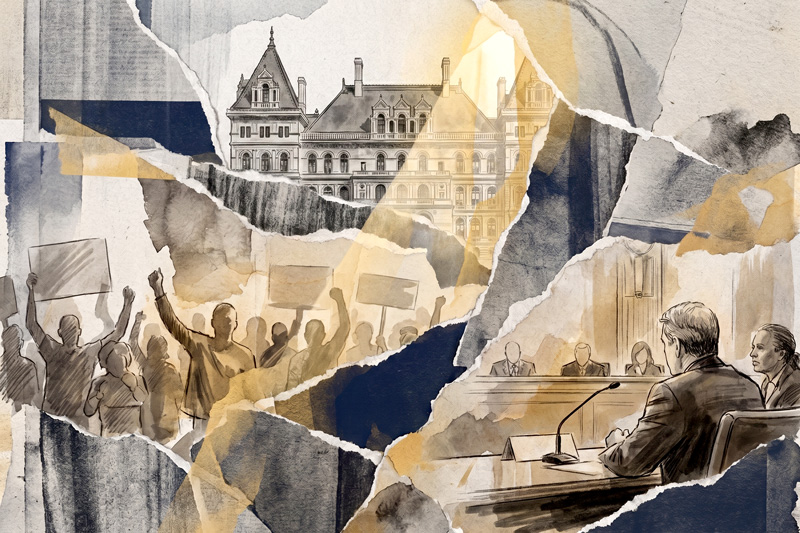
Policy development is an incremental process that unfolds amid inordinately complex sociopolitical, economic, and cultural dynamics. The metaphorical “seed” of the FY 2024 Executive Budget was planted at the inception of a deinstitutionalization movement, and it matured throughout ensuing decades as formerly institutionalized persons (and those who might have been institutionalized in previous eras) found themselves deprived of support services essential to their health and wellbeing in community-based settings. Individuals with serious behavioral health conditions often inhabit the margins of society and are at disproportionate risk of poverty, homelessness, chronic physical ailments, and other debilitating life challenges, particularly during periods of increased scarcity. A rapid rise in the cost of living coupled (and perhaps inextricably linked) with a widespread crisis in housing affordability have relegated the most vulnerable members of our society to homeless shelters and streets. To paraphrase a purported misquotation often attributed to Mahatma Gandhi, “When a society’s neglect of its most vulnerable citizens can no longer be concealed, persons of conscience must act.” In other words, passage of the FY 2024 budget would not have occurred in the absence of an advocacy community galvanized by the plight of those entrusted to its care.
Governor Hochul’s Administration announced the passage of the FY 2024 budget with considerable fanfare and touted it as one that “will correct a [mental healthcare] system that has suffered from decades of chronic underinvestment” through an expansion of supportive housing and other community-based services for individuals with serious behavioral health conditions (Governor’s Press Office, 2023). Stakeholders to the state’s beleaguered behavioral healthcare and social welfare systems celebrated these investments and credited the advocacy community for its role in producing an unprecedented public policy advancement. This community deserved at least partial credit for this accomplishment, but it would be naïve to conclude the budget was a product of concerted advocacy alone. By many accounts, inadequate and poorly coordinated community-based services for society’s most vulnerable individuals are legacies of a deinstitutionalization movement that commenced with passage of the Community Mental Health Center (CMHC) Act in the 1960s and persisted despite advocates’ repeated appeals for reform (Dixon & Schwarz, 2013). The CMHC’s failure to deliver on its promise to replace institutions with a robust array of community support services is evident in epidemics of unmet housing and social welfare needs among those it was designed to serve. These epidemics were exacerbated by the COVID-19 pandemic and associated socioeconomic upheaval of recent years, and they culminated in a political calamity for former Mayor Eric Adams when New York City emerged as the epicenter of a homelessness crisis for which individuals with severe behavioral health conditions became the “public face.” The Mayor’s response to this crisis, though highly controversial, inarguably influenced Governor Hochul’s policy priorities as expressed in the state budget.
A March 2022.pdf) report by the Coalition for the Homeless revealed a precipitous rise in homelessness in New York City (NYC) throughout the preceding decade. This report also revealed a recent spike in deaths among homeless persons attributable to the Coronavirus, drug overdoses, and other untoward events (Coalition for the Homeless, 2022). A prohibitively priced housing market coupled with the expiration of an eviction moratorium enacted at the outset of the pandemic magnified the scope of this crisis. Merely months into Eric Adams’ first and only term as Mayor, he was confronted with an outsized public health and social welfare crisis amplified by well-publicized tragedies. In response to a succession of physical assaults committed in the city’s subway system, ostensibly by individuals with mental illness, Mayor Adams imposed aggressive measures that empowered law enforcement and other public officials to remove persons from public places whose behaviors were believed to pose a hazard to themselves or to others (Hicks et al., 2022). Those with mental illness are significantly more likely to be victims of violence than perpetrators of it, but this fact seldom garners media attention or influences public policy (NeuroLaunch, 2025). Furthermore, an investigation by the New York City Council suggested the Mayor’s response failed to achieve its desired outcomes. Nearly half (40%) of those transported to city hospitals were not admitted for inpatient care. Perhaps more significantly, the vast majority of involuntary transports originated in private dwellings. That is, individuals were five times more likely to be removed from private dwellings than from public spaces, a finding that belied the avowed objective underpinning the Mayor’s involuntary removal policy (New York City Council, 2025).
As the most populous city in the United States and proverbial “Capital of the World,” New York City exerts considerable influence in public affairs and the zeitgeist writ large. It naturally follows that Mayor Adams’ vehement proclamations that NYC faced unmanageable public health and social welfare crises, when coupled with calls for reform from leading behavioral healthcare advocacy groups, would garner a similarly outsized response from the state government irrespective of the veracity of his claims or the efficacy of his interventions. The FY 2024 budget supported both a restoration of existing behavioral health services and the implementation of new initiatives, some of which were dedicated solely or primarily to NYC. These services surely constituted a welcome revitalization of the state’s social safety net as affirmed in the Governor’s press release that accompanied passage of the budget. They have saved and transformed lives that would have been lost in their absence. And they were a product of a cacophony of competing, and at times controversial, voices that coalesced into that collective we call “advocacy.”

Ashley Brody, MPA, CPRP, is Chief Executive Officer of Search for Change, Inc. and may be reached at (914) 428-5600 (x9228) or [email protected].
References
Coalition for the Homeless. (2022). State of the homeless 2022: New York at a crossroads. https://www.coalitionforthehomeless.org/wp-content/uploads/2022/03/StateofThe-Homeless2022.pdf
Dixon, L. B., & Schwarz, E. C. (2014). Fifty years of progress in community mental health in the US: the growth of evidenced-based practices. Epidemiology and Psychiatric Services, 23, 5-9. https://doi.org/10.1017/S2045796013000620
Governor’s Press Office. (2023, May 3). Governor Hochul announces passage of $1 billion plan to overhaul New York State’s continuum of mental health care. https://www.governor.ny.gov/news/governor-hochul-announces-passage-1-billion-plan-overhaul-new-york-states-continuum-mental
Hicks, N., Hogan, B., McCarthy, C., Andrews, D., & Golding, B. (2022). NYC to involuntarily commit more mentally unstable people after subway attacks. New York Post. Retrieved June 21, 2026, from https://nypost.com/2022/11/29/nyc-to-involuntarily-commit-more-mentally-unstable-people/
NeuroLaunch. (2025, February 16). Mental health and violence: debunking myths and exploring facts. https://neurolaunch.com/mental-health-and-violence/
New York City Council. (2025). What the data shows about Mayor Adams’ involuntary removal policy. https://council.nyc.gov/press/wp-content/uploads/sites/56/2025/03/involuntary-removals-memo_032125.pdf