At a moment when New York’s intellectual and developmental disabilities (I/DD) system faces significant challenges, one network chose not to wait for change but to lead it.
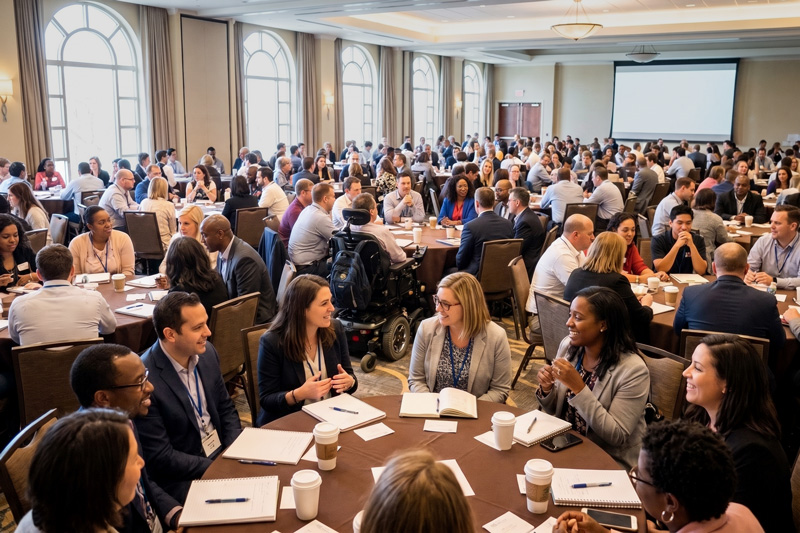
On March 31, 2026, the New York Integrated Network (NYIN) convened its 13 provider agencies, advocacy partners, and system leaders in New York City for a Summit that signaled more than alignment; it signaled movement. In an environment shaped by workforce shortages, fiscal pressure, and rising demand, the gathering marked a shift from navigating challenges to actively shaping solutions.
This was not a meeting defined by constraint. It was defined by collective capacity.
Founded in 2012, NYIN has built one of the most structured and collaborative provider networks in New York State. Through aligned governance and shared accountability, it has created conditions for coordinated action. Today, serving approximately 17,000 individuals and supported by 20,000 staff statewide, NYIN represents more than 12% of the state’s I/DD system, large enough to reflect system realities and strong enough to influence what comes next.
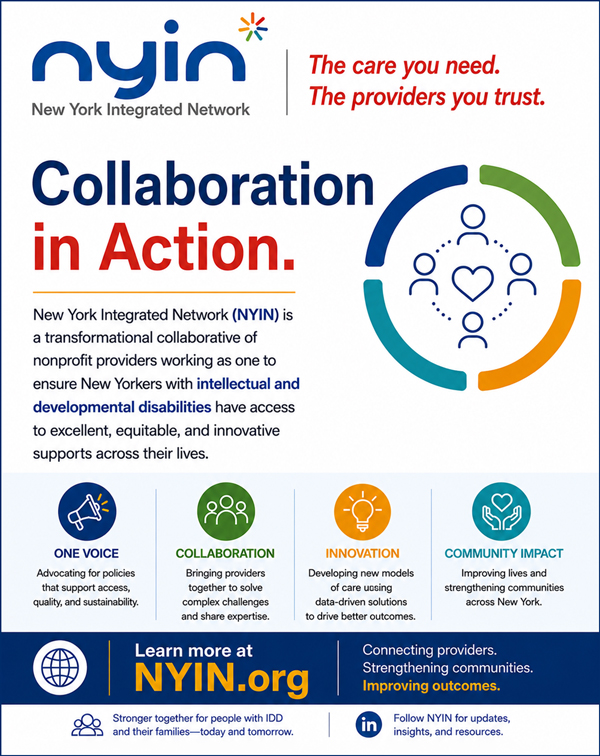
Scale matters. It allows NYIN not only to identify challenges but to test, refine, and implement solutions in real time. It transforms collaboration from an ideal into an operating model and positions the network as a driver of meaningful, system-wide progress.
The Summit was designed with that purpose in mind. It brought together leadership, data, and frontline experience to create something the field often lacks: shared clarity paired with coordinated direction. Throughout the day, one message came through with increasing urgency — misalignment between policy and practice is no longer sustainable. The expectations placed on providers have continued to evolve, but the structures supporting them have not kept pace.
And yet, what made the Summit powerful was not simply the acknowledgment of this tension. It was the collective refusal to accept it.
Discussions of the direct support workforce crisis reflected both realism and resolve. Persistent vacancies, high turnover, and recruitment difficulties continue to limit access to care. At the core of this challenge is a structural imbalance: compensation has not kept pace with cost-of-living realities or with the increasing skill and responsibility required of direct support professionals. Without sustained investment, these pressures will continue to limit access and quality. Yet across the network, providers are already responding, reimagining workforce pathways, investing in development, and advancing new approaches to stabilization.
Residential capacity challenges revealed a similar pattern of misalignment and opportunity. While authorized capacity exists, it is often underutilized due to workforce shortages and financial constraints. At the same time, individuals, particularly those with complex or urgent needs, face delays in accessing appropriate placements. The disconnect between authorization, funding, and operational capacity creates inefficiencies that ripple across the system. The Summit reframed this not as a limitation but as a solvable alignment challenge, one that can be addressed through coordinated policy and operational change.
A parallel shift emerged in discussions on data. Providers are generating increasing volumes of operational and clinical information, yet current systems often emphasize compliance over insight. Participants emphasized the need to move beyond reporting requirements toward data that actively informs decision-making, strengthens accountability, and drives quality improvement. In a coordinated network, data becomes more than measurement; it becomes a tool for acceleration.
What distinguished the Summit, however, was its momentum.
Across the network, providers are not waiting for external solutions; they are building them. Innovative approaches to workforce development, service delivery, and operational efficiency are already being tested and refined. NYIN’s structure ensures these efforts do not remain isolated; they are shared, scaled, and translated into broader system impact.
From this work, clear priorities emerged, grounded in action and shared accountability. These include strengthening and stabilizing the workforce through sustainable funding and career pathways; modernizing reimbursement structures to reflect real costs and service complexity; improving utilization of residential and program capacity; aligning data systems with meaningful outcomes; and creating pathways to scale provider-led innovation.
Together, these priorities reflect a critical understanding: the challenges facing the I/DD system are interconnected and require coordinated, system-level solutions. Fragmented approaches will continue to yield fragmented results. Progress depends on alignment across policy, practice, and partnership.
NYIN’s role at this moment is both practical and catalytic. It bridges the gap between policy and practice, connects providers in meaningful ways, and translates operational experience into actionable insight. Its scale enables validation. Its governance enables coordination. And its collaborative model ensures that momentum is not lost; it is built and sustained.
The Summit ultimately served as both a reflection point and a catalyst for what comes next. It demonstrated that when collaboration is embedded into structure, it becomes a force for clarity, alignment, and measurable progress. It also reinforced that value in the I/DD system is not created through isolated excellence but through collective capacity.
As NYIN Board President Matt Sturiale noted, “The challenges facing New York’s I/DD system cannot be solved by any one organization alone. What was most encouraging about the Summit was the shared commitment among providers, advocates, and stakeholders to work together toward meaningful solutions. NYIN’s strength has always been its ability to bring diverse voices together around common goals, and the momentum generated through this Summit demonstrates what is possible when collaboration is paired with action.”
Looking ahead, the future of New York’s I/DD system will depend on sustained alignment between policymakers, providers, and stakeholders. The momentum generated by the Summit offers a clear path forward, one that builds on what is already working and expands it with intention.
At its core, this work is grounded in a shared commitment: ensuring that individuals with disabilities receive services that are sustainable, person-centered, and rooted in dignity and inclusion. Achieving that vision requires systems that are responsive, adequately resourced, and informed by those delivering care every day.
The NYIN Summit made one thing clear: meaningful change is not only possible but already underway.
The task ahead is to carry that momentum forward, together.

Nicole Willner is a human services leader with more than 30 years of experience in social work and behavioral health systems. She currently serves as Executive Director of the New York Integrated Network (NYIN), where she leads efforts to strengthen collaboration among providers and government agencies to improve service delivery and outcomes across New York. Her career spans executive leadership roles supporting individuals with developmental disabilities and behavioral health needs, with extensive experience in New York’s OPWDD system overseeing residential and community-based services. Through her work with an Independent Practice Association, she has also partnered with OMH and OASAS organizations to advance integrated, person-centered care. Nicole holds a degree in Social Work from Widener University and is committed to developing innovative, sustainable solutions that improve the lives of individuals and families in New York.