For decades, our behavioral health systems have faced the growing challenge of meeting the needs of people with serious mental illness (SMI). In New York, where the Institute for Community Living (ICL) operates, and most places in the country, demand for services far exceeds supply. Furthermore, there are critical gaps in the continuum of care. We see these gaps show up in news headlines, but worse yet, we, as providers, see them all too often show up as people needlessly struggling and suffering.

The great news is that we have, for the most part, figured out interventions for people with the most acute needs. But once individuals stabilize in highly intensive programs, they still need ongoing support to maintain housing, manage medications, avoid hospitalization, and continue their recovery. Keeping people in programs that are more intensive than necessary creates a backlog for those services for others in need. And discharging people to community-based services that don’t meet their needs often risks having them spiral back into crisis.
At ICL, we saw this gap firsthand. Our Assertive Community Treatment (ACT) and Intensive Mobile Treatment (IMT) teams serve New Yorkers with some of the most significant mental health challenges, including people who have experienced homelessness, repeated psychiatric hospitalizations, and involvement with the criminal legal system. These programs work incredibly well. But once participants achieved stability, we had nowhere to discharge them to that would maintain the needed level of support. At the same time, hundreds of others remained on waiting lists for ACT and IMT intensive services.
It was obvious that we needed to create a new intervention.
Identifying a Gap in the Continuum
ICL has spent nearly four decades building a continuum of care designed around a simple principle: people get better when services evolve alongside their needs.
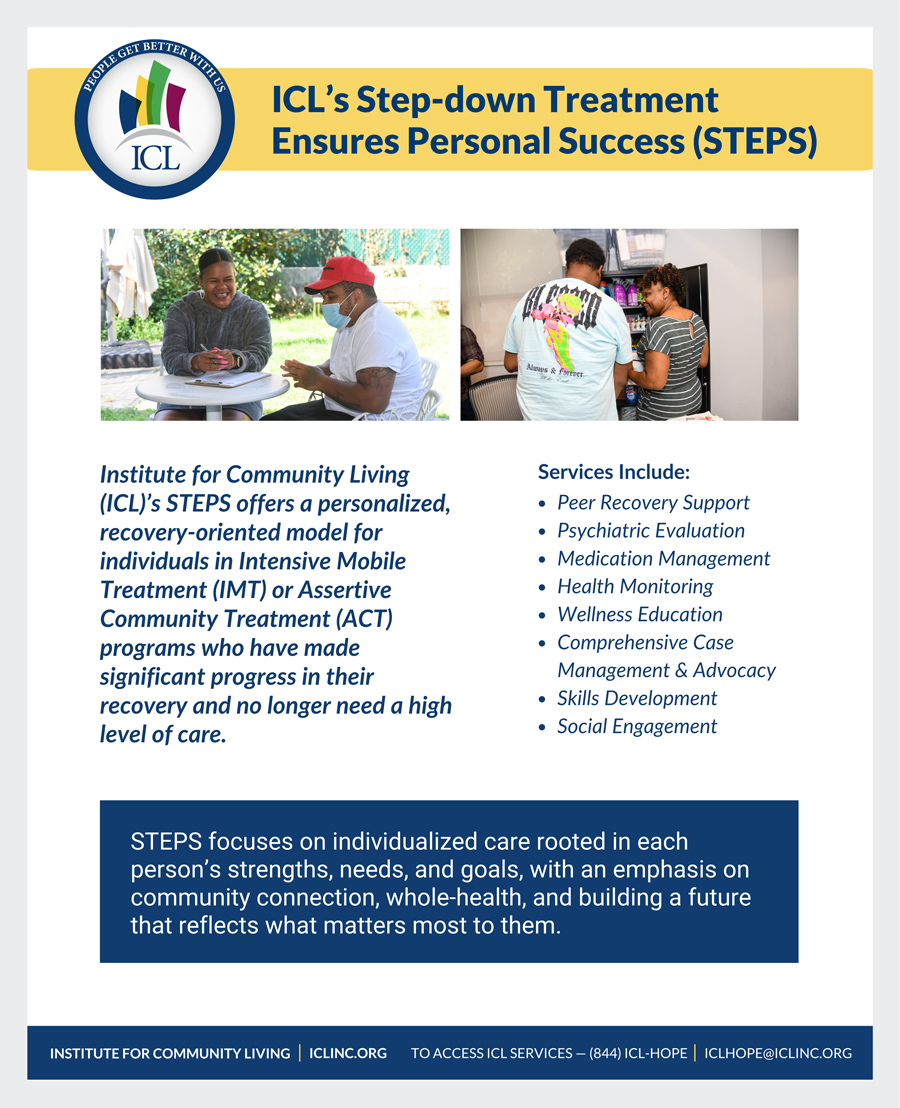
That understanding led us to develop Step-Down Treatment Ensures Personal Success (STEPS), a mobile program designed specifically for individuals transitioning from ACT and IMT who still require support but no longer need the highest level of intervention.
STEPS provides medication management, wellness education, peer support, skills development, and case management while helping participants build greater independence. It fills a critical space between intensive treatment and traditional outpatient care.
Like many innovations in behavioral health, the idea began with providers recognizing an unmet need. But recognizing a need and creating a new public program are two very different things.
From Pilot to Proof Point
To launch STEPS, ICL secured philanthropic support from The Leona M. and Harry B. Helmsley Charitable Trust, allowing us to test the model and collect data.
The results were immediate and compelling.
In the program’s first year, 94 percent of participants remained housed, 97 percent adhered to medication regimens, and none required emergency room visits or psychiatric hospitalization. Just as importantly, transitioning participants into STEPS created new capacity within ACT and IMT, enabling those programs to serve more individuals with acute needs.
The pilot demonstrated that this new intervention could solve two problems at once: helping people build on their stability and getting more people who need it into the most intensive programs.
Turning Evidence into Policy
Data alone rarely changes systems.
Creating sustainable change required a coordinated advocacy effort involving providers, elected officials, participants, and community partners.
From the beginning, ICL worked to ensure policymakers understood not only the outcomes, but the stories behind them. We invited elected officials to visit programs, meet participants, and see firsthand how STEPS was helping New Yorkers maintain stability and independence. We incorporated STEPS into testimony, developed briefing materials, shared participant success stories, and highlighted results through media outreach and public events.
Press became an important advocacy tool. By publicly sharing outcomes and elevating the voices of participants, providers, and policymakers, we helped demonstrate that STEPS was addressing a real and costly gap in the system. Including elected officials in press events and public announcements helped build ownership and deepen support for expansion efforts.
Those efforts helped generate significant momentum. Last year, the New York City Council Speaker talked about the STEPS program in her State of the City address, and the Council allocated $4.3 million in the city budget to expand the STEPS model and make it available to more New Yorkers.
For behavioral health advocates, that was an important victory. It demonstrated that local government recognized the value of investing in innovative community-based interventions that help people remain stable while reducing pressure on hospitals, shelters, and crisis systems.
The Work Is Not Finished
Unfortunately, budget allocations do not always translate into services.
Despite the Council’s commitment, the City did not release the allocated funding in FY26. This was in part due to a change in leadership at the city level, and it required us to start our advocacy work from scratch with many new leaders.
That reality highlights an important lesson for behavioral health advocates: securing funding is not the end of advocacy. It is often the beginning.
Providers must continue educating policymakers, engaging stakeholders, sharing outcomes, and demonstrating impact long after a budget vote is cast.
To help re-energize local government officials, we completed and released an analysis of the STEPS program in year two. We found that, on average, STEPS clients were adherent with their medications (81%), were housed (97%), did not visit the ER (86%), were not hospitalized (89%), and were not arrested or incarcerated (100%). Importantly, we also demonstrated the cost efficiency of the program: STEPS costs are approximately 18% of IMT and 31% of ACT costs.
We stepped up our advocacy efforts, meeting with new City Hall leaders and City Council members. At times it felt like we were having the same conversations over and over again, to no effect. We also maintained our communications efforts, placing press stories about the program and lack of funding with leading media outlets, engaging people on social channels, and using our email platform to remind people about why STEPS is a crucial component in a robust behavioral health system.
Finally, Positive News
On June 30, 2026, the New York City Mayor and City Council Speaker shook hands over a new budget agreement for FY27 — it included $4.5 million in baseline funding for the creation of a step-down program modeled after ICL’s STEPS pilot. We know we owe a big thanks to Speaker Menin, City Council Member Linda Lee — who has long championed the program — and to Deputy Mayor Arteaga.
A Blueprint for System Change
STEPS represents more than a successful pilot. It demonstrates how providers can identify gaps, test solutions, build evidence, and work with policymakers to strengthen the continuum of care.
As behavioral health systems nationwide grapple with rising demand, workforce shortages, and increasing acuity, innovation and advocacy must go hand in hand.
The future of behavioral health will be shaped not only by the services we provide, but by our willingness to advocate for the services that do not yet exist.

Troy Boyle is the Chief Operating Officer at the Institute for Community Living.