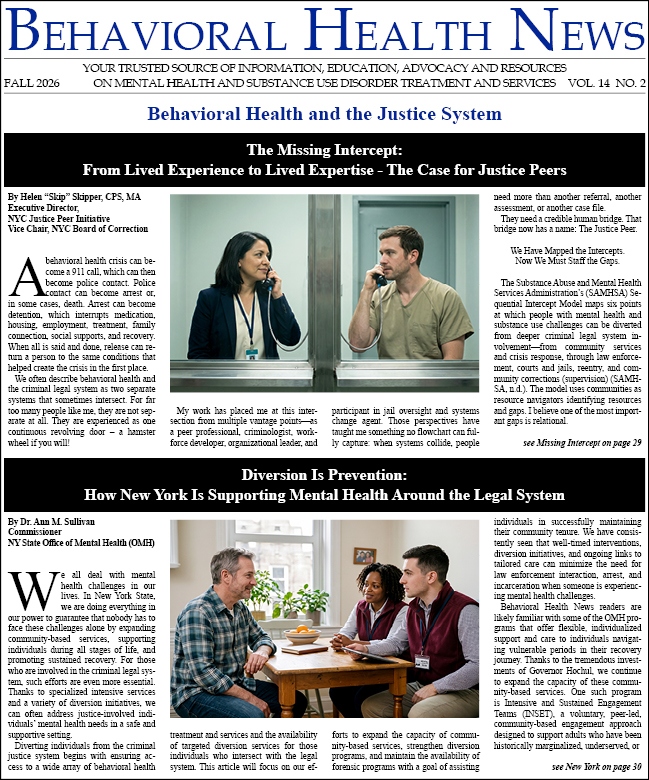
-
It’s 2026. Why Are Peers Not Front and Center in Our Mental Health Crisis Response System in NYC?
The movement toward non-police-based responses to mental health crises in our city has taken on many shapes and sizes. For years, efforts were made to train NYPD rookies, sergeants, and captains on appropriate crisis intervention techniques. Over three days of intensive training at the police...
-
Relationship-Driven Recovery: Reimagining Behavioral Health Support for Justice-Involved Individuals
For many people leaving jail or prison, release isn't just the end of a difficult journey; it's the beginning of an entirely new set of challenges. Returning to the community often means rebuilding nearly every aspect of daily life: obtaining identification, securing housing, finding employment,...
-
Diversion Is Prevention: How New York Is Supporting Mental Health Around the Legal System
We all deal with mental health challenges in our lives. In New York State, we are doing everything in our power to guarantee that nobody has to face these challenges alone by expanding community-based services, supporting individuals during all stages of life, and promoting sustained recovery. For...
-
The Missing Intercept: From Lived Experience to Lived Expertise – The Case for Justice Peers
A behavioral health crisis can become a 911 call, which can then become police contact. Police contact can become arrest or, in some cases, death. Arrest can become detention, which interrupts medication, housing, employment, treatment, family connection, social supports, and recovery. When all is...
-
What Looked Like Defiance Was Actually Grief: The Healing Power of Peer Support in Children’s Mental Health
Ten-year-old Marcus stopped talking after his father was incarcerated. At first, school staff assumed he was angry. Then they thought he was being oppositional. Over time, his silence became impossible to ignore. He stopped participating in class discussions. He isolated himself during lunch. He...
-
Peer Support and Case Management: Complementary, Not Interchangeable
Across the behavioral health field, two frontline roles increasingly shape how services are delivered: case managers and peer support specialists. Both work directly with individuals navigating mental health challenges, substance use recovery, housing instability, and community reintegration. Both...
-
Peer Supervision: A Model for Enhanced Vocational and Emotional Support
For many of us in the field of mental health and substance use disorder, the idea of peer services feels like a new and welcome change that brings with it equity and a workforce with a more complete perspective on lived experience. Many people are surprised to learn that peer services have a...
-
Peering In: A Look at Mental Health Peer Providers and How They Help People Recover
I believe that recovery is possible. Not just for me, but for EVERYONE. Does this mean that everyone recovers? No, because not everyone is taught the skills to recover. Also, once a person learns the skills, they must choose to use them. My peer specialist colleagues and I can give you a flashlight...
-
Addiction Recovery: The Role of Peer and Alumni Support
Behavioral health care has made meaningful progress in evidence-based treatment, yet one of the most persistent challenges remains what happens after discharge. Recovery does not end when a person leaves residential care. In many ways, that is when real-world pressure begins. The transition...
-
Strengthening Peer Services Through Partnership
The expansion of peer-delivered services is one of the most significant developments in behavioral health over the past decade. What was once a rare, little-known role has become mainstream. A 2024 report by the Peer Recovery Center of Excellence estimated that more than 100,000 individuals...