-
Beyond Deinstitutionalization: Unraveling the Complex Criminalization of Serious Mental Illness in America
Individuals with Serious Mental Illness (SMI) are disproportionately represented among the populations of the nation's correctional facilities. Some have dubbed jails and prisons the "New Asylums" as the criminal justice system has become the de facto service provider for individuals with severe...
-
Financial Stability: Building Practical Infrastructure for Reentry
James1 completes a 90-day residential treatment program with a job interview set up for the coming week and a probation meeting he cannot miss. He also leaves with thousands of dollars in outstanding legal financial obligations (LFOs), a suspended driver's license related to unpaid fees, and no...
-
Beyond Punishment: Rethinking Behavioral Health Care in the Justice System
Correctional facilities in the United States have increasingly become major providers of mental health care (Cherson, 2025). One in every two to three people incarcerated in U.S. prisons is estimated to live with a mental illness, far higher than the general population (Dumont et al., 2012)....
-
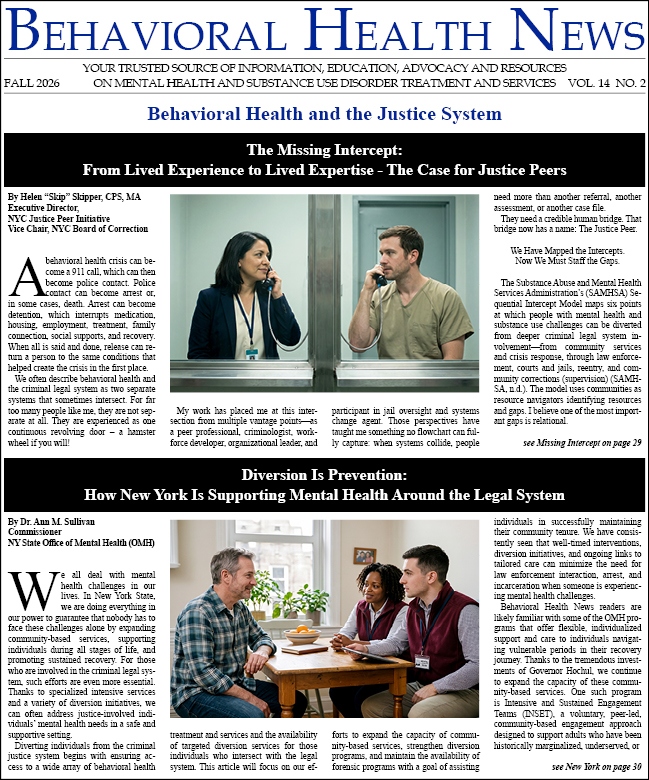
The Missing Intercept: From Lived Experience to Lived Expertise – The Case for Justice Peers
A behavioral health crisis can become a 911 call, which can then become police contact. Police contact can become arrest or, in some cases, death. Arrest can become detention, which interrupts medication, housing, employment, treatment, family connection, social supports, and recovery. When all is...
-
Comprehensive Linkage to Care for Individuals Living With HIV Returning From Incarceration: Behavioral Health and Re-Entry Considerations
Comprehensive and expeditious linkage to appropriate care is vital for people being released from correctional facilities who are living with HIV and experience behavioral health conditions. In the United States, the incarcerated population, including prisons and local jails, has an HIV rate of up...
-
Justice Peer Support: On the Trauma of (and Resilience from) Incarceration
Editorial Note: Given the recent NYS correction officers' strike, this article is especially timely. The strike, driven by concerns over staffing shortages and solitary confinement reforms, has coincided with the tragic deaths of nine incarcerated men (so far). This context underscores the urgency...
-
Offering Buprenorphine Medication to People with Opioid Use Disorder in Jail May Reduce Rearrest and Reconviction
A study conducted in two rural Massachusetts jails found that people with opioid use disorder who were incarcerated and received a medication approved to treat opioid use disorder, known as buprenorphine, were less likely to face rearrest and reconviction after release than those who did not...
-
A Human Right Still Unmet: Medical Treatment of Mentally Ill Prisoners
Individuals with mental illness have the right to receive appropriate medical treatment in correctional settings and upon release. It sounds perfectly reasonable, but unfortunately, is far from reality. That was the consensus of a distinguished panel of mental health and legal experts who recently...
-
Housing People with Serious Mental Illness in Jails and Prisons: Why Are We Still Criminalizing Mental Illness?
Lack of appropriate access to mental health care for the seriously mentally ill in the U.S. is a critical issue. Such lack of access can lead to significant, adverse living outcomes for individuals living with mental illness, including homelessness and incarceration. It is a disturbing fact that...