

For many people leaving jail or prison, release isn’t just the end of a difficult journey; it’s the beginning of an entirely new set of challenges. Returning to the community often means rebuilding nearly every aspect of daily life: obtaining identification, securing housing, finding employment, accessing transportation, restoring benefits, and reconnecting with family and friends. Many are also managing physical or behavioral health needs while trying to establish stability. Yet they’re expected to accomplish all of this with little more than a list of appointments and referrals and very few trusted relationships.
The Missing Piece
Some people successfully navigate reentry despite enormous obstacles. Many others do not.
This isn’t because they lack motivation. More often, it’s because they lack meaningful connections to community, support, and opportunity. Without those connections, people may find themselves cycling through emergency rooms, overusing crisis services, becoming increasingly isolated, or, in some cases, returning to incarceration.
The individuals served through Hands Across Long Island’s (HALI) Forensic INSET program often arrive with extensive system involvement. More than 80% have experienced psychiatric hospitalization, and many have experienced years of involvement with both the behavioral health and criminal justice systems. Their challenges rarely exist in isolation. They are interconnected, requiring coordinated, relationship-based support rather than fragmented services.
Upon release, individuals are assigned a parole officer with whom they must attend frequent, in-person check-ins. Those with identified behavioral health issues are also referred to ongoing providers or programs. But engagement with these systems doesn’t always feel like the answer when you’re feeling intimidated, isolated, and hopeless, or if you’ve had negative past experiences with traditional support. Furthermore, those with undiagnosed challenges may not have access to the resources they need. Well-meaning parole officers are concerned with ensuring compliance with the conditions of release, not necessarily centered on the individual’s own goals and priorities.
Why Traditional Models Miss the Mark
Traditional behavioral health often begins with a question:
“What problems need to be solved?”
While this can be effective for some people, others require a different approach. That’s where peer support models offer great value to individuals recently released from prison or jail.
Peer support begins with a different question:
“What matters most to you right now?”
That answer is different for each person. For some, it may be getting their driver’s license back. For others, it’s reconnecting with a friend or family member. And for someone else, it may be navigating life back home with a parent after having been incarcerated for several years. Whether it’s reconnecting with family, finding work, restoring a driver’s license, or simply rebuilding confidence, peer support begins with the individual’s unique goals, not the system’s expectations. By starting with the person’s priorities, peer support restores hope, builds confidence, and empowers individuals to move forward on their own terms.
Rather than focusing solely on what led to a person’s incarceration, peer specialists recognize the resilience it took to survive those experiences. Instead of asking, “What’s wrong with you?” they ask, “What has helped you survive everything you’ve been through?”
Relationships Before Referrals
Recovery begins with relationship, not compliance. Our goal isn’t to tell people who they should become. It’s to walk alongside them as they rediscover who they’ve always been capable of being. That approach is reflected in the program’s engagement. Nearly 80% of individuals referred to HALI’s Forensic INSET (Intensive and Sustained Engagement Team) remain engaged beyond their first three meetings — a critical milestone for people who have often experienced repeated disconnection from traditional systems.
Forensic INSET is a peer-led mental health program for individuals with complex conditions and criminal justice involvement. It bridges gaps left by traditional behavioral health services and supports people whose past involvement with the criminal justice system may impact their path back to community connection.
HALI’s Forensic INSET program demonstrates what a relationship-first model can look like in practice. At HALI, Forensic INSET is designed to reach individuals who need more than conventional services can offer. It is a voluntary, community-based model that prioritizes trust, persistence, and choice over compliance.
Using a person-driven, peer-led approach, Forensic INSET is led by a multidisciplinary group of experienced professionals who work together to build trust and provide wraparound support. Certified Peer Specialists work alongside licensed clinicians and Family Peer Advocates to provide individualized, flexible services tailored to each person’s goals.
Recovery Is Bigger Than Treatment
Recovery cannot be mandated. While accountability has an important role in the justice system, healing happens through trust, autonomy, and meaningful relationships. When people are offered choice rather than coercion, they’re more likely to engage, remain connected, and build lives they value.
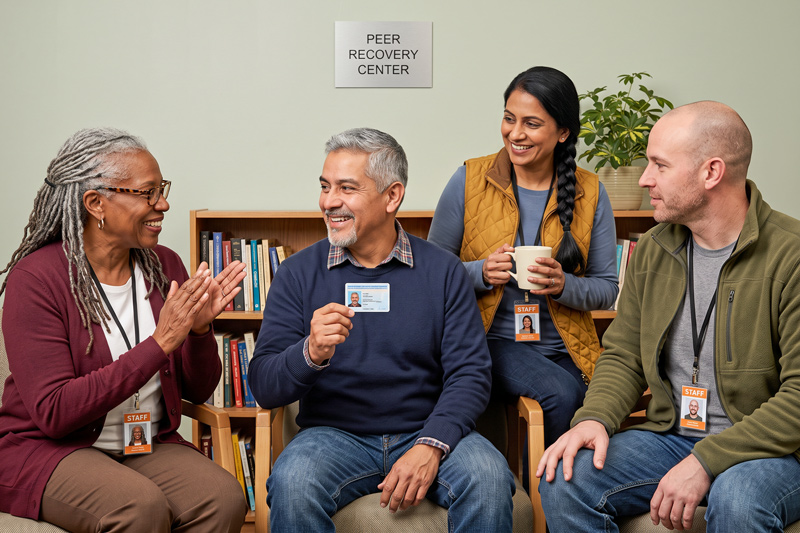
It can be tempting to point to data to prove outcomes, but it doesn’t usually tell the whole story. Every person is different, and therefore success looks different for everyone. We recently had an individual come through our Forensic INSET program who decided to participate in a Department of Labor training opportunity soon after their release. They successfully completed the series only a short time after returning to the community. What mattered most wasn’t that they completed the program so quickly; it was that they invited members of our team to celebrate with them. That invitation reflected trust, connection, and the belief that they no longer had to navigate recovery alone. That moment says more than statistics ever will.
Success is measured not only in clinical outcomes, but in reconnecting with family, securing housing, obtaining employment, accessing recovery supports, and rediscovering meaningful roles in the community.
Recovery Doesn’t Happen Through One Program
Recovery isn’t a single service. It’s a continuum of relationships, supports, and opportunities that evolve over time. Forensic INSET is just one aspect of a range of supports that help a justice-involved individual navigate life outside of jail or prison.
For many individuals, the journey begins before release with Forensic Bridging, which is a service that helps inmates successfully transition from prison to the community. Forensic peers facilitate groups within local jails and state prisons, sharing their own experiences with “bridging” to the community post-release, and answering questions about what to expect.
HALI’s forensic peer specialists meet individuals primarily from the Sing Sing Correctional Facility Community Orientation and Reentry Program (CORP), help them transition back into the community, and remain connected through one-on-one support and peer groups at the organization’s recovery center in Suffolk County, New York, as well as its drop-in center in Manhattan. This model is designed to reduce recidivism while giving people the respect, connection, and opportunities they deserve.
Forensic INSET builds relationships and offers ongoing, flexible support to help them navigate the transition, reduce isolation, and move forward on their own terms. Ongoing community support allows them to form positive connections with individuals who are committed to staying on the right track.
Looking Ahead
Supporting successful reentry requires more than behavioral healthcare alone. It also requires addressing the practical conditions that make recovery sustainable. Without a safe place to live, it’s difficult to maintain employment, engage in treatment, reconnect with family, or build the stability that lasting recovery requires. Housing remains one of the greatest unmet needs for justice-involved individuals. Among individuals entering Forensic INSET, 64% are experiencing homelessness or housing instability, underscoring why safe, stable housing remains one of the most significant barriers to successful reentry. HALI’s forthcoming re-entry housing initiative reflects a commitment to addressing that need while creating lasting stability.
Justice involvement should not define a person’s future. People are people regardless of their past experiences or system involvement. If we meet people where they are and help them move toward the future they envision, we create the conditions for hope, empowerment, and lasting recovery.
People don’t reconnect with systems. They reconnect with people.

Alexander Frisina is Senior Director of Empowerment Services at Hands Across Long Island, Inc. (HALI).


