The movement toward non-police-based responses to mental health crises in our city has taken on many shapes and sizes. For years, efforts were made to train NYPD rookies, sergeants, and captains on appropriate crisis intervention techniques. Over three days of intensive training at the police academy in Queens, thousands of officers were trained by peers (those with lived mental health experience), paid actors, and non-profit professionals in real-life scenarios set in staged subway cars and delicatessens. Police received badges of recognition and special identifiable jackets, and were deployed to active crises in the community. The results, sadly, were not that successful. People in crisis still ended up seriously hurt, and in 24 cases alone since 2015, shot and killed by police during a mental health crisis encounter. In turn, the NYPD has made it clear that they did not feel comfortable being the first responders to mental health crises.
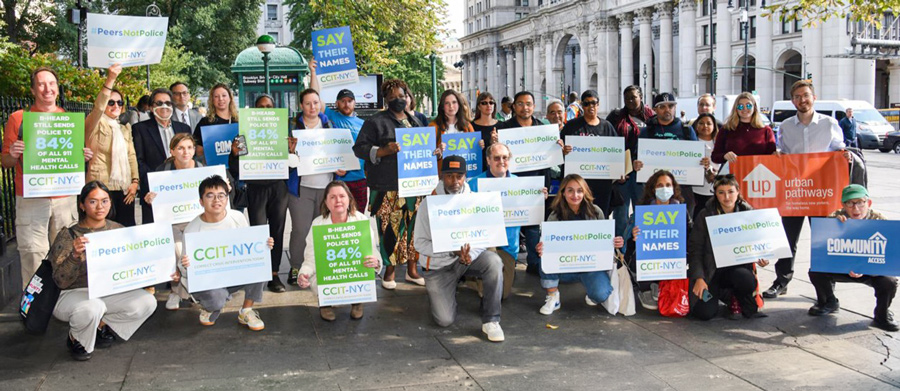
Members of CCIT-NYC rally at City Hall in support of adding peers to the city’s B-HEARD crisis response teams.
New York City has responded over the past decade with a flurry of new mobile crisis teams, co-response teams, peer-respite-based crisis centers, a 988 crisis number, and B-HEARD (Behavioral Health Emergency Assistance Response Division) teams employing social workers and emergency medical technicians (EMTs) to select high-need neighborhoods around the city for 16 hours per day. The program was recently shifted to oversight by NYC Health & Hospitals after complaints that EMTs were being taken away from other medical emergencies. One of B-HEARD’s most critical defects is the failure to involve trained peers with lived experience who can be the first responders to most, if not all, mental health crises.
Since 2012, Correct Crisis Intervention Today – NYC (CCIT-NYC) has advocated for a crisis response model that is peer-led in composition and expertise. CCIT-NYC is a broad-based coalition of organizations and individuals working to transform how New York City responds to mental health crisis calls. We advocate for a non-police response to mental health crises led by peers. Our model utilizes teams that would consist of one peer trained as a crisis counselor and one EMT independent of city government. It would operate citywide, 24/7. Our vision utilizes 988 — rather than the police-run 911 — as the primary contact method for dispatching responders. There would be interoperability between all relevant three-digit numbers: 911, 988, and 311, and the crisis response teams dispatched via 988 would be able to request police assistance when needed. The coordinated crisis response system would include prevention, alternatives to hospitals, and robust follow-up from local service providers to avoid future crises.
So why is having a peer as part of a crisis response so important? A 2024 Bazelon Center report found that peers are best suited for crisis response work because they are credible messengers, bring cultural responsiveness, are cost-effective in the long term via reduced emergency service use, and their emphasis is on recovery. The concept is also nothing new, having been part of successful crisis response models in Oregon, Colorado, and Toronto for many years. In addition, a recent report released in April 2026 by Human Rights Watch (HRW), New York Lawyers for the Public Interest (NYLPI), and the Center for Racial and Disability Justice (CRDJ) identified more than 150 non-police crisis response programs nationwide, many of which promote peer-involved solutions to their efforts.
What can New York do to address this remaining piece of the crisis response puzzle? The expertise is clearly out there. The peer training is available. Perhaps one additional solution lies with the expansion of Daniel’s Law in New York State. In March 2020, Daniel Prude was experiencing an acute mental health crisis in Rochester, New York, when his family called 911 for help. He was naked in the street in freezing weather, but posed no risk to any other person. Yet Rochester Police responded in force, handcuffed him, placed a “spit hood” over his head, and held him face down on the cold pavement until he stopped breathing. Daniel Prude was a man experiencing an obvious mental health crisis, and he deserved care and dignity — but he was denied both. Instead, police killed him. In response to the tragedy, city and state elected officials — including previously Zohran Mamdani, then Assemblymember, and most recently City Councilmember Carl Wilson — have advocated for the expansion of Daniel’s Law, which would ensure that every locality in our state has a plan and resources in place for responding to mental health-related emergencies in a sensitive, constructive manner. Last year, the New York City Council devoted discretionary funding awards to help launch and expand peer-involved crisis response programming for the first time, and funding has continued for 2026. The time for peers to become a major part of the solution is clear, and that time is now.
Jim Mutton is the Associate Executive Director of NYC Operations at Concern Housing and serves as a steering committee member at CCIT-NYC.