-
Nobody Listened Until She Was in a Courtroom: Postpartum Illness and a Diagnosis That Runs Out
Dana came onto our unit nineteen weeks after she delivered her son. Her husband got up at two that morning and found her side of the bed empty. She was in the baby's room, sitting straight up in the rocking chair, not rocking, looking at the wall. She did not lift her head when he came in, or when...
-
The NYSPA Report – Treatment Before Arrest: Why Diversion Begins With Engagement
When psychiatrists discuss behavioral health diversion, we usually mean redirecting a person away from arrest, jail, or prosecution and toward treatment. Mental health courts, crisis-response programs, and alternatives to incarceration are essential; yet if diversion begins only after...
-
Decriminalization Alone Won’t Fix Addiction – Infrastructure Will: A Comparative Look at Portugal, the Netherlands, and the U.S.
In Chasing the Scream: The Search for the Truth About Addiction, Johan Hari asks, "What if everything you think you know about addiction is wrong?" (Hari, 2015). Hari posits that addiction is driven by isolation more than chemicals. In a widely viewed TED Talk he states, "The opposite of addiction...
-
Beyond Deinstitutionalization: Unraveling the Complex Criminalization of Serious Mental Illness in America
Individuals with Serious Mental Illness (SMI) are disproportionately represented among the populations of the nation's correctional facilities. Some have dubbed jails and prisons the "New Asylums" as the criminal justice system has become the de facto service provider for individuals with severe...
-
Closing the Re-Entry Gap: Connecting Justice-Involved Individuals to Addiction Treatment
Individuals in incarcerated settings are found to have an increased risk of overdose and drug-related injury during community re-entry, with the first two weeks carrying the most risk (Hartung et al., 2023). Justice-involved individuals face significant barriers to accessing substance use services...
-
Relationship-Driven Recovery: Reimagining Behavioral Health Support for Justice-Involved Individuals
For many people leaving jail or prison, release isn't just the end of a difficult journey; it's the beginning of an entirely new set of challenges. Returning to the community often means rebuilding nearly every aspect of daily life: obtaining identification, securing housing, finding employment,...
-
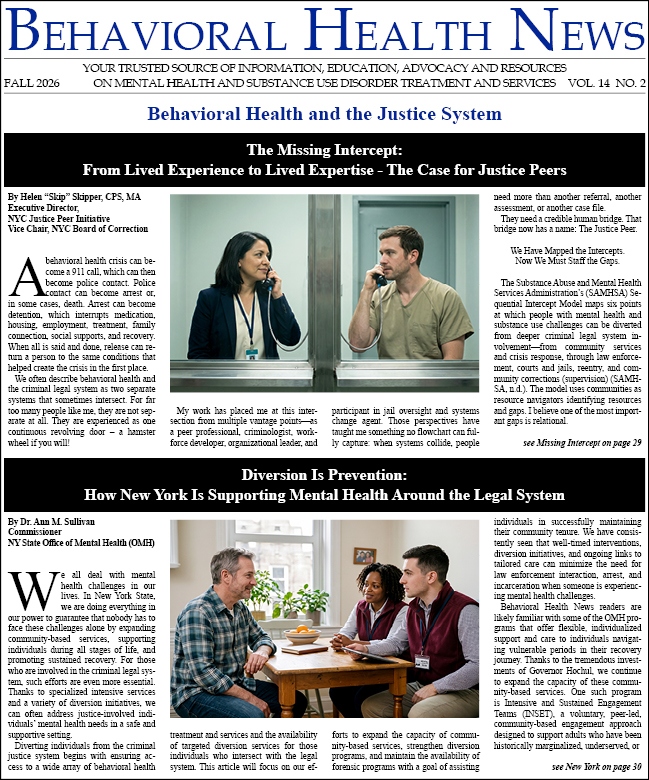
Diversion Is Prevention: How New York Is Supporting Mental Health Around the Legal System
We all deal with mental health challenges in our lives. In New York State, we are doing everything in our power to guarantee that nobody has to face these challenges alone by expanding community-based services, supporting individuals during all stages of life, and promoting sustained recovery. For...
-
Community Integration, Economic Security, and the Promise of Olmstead
True economic security for individuals with intellectual and developmental disabilities is shaped by whether individuals have meaningful opportunities to work, earn income, build relationships, make choices, and participate fully in their communities. Financial planning and economic security for...
-
Beyond Either/Or: Where Assisted Outpatient Treatment Fits in Mental Health Care
Debates over Assisted Outpatient Treatment (AOT) too often ask us to choose a side. Either we respect autonomy and rely exclusively on voluntary treatment, or we accept coercion as necessary to ensure people receive care. Neither position adequately reflects the complexity of serious mental illness...
-
Why Caregiver Involvement Is a Cornerstone of Treatment for Adolescents with Problematic Sexual Behavior
Adolescents with Problematic Sexual Behavior – just the phrase conjures up stereotypes of these youth as “mini sex offenders.” For many years, treatment approaches for these youth were founded on a set of principles drawn from theories about adult pedophilia. Treatment protocols for youth...