

True economic security for individuals with intellectual and developmental disabilities is shaped by whether individuals have meaningful opportunities to work, earn income, build relationships, make choices, and participate fully in their communities. Financial planning and economic security for individuals with developmental disabilities and their families extend far beyond benefits planning, special needs trusts, or long-term financial tools.

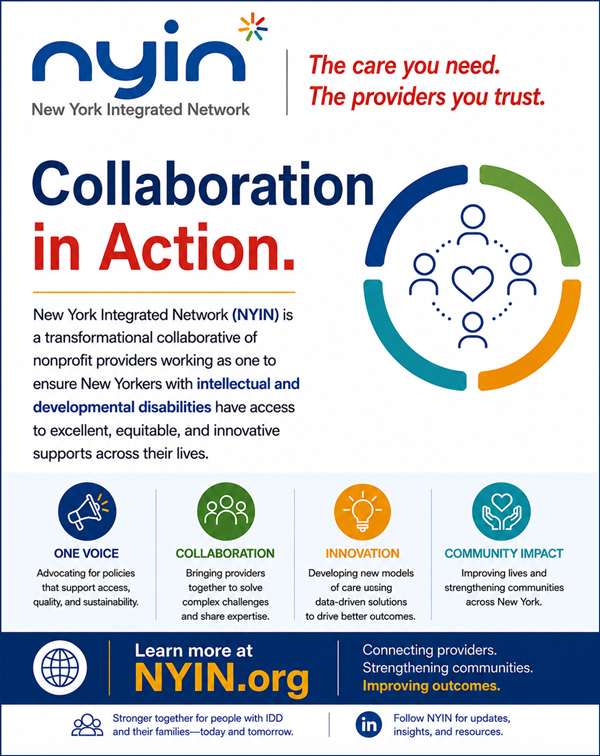
The New York Integrated Network (NYIN) is a regional network of not-for-profit organizations supporting individuals with intellectual and developmental disabilities and their families. Collectively, NYIN member organizations serve approximately 12% of New York State’s developmental disability population, giving the network a significant perspective on the opportunities and challenges facing individuals, families, and providers. Every day, our members see the connection between meaningful community inclusion, greater independence, and long-term economic security.
For more than twenty-five years, the Supreme Court’s decision in Olmstead v. L.C. has been a major affirmation of national disability rights policy. In its 1999 decision, the U.S. Supreme Court held that the unjustified segregation of individuals with disabilities can constitute discrimination under Title II of the Americans with Disabilities Act (ADA). The Court recognized that public entities are required to provide community-based services when such services are appropriate, individuals do not oppose community-based treatment, and the placement can be reasonably accommodated, considering available resources and the needs of others receiving disability services.
Recent developments at the federal level have renewed debate over the scope of that obligation. In a June 18, 2026, memorandum, the Department of Justice’s Office of Legal Counsel (OLC), responding to a request from the White House Counsel’s Office, concluded that neither Title II of the ADA nor Section 504 of the Rehabilitation Act imposes a broad integration mandate on states. The memorandum states that Olmstead’s holding was narrow, acknowledges that its interpretation is “out of step with the common understanding” of the decision in federal courts, and argues that institutional treatment is not discriminatory when a state has a “nonarbitrary rationale” for choosing it. It further concludes that the existing Health & Human Services (HHS) and Department of Justice (DOJ) integration-mandate regulations exceed the agencies’ statutory authority and states that the agencies can rescind those regulations and related guidance. These are not merely technical distinctions: they could lower the federal government’s standard for challenging unnecessary segregation and weaken the enforcement framework that has supported community living for decades. Importantly, however, Olmstead remains binding Supreme Court precedent, and a memorandum cannot itself rescind existing regulations or overturn the Court’s decision.
For individuals with developmental disabilities and their families, the stakes extend well beyond legal interpretation. Community integration is not simply a location. It is a lived experience. A fully integrated life means having meaningful choice over where and with whom to live, opportunities for competitive integrated employment, relationships and natural supports beyond paid service systems, and the ability to participate and contribute as a member of the broader community.
These opportunities are also fundamental to economic security.
Community inclusion can create pathways to competitive employment; employment creates opportunities to earn income, develop skills, build financial independence, and establish long-term stability. Work also expands social networks and creates relationships and opportunities that extend beyond disability service systems. For families, greater independence can reduce some of the financial and caregiving pressures that affect parents’ and caregivers’ own employment, savings, and retirement planning.
The employment gap facing people with disabilities demonstrates why this connection deserves greater attention. In 2025, 38.1 percent of working-age people with disabilities, ages 16–64, were employed, compared with 74.8 percent of working-age people without disabilities. Among this same age group, the unemployment rate was 8.8 percent for people with disabilities, compared with 4.1 percent for people without disabilities. These disparities illustrate that closing the disability employment gap is not simply a workforce objective. It is an economic-security imperative for individuals and families.
Conversely, limited access to employment and meaningful community participation can reinforce dependence and restrict lifelong economic opportunities. This is why sustained investment in the direct support workforce, affordable and accessible housing, transportation, behavioral health services, and family support are essential. These are not optional enhancements; they are the infrastructure of inclusion. Without that infrastructure, the pathway from community participation to employment, financial independence, and greater family economic security becomes far more difficult to achieve.
Governor Hochul’s 2024 Executive Order 40, committing New York to becoming an Employment First state, recognizes this connection. Competitive integrated employment should be considered a preferred outcome for New Yorkers with disabilities, with state policy supporting opportunities for people with disabilities to work alongside people without disabilities and participate meaningfully in the workforce.
NYIN strongly supports this direction because employment is one of the clearest ways that the promise of integration translates into greater independence and economic security.
Across the communities they serve, NYIN member organizations are demonstrating what a fully integrated life can look like in practice. Three areas are particularly important.
First, competitive integrated employment means more than placing someone in a job. NYIN members support career exploration, job development, coaching, and employer partnerships designed to help individuals obtain meaningful work and build toward long-term success and advancement. Employment provides wages, but it can also create professional relationships, confidence, skills, and a greater degree of financial independence.
Second, authentic relationships and community connections are essential measures of genuine inclusion. NYIN organizations help individuals participate in civic, recreational, volunteer, faith, and other community activities where relationships can develop outside paid service systems. True integration occurs when a person’s connections include coworkers, friends, neighbors, and other community members, not only providers and support staff.
Third, choice over housing and community life allows individuals to define what independence means for them. Person-centered planning and self-advocacy help ensure that individuals have a meaningful voice in decisions about where and with whom they live, how they spend their time, the relationships they pursue, and the goals they set for their lives.
Imagine a young adult with an intellectual disability and anxiety who wants to work but has repeatedly been told they are not ready. Unfamiliar environments feel overwhelming, transportation is a barrier, and past experiences have weakened their confidence. With coordinated behavioral health support, travel training, job coaching, and an employer willing to provide reasonable accommodations, that person secures a competitive job in the community. Over time, they begin earning a paycheck, contributing to household expenses, forming relationships with coworkers, and making plans for their future. Their family, once uncertain whether employment was possible, can begin to imagine a future defined by greater independence rather than lifelong dependence. This is what meaningful integration can make possible and what is at risk when community-based support is weakened.
These outcomes illustrate why the current federal debate matters. A policy framework that focuses primarily on physical placement risks setting the standard too low. Being in the community is not the same as belonging to it. Public policy should continue creating conditions that allow individuals to work, form relationships, exercise meaningful choices, and participate economically and socially in their communities.
NYIN firmly opposes federal policy or enforcement approaches that diminish meaningful community integration or make segregation easier to accept as an adequate outcome. Olmstead remains binding law, and the progress it helped advance should be strengthened rather than diminished.
For individuals with developmental disabilities and their families, community integration and economic security are inseparable. When people have meaningful opportunities to work, earn income, build relationships, make choices, and belong, they are better positioned to build greater independence and long-term stability. Their families, in turn, are better positioned to plan for their own economic future with confidence.
That is the promise Olmstead helped establish. It is also the standard to which we must continue to hold ourselves: not simply services delivered in the community but lives fully lived within it.

Nicole Willner is a human services leader with more than 30 years of experience in social work and behavioral health systems. She currently serves as Executive Director of the New York Integrated Network (NYIN), where she leads efforts to strengthen collaboration among providers and government agencies to improve service delivery and outcomes across New York. Her career spans executive leadership roles supporting individuals with developmental disabilities and behavioral health needs, with extensive experience in New York’s OPWDD system overseeing residential and community-based services. Through her work with an Independent Practice Association, she has also partnered with OMH and OASAS organizations to advance integrated, person-centered care. Nicole holds a degree in Social Work from Widener University and is committed to developing innovative, sustainable solutions that improve the lives of individuals and families in New York.
Sources
Centers for Medicare & Medicaid Services. Medicaid Community Engagement Requirement for Certain Individuals Interim Final Rule with Comment Period (CMS-2454-IFC). June 1, 2026. https://www.cms.gov/newsroom/fact-sheets/medicaid-community-engagement-requirement-certain-individuals-interim-final-rule-comment-period-cms
U.S. Bureau of Labor Statistics. People with a Disability: Labor Force Characteristics — 2025. U.S. Department of Labor, USDL-26-0364, March 3, 2026. Data from the Current Population Survey (CPS). https://www.bls.gov/news.release/disabl.nr0.htm
U.S. Department of Justice, Office of Legal Counsel. Whether the Rehabilitation Act or Americans with Disabilities Act Impose or Authorize an Integration Mandate. 50 Op. O.L.C. , June 18, 2026. https://www.justice.gov/olc/media/1446701/dl


