

In Chasing the Scream: The Search for the Truth About Addiction, Johan Hari asks, “What if everything you think you know about addiction is wrong?” (Hari, 2015). Hari posits that addiction is driven by isolation more than chemicals. In a widely viewed TED Talk he states, “The opposite of addiction is not sobriety. The opposite of addiction is connection” (Hari, 2019).
This literature review examines the approaches of three different countries and their drug policies. The countries examined are Portugal, the Netherlands, and the United States, which have policies ranging from decriminalization of substances, public health, and approaches that combine harm reduction with criminalization.
With the rate of overdoses and overdose deaths around the world in the tens of thousands, a study of drug policies was needed to examine the strengths and weaknesses of each model.
For this review, we selected literature from government and scholarly sources. Government statistics presumably gather information that reflects the success rates of different approaches for the purpose of driving the focus of interventions.
Data from the European Union Drug Agency (EUDA) and the Trimbos Institute (Formerly known as the Netherlands Institute of Mental Health and Addiction) was utilized for the Netherlands, and the EUDA data was also utilized for Portugal. Statistics from the Centers for Disease Control (CDC) were utilized to look at outcomes in the United States.
Research Questions:
- Does a public health policy or a criminal justice-focused policy more effectively address substance use disorder as measured by overdose death rates?
- Does a public health policy or a criminal justice-focused policy more effectively address substance use disorder as measured by the number of people incarcerated for substance use?
- Does a public health policy or a criminal justice-focused policy more effectively address substance use disorder as measured by the costs associated with each approach?
Addiction as a Disease: A Public Health Model – Portugal
In the 1990s, Portugal faced one of the most severe heroin crises in Europe (Moury & Escada, 2022), with approximately one percent of the population reported as heroin dependent and overdose deaths peaking at 369 in 1999 (McCarthy, 2020). Waters (2019) stated that treating drug use primarily as a criminal issue had failed to contain the crisis, prompting Prime Minister António Guterres to convene an expert panel of clinicians, psychiatrists, and legal experts under the leadership of Dr. João Goulão. Following the panel’s recommendations, Portugal adopted the National Drug Strategy in July 2001 (Soares, 2016). The law maintained the illegality of drug use and possession but reclassified personal possession of up to a ten-day supply as an administrative offense rather than a criminal one, while trafficking and supply remained criminal, punishable by one to twelve years in prison (Hughes & Stevens, 2010). Central to this reform was the creation of the Commissions for the Dissuasion of Drug Addiction (CDT). The CDT system served as a structured diversion mechanism that redirected individuals away from criminal prosecution and toward assessment, voluntary treatment, and social support (Transform Drug Policy Foundation, 2021). Portuguese policymakers shifted the primary objective of drug policy from punishment to health promotion, prevention, recovery, and social inclusion (Justice Trends, 2018).
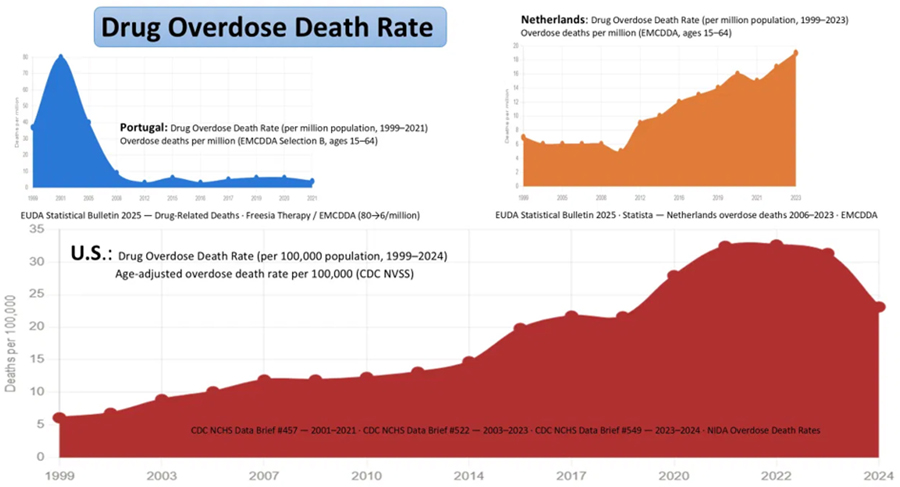
Over the first decade after reform, Portugal consolidated harm reduction programs and treatment services (Hughes & Stevens, 2010). The country experienced a drop in drug-related incarceration from 3,863 individuals in 1999 to 1,140 in 2017, representing a reduction of more than 70 percent (McCarthy, 2020; Transform Drug Policy Foundation, 2021). Overdose death rates declined from approximately 80 per million in 2001 to 6 per million by 2021, placing Portugal far below the EU average of 20.3 per million recorded in 2015 (Drug Policy Alliance, 2023; EUDA, 2026; Frayer, 2019). Rego et al. (2021) note that decriminalization allowed resources to be reallocated toward prevention, harm reduction, treatment, and social reintegration, and that lower stigma improved the reach of those services (Hughes & Stevens, 2010). The most important lesson from this period is that infrastructure came before law (Moury & Escada, 2022; Transform Drug Policy Foundation, 2021).
Portugal experienced a precipitous drop in overdose death rates (Kristof, 2017). The country went from having the highest rate in the European Union (EU) in 1999 to the lowest in 2021 (European Union Drugs Agency (EUDA), 2025). Portugal’s 93% reduction in overdose death rates over two decades (1999–2021) was produced by decriminalization layered on top of a pre-existing, state-funded harm reduction infrastructure (Hughes & Stevens, 2010; Transform Drug Policy Foundation, 2021). Portugal’s experience therefore demonstrates that successful drug policy depends less on changing criminal law than on building and maintaining a comprehensive public health system capable of supporting individuals throughout prevention, treatment, recovery, and long-term social reintegration.
Mixed Approaches With Differing Outcomes – The Netherlands
In 1976, the Netherlands, which pioneered harm reduction, moved to a harm reduction approach. The Opium Act created a distinction between drugs with unacceptable risks, such as heroin, LSD, cocaine, and amphetamines, and those that were under the heading of cannabis products, including hashish (Leuw, 1991). It was designed to make substance use by the public more manageable. Part of the benefit of this law was that it legalized less dangerous (i.e., “soft”) drug sales, so dealers (who now had to be licensed and follow regulations) were not lacing products, and customers knew what they requested was what they were getting (Henk & Ven Vliet, 1990). Due to cannabis now being a lawful substance, shops that sold drinks and food started selling cannabis products also (Henk & Ven Vliet, 1990).
In 2010 the Netherlands switched back to a more criminal justice approach due to the side effects of “coffee shop ecstasy” (Van Ooyen-Houben & Kleemans, 2015), which is another name for soft drugs (those made with cannabis, sold in shops that also sell drinks and food). Dutch politicians wanted to demonstrate that they were tough on crime. There were still needle exchanges and supervised consumption rooms, but penalties were harsher (Busz et al., 2024).
In 2024, as overdose rates surged and international control efforts were increasingly seen as ineffective, the Netherlands reverted to a public-health-centered approach (Busz et al., 2024). That same year, the Office of the United Nations High Commissioner for Human Rights (OHCHR) issued a statement urging rights-based drug policies, reinforcing this broader shift (Busz et al., 2024). The Dutch experience illustrates how policy direction can directly shape outcomes. After the country moved away from harm reduction toward a criminal justice model, overdose mortality steadily increased — from roughly 5 deaths per million people in 2010 to 19 deaths per million in 2023 (EUDA, 2025) — underscoring the importance of stable, sustained public health investment and consistent policy implementation (EUDA, 2025).
Focus on Interdiction and Criminalization: With Treatment and Harm Reduction – United States
The so-called “War on Drugs” began in the 1970s, treating substance use primarily as a criminal issue (Hari, 2015). This approach coincided with increased substance use, overdose deaths, and the spread of illnesses (HIV, hepatitis) and infections due to the sharing of needles. Minimum sentencing and differential sentencing for different substances have disproportionately penalized minority communities (Pamplin et al., 2023). African Americans make up 14% of the total U.S. population and account for 38.5% of the total prison population (The Global Statistics, 2026; Federal Bureau of Prisons, 2026).
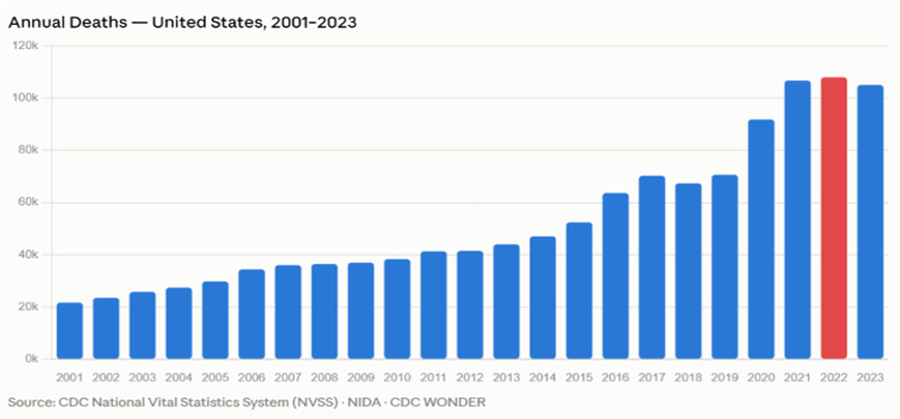
The sustained increases in overdose mortality documented by the CDC during 1999–2018 raise important questions about the effectiveness of a predominantly criminal-justice-oriented approach when it is not accompanied by comprehensive harm reduction and accessible treatment. The age-adjusted rate of drug overdose deaths increased from 6.1 deaths per 100,000 standard population in 1999 to 21.7 deaths per 100,000 in 2017, with the rate increasing by an average of 10% per year from 1999 through 2006, 2% per year from 2006 through 2013, and 14% per year from 2013 through 2016 (Hedegaard et al., 2018).
Another issue for the U.S. is the lack of access to substance abuse treatment. According to the Southwest Rural Health Research Center (2025), only about 6% of those who wanted treatment, in rural areas, were able to obtain it. A study by Choi & Marti (2025) found that 75.46% of those who sought treatment could not get it due to inadequate insurance.
While the 2026 National Drug Control Strategy articulates important public health goals for the United States — making treatment more accessible than illegal drugs, expanding naloxone availability, and strengthening community-based recovery support (National Drug Control Strategy, 2026) — KFF Health News (Aneri Pattani, 2026) reports that accomplishing the strategy’s goals “will be difficult in the face of the . . . mass layoffs of federal employees, cancellation of research and community grants, attacks on organizations and practices that serve people who use drugs, and cuts to Medicaid,” which is the largest payer for addiction and mental health care nationwide. Specifically, Medicaid work requirements in the administration’s legislative agenda are projected to strip coverage from approximately 1.6 million people with substance use disorders, directly undermining the strategy’s stated goal of expanding treatment access. When Medicaid rolls were previously reduced after COVID-era protections expired, many people receiving medication treatment for opioid addiction stopped it, and fewer people started treatment.
Treatment capacity in the United States remains uneven and often inadequate, especially when addiction intersects with mental illness, homelessness, and poverty. The U.S. system is fragmented across local, state, and federal agencies, making coordination between police, courts, treatment systems, and housing services difficult to sustain.
In addition, the current U.S. drug environment is dominated by fentanyl and other highly potent synthetic substances, which create a much faster and deadlier risk environment than the heroin epidemics that shaped many earlier European reforms. Political polarization and punitive public narratives make it difficult to sustain support for reforms when visible disorder or the perception of disorder increases.
The United States policy endorses harm reduction on the record (National Drug Control Strategy, 2026), while simultaneously reducing Medicaid coverage, SAMHSA grants, and community organization funding that deliver those services. The document is not the policy; the funding is the policy.
Why Treatment-Centered Policy Matters
The economic costs of addiction have steadily increased over time, with estimates indicating that substance abuse costs the United States over $740 billion annually (Lines, 2019). In 2015, the United Nations Office of Drugs and Crime and the World Health Organization established an Informal International Scientific Network. This committee was comprised of experts in SUD sciences. The members of the committee were appointed by Member States and represented widely diverse geographical regions, political systems, and cultures. As per Volkow, et al., (2016) they concluded that there was scientific evidence supporting the idea that, “. . . substance use disorders are brain disorders; that they can be treated; that people with even the most severe forms can recover with access to evidence‐based treatment and social supports; and that criminal sanctions are ineffective at preventing or addressing these disorders.” (Emphasis added by authors). Bernard, et al., (2020) found that diversion programs decrease criminal justice costs while only moderately raising health care costs. If criminal justice interventions are ineffective at stemming the devastating impact of SUD, where is the best place to focus resources?
Portugal’s model worked because decriminalization was embedded in a broader public-health system. The reform was backed by state-supported treatment, methadone programs, psychosocial care, and welfare infrastructure. (These factors highlight why decriminalization of substances in Oregon from 2021–2024 was not considered successful; the treatment capacity, access, and diversion programs were not put in place prior to decriminalization of substances.)
Another strength of Portugal’s model is institutional coherence. The police, treatment system, and public administration had differentiated but connected roles: police could still target traffickers, while drug users were diverted into a structured process of evaluation and support.
The Netherlands followed a different path from Portugal, yet it also provides evidence that treatment and harm reduction can be more effective than punishment-only strategies. By distinguishing between so-called “soft” and “hard” drugs, allowing regulated tolerance toward cannabis while maintaining stricter control over heroin, cocaine, and organized trafficking, they avoided the false choice between total criminalization and unrestricted permissiveness. Its relative success lay in treating chronic drug dependence as a social and medical issue that required management, rather than assuming that punishment alone would eliminate it.
At the same time, the Dutch case also reveals the limits of tolerance when it is not matched by sufficient enforcement against organized crime. Over time, criticism grew that the Netherlands had become a hub for drug trafficking and related violence, particularly as synthetic drug production and organized criminal networks expanded. Dutch policy has not simply “returned” from treatment to punishment and back again. Rather, it has evolved into a hybrid approach: stronger criminal enforcement against violent networks and traffickers, while retaining treatment and harm reduction for users and vulnerable populations.
As reported in JAMA, the United States has continued to suffer from the highest overdose death rates in the world (Anderer, 2025). This is likely a result of lack of treatment infrastructure, lack of health care coverage, criminalization policies that disproportionately target minority communities resulting in higher rates of incarceration (which continues the cycle of broken families and poverty), and poor housing and vocational opportunities for those struggling with substance use disorder.
Portugal, the Netherlands, and the United States show that treatment-centered drug policy can be more effective and humane than punishment-centered policy, and that resources can be used more efficiently, when it is backed by institutional capacity, clear governance, and a realistic division between user management and trafficking control.



Shawna Logue, CHW, PS, is completing her degrees in social work, addiction counseling, and social science at Kansas State University. She is a participant in the McNair Scholars Program. Mihwa Gassett, ST-LAC (Student Temporary Addiction Counselor License), is completing her degree in social work and addiction counseling at Kansas State University. She is a participant in the McNair Scholars Program. Elaine Edelman, PhD, LCSW, CASAC-Adv., is a Professor of Practice in Social Work and Addiction Counseling at Kansas State University and serves as a mentor in the McNair Scholars Program. She can be reached at [email protected].
The Kansas State University McNair Scholars Program is a comprehensive two-year program that aims to prepare eligible undergraduate students for graduate education and research-oriented careers. McNair Scholars Programs nationwide work to increase graduate degree attainment — especially PhD degree attainment — by providing opportunities for doctoral degree preparation to students from segments of U.S. society that are underrepresented in higher education.
References
American Psychiatric Association. (2022). Diagnostic and Statistical Manual of Mental Disorders: Fifth Edition Text Revision DSM-5-TR. Sheridan Books, Inc.
Anderer S. US Ranks Highest in Global Overdose Deaths. JAMA. 2025;333(10):837. doi:10.1001/jama.2025.0240
Bernard CL, Rao IJ, Robison KK, Brandeau ML. Health outcomes and cost-effectiveness of diversion programs for low-level drug offenders: A model-based analysis. PLoS Med. 2020 Oct 13;17(10):e1003239. doi: 10.1371/journal.pmed.1003239. PMID: 33048929; PMCID: PMC7553283.
Busz, M., Schiffer, K., Ancella Voets, & Pomfret, A. (2024). Reframing Dutch drug policies: a new era for harm reduction. Harm Reduction Journal, 21(1). https://doi.org/10.1186/s12954-024-01071-1
CDC. (2026). Data Resources. In Overdose Prevention. https://www.cdc.gov/overdose-prevention/data-research/facts-stats/index.html
Choi, N. G., & Marti, C. N. (2025). Treatment Use Among U.S. Adults with a Substance Use Disorder: Associations with Symptom Severity, Problem Self-Perception, Comorbid Mental Illness, and Mental Health Treatment. International Journal of Environmental Research and Public Health, 22(4), 640. https://doi.org/10.3390/ijerph22040640
Correctional Populations and Facilities. (n.d.). In Bureau of Justice Statistics. Retrieved July 22, 2026, from https://bjs.ojp.gov/drugs-and-crime-facts/correctional-populations-and-facilities
DEA website. https://www.dea.gov/drug-information/csa, accessed 7.22.26
Decriminalization and Harm Reduction in Portugal: An Interview with Dr. João Goulão. (n.d.). In Multidisciplinary Association for Psychedelic Studies – MAPS. https://maps.org/news/bulletin/decriminalization-and-harm-reduction-in-portugal-an-interview-with-dr-joao-goulao/
Dickson-Gomez, J., Weeks, M., Green, D., Boutouis, S., Galletly, C., & Christenson, E. (2022). Insurance barriers to substance use disorder treatment after passage of mental health and addiction parity laws and the affordable care act: A qualitative analysis. Drug and Alcohol Dependence Reports, 3(3), 100051. https://doi.org/10.1016/j.dadr.2022.100051
Drug Decriminalization in Portugal: A Health-Centered Approach. (2015). https://static.prisonpolicy.org/scans/DPA_Fact_Sheet_Portugal_Decriminalization_Feb2015.pdf
Drug Policy Alliance (2023)—MISSING
EUDA home page | www.euda.europa.eu. (n.d.). In www.euda.europa.eu. Retrieved July 30, 2026, from https://www.euda.europa.eu/index_en
European Union Drugs Agency. (2025). Statistical Bulletin 2025 — drug-induced deaths | The European Union Drugs Agency (EUDA). In Europa.eu. https://www.euda.europa.eu/data/stats2025/drd_en
European Union Drugs Agency. (2026). https://european-union.europa.eu/institutions-law-budget/institutions-and-bodies/search-all-eu-institutions-and-bodies/european-union-drugs-agency-euda_en, accessed 7.30.26
Federal Bureau of Prisons. (2026). BOP statistics: Inmate race. In Bop.gov. Federal Bureau of Prisons. https://www.bop.gov/about/statistics/statistics_inmate_race.jsp
Foundation, R. R. (2021). Portugal’s National Drug Coordination Structure. In Drug Policy Facts. https://www.drugpolicyfacts.org/node/3682
Frayer, L. (2019). In Portugal, Drug Use Is Treated As A Medical Issue, Not A Crime. In Npr.org. https://www.npr.org/sections/parallels/2017/04/18/524380027/in-portugal-drug-use-is-treated-as-a-medical-issue-not-a-crime
Garnett, M. F., & Miniño, A. M. (2024). Drug Overdose Deaths in the United States, 2003-2023. HRB National Drugs Library (Health Research Board), 522(522). https://doi.org/10.15620/cdc/170565
Hari, J. (2015). Chasing the scream: The first and last days of the war on drugs (First U.S. edition.). Bloomsbury.
Hari, J. (2019). Ted Talk. “Everything You Think You Know About Drug Addiction is Wrong.” https://www.facebook.com/TED/videos/262257364586249/, accessed 8.5.26
Harm and Risk Reduction in Portugal | Drug Policy Facts. (2020). Drug Policy Facts. https://www.drugpolicyfacts.org/node/1218
Hedegaard, H., Miniño, A. M., & Warner, M. (2018, November). Drug Overdose Deaths in the United States, 1999-2017. Cdc.Gov. https://stacks.cdc.gov/view/cdc/60895
Henk, J., & Van Vliet. (1990). THE UNEASY DECRIMINALIZATION: A PERSPECTIVE ON DUTCH DRUG POLICY. Retrieved July 6, 2026, from https://www.hofstralawreview.org/wp-content/uploads/2014/05/27_18HofstraLRev7171989-1990.pdf
Hughes, C. E., & Stevens, A. (2010). What Can We Learn From The Portuguese Decriminalization of Illicit Drugs? British Journal of Criminology, 50(6), 999–1022. https://doi.org/10.1093/bjc/azq038
Jake Wasinger (2026) The Failures of Oregon’s Measure 110 – BJCL. (2026). In BJCL. https://www.bjcl.org/blog/the-failures-of-oregons-measure-110
Justice Trends (2018). The decriminalization of drug use in Portugal and its impact in the criminal justice system. In JUSTICE TRENDS Magazine. Retrieved August 3, 2026, from https://justice-trends.press/the-decriminalisation-of-drug-use-in-portugal-and-its-impact-in-the-criminal-justice-system/
Kristof, N. (September 22, 2017). “How to Win a War on Drugs. Portugal Treats Addiction as a Disease Not a Crime.” New York Times.me. https://www.nytimes.com/2017/09/22/opinion/sunday/portugal-drug-decriminalization.html
Leuw, E. (1991). Drugs and Drug Policy in the Netherlands. Crime and Justice, 14, 229–276. JSTOR. https://doi.org/10.2307/1147462
Lines, L. (2019). Economic Impact of Addiction. EBSCO. https://www.ebsco.com/research-starters/economics/economic-impact-addiction#full-article
McCarthy, E., Wright, D., & Chisholm, L. (2022). 2022 opioids and the ongoing drug overdose crisis in Oregon (LE2479). Oregon Health Authority, Public Health Division, Injury & Violence Prevention Program. https://sharedsystems.dhsoha.state.or.us/dhsforms/served/le2479_22.pdf
McCarthy, N. (2020). Infographic: Then & Now Portugal’s Drug Decriminalization. In Statista Infographics. https://www.statista.com/chart/20616/key-developments-since-portugal-decriminalized-drugs/
Measure 110 Lacks Stability, Coordination, and Clear Results. (2025). https://sos.oregon.gov/audits/Documents/2025-29.pdf
Moury, C., & Escada, M. (2022). Understanding Successful Policy innovation: the case of Portuguese drug policy. Addiction, 118(5), 967–978. https://doi.org/10.1111/add.16099
NATIONAL DRUG CONTROL STRATEGY. (2026). https://www.whitehouse.gov/wp-content/uploads/2026/05/National-Drug-Control-Strategy-2026-1.pdf
National Drug Intelligence Center, The Economic Impact of Illicit Drug Use on American Society. Washington D.C.: United States Department of Justice, 2011. https://www.hsdl.org/?abstract&did=4814
Netherlands: number of drug deaths 2006-2017 | Statista. (2017). InStatista. Statista. https://www.statista.com/statistics/632372/total-number-of-drug-deaths-in-the-netherlands/
NIDA. 2020, June 1. Criminal Justice DrugFacts. Retrieved from https://nida.nih.gov/publications/drugfacts/criminal-justice on 2026, August 4
Pamplin JR 2nd, Rouhani S, Davis CS, King C, Townsend TN. (2023). Persistent Criminalization and Structural Racism in US Drug Policy: The Case of Overdose Good Samaritan Laws. Am J Public Health. Jan;113(S1):S43-S48. doi: 10.2105/AJPH.2022.307037. PMID: 36696623; PMCID: PMC9877371. Persistent Criminalization and Structural Racism in US Drug Policy: The Case of Overdose Good Samaritan Laws – PMC
Pattani, A. (2026, May 6). Trump’s Drug Strategy Aims To Bolster Addiction Services — Despite Gutting of Government Support – KFF Health News. KFF Health News. https://kffhealthnews.org/public-health/trump-national-drug-control-strategy-addiction-treatment-funding-cuts/
Portugal Drug Decriminalization Statistics: Market Data Report 2026. (2026). In Worldmetrics.org. https://worldmetrics.org/portugal-drug-decriminalization-statistics/
Rego, X., Oliveira, M. J., Lameira, C., & Cruz, O. S. (2021). 20 years of Portuguese drug policy – developments, challenges and the quest for human rights. Substance Abuse Treatment, Prevention, and Policy, 16(1). https://doi.org/10.1186/s13011-021-00394-7
Sharp, A. (2023). Substance Abuse in Rural Communities & Small Towns. In American Addiction Centers. https://americanaddictioncenters.org/rehab-guide/rural-small-town
Soares, E. (2016). Decriminalization of Narcotics: Portugal. In maint.loc.gov. https://maint.loc.gov/law/help/decriminalization-of-narcotics/portugal.php
Southwest Rural Health Research Center. (2025). Exploring Substance Use Disorder Treatment in Rural Communities: Access, Utilization, and Perceived Barriers: Rural Health Research Project. In Ruralhealthresearch.org. https://www.ruralhealthresearch.org/projects/1125
Statistical Bulletin 2025 — drug-induced deaths | The European Union Drugs Agency (EUDA). (2025). In Europa.eu. https://www.euda.europa.eu/data/stats2025/drd_en
Statistics Netherlands. (2024). In 2023 6 in 10 detainees had been held in detention previously. In Statistics Netherlands. Centraal Bureau voor de Statistiek. https://www.cbs.nl/en-gb/news/2024/38/in-2023-6-in-10-detainees-had-been-held-in-detention-previously
The Global Statistics. (2026). Race Statistics in the US 2025 | Race Percentage in US. In The Global Statistics. https://www.theglobalstatistics.com/united-states-race-statistics/
Transform Drug Policy Foundation. (2021). Drug decriminalization in Portugal: setting the record straight. In Transform Drug Policy Foundation. https://transformdrugs.org/blog/drug-decriminalisation-in-portugal-setting-the-record-straight
Van Ooyen-Houben, M and Kleemans, E. (September 2015). “The Dutch Model”. Crime and Justice, Vol. 44, No. 1, A Review of Research. pp. 165-226.
Waters, R. (2019). Portugal’s Path to Breaking Drug Addiction. In The Craftsmanship Initiative. https://craftsmanship.net/portugals-path-to-breaking-drug-addiction/


