

Dana came onto our unit nineteen weeks after she delivered her son. Her husband got up at two that morning and found her side of the bed empty. She was in the baby’s room, sitting straight up in the rocking chair, not rocking, looking at the wall. She did not lift her head when he came in, or when he said her name. Her robe was open. One flange of the pump still hung off her breast, the tubing in her lap, the bottle empty. She had been at it an hour and gotten nothing.
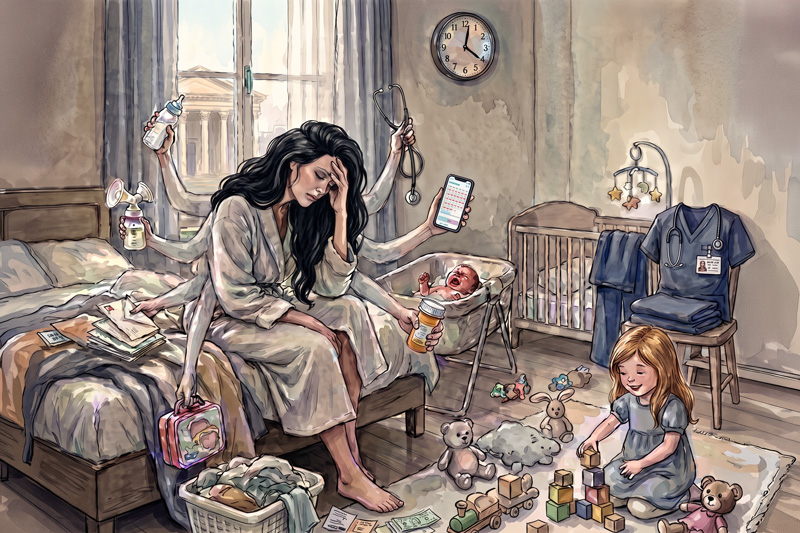
By the time I saw her on our unit, her hair had matted at the nape. She smelled like milk and old sweat. Her breasts were still hard, and she flinched when any piece of clothing brushed one.
She had not slept more than two hours at a stretch in eleven days, and none of it went anywhere deep. She lay down, which is what she told people who asked, then held just under the surface, listening through the wall for the baby while her husband slept an arm’s length away. She told the intake nurse she was frightened to be alone with the baby, then said it again, slower, watching what would happen.
Her admitting diagnosis read major depressive disorder, recurrent episode, severe, with psychotic features. Accurate as far as it went. Nothing in the diagnostic line indicated she had given birth four and a half months earlier. Nobody made a charting error. The manual worked as written.
A Four-Week Window Inside a Twelve-Month Illness
The DSM-5-TR contains no diagnosis called postpartum depression. It has a specifier, “with peripartum onset,” applied when symptoms begin during pregnancy or within four weeks of delivery (American Psychiatric Association, 2022). Past four weeks there is no modifier and it gets coded as ordinary depression.
Clinically we work in twelve months. Pediatrics screens the first year. Medicaid covers twelve months in most states. The manual stops at four.
The window was not arbitrary. Roughly half of episodes labeled postpartum are now understood to have begun during pregnancy, which is why it was broadened to peripartum. It left behind the woman who gets sick at three months.
Mothers Are Older Now and the Window Never Moved
The window assumes a population that no longer exists. The mean age at first birth hit a record 27.6 in 2024, up from 21.4 in 1970, and in Massachusetts it is 30.0. Birth rates now fall for every group under 35 and rise only for women in their 40s (National Center for Health Statistics, 2026).
For Dana, maternity leave ended two weeks ago. The alarm is set for 5:10, but she is already up, because the baby was up at 2:00 and again at 4:15. She pumps in her car in the parking garage with a jacket over the window, because her building has no room for it. At 9:00 she sits in a meeting as the only person who did not sleep. At lunch she books the pediatric checkups, answers the school’s email about her older child, and orders the school supplies. Her mother calls about her father’s appointments, because he cannot keep them straight and she is the one they call. Pickup at 5:30, dinner, bath, books. The laundry is from Tuesday and has to run again.
She is forty-one. She has mentioned the night sweats, the hot flashes, and the panic attacks in the grocery store parking lot to more than one person, and nothing came of it. So when someone asks how she is doing she says tired. She tried saying more and it went nowhere.
On Saturday she packs the beach bag. Towels, sunscreen, the cooler, snacks in separate bags because one of them will not eat anything that has touched anything else, shovels, a change of clothes for the baby. She gets everyone out the door and realizes in the parking lot that she never packed a suit for herself.
The water is fifty-eight degrees. She goes in anyway, in the jumper she put on that morning, and lets it dry on her after. Under the surface there is no sound except water in her ears, and for five seconds nobody needs anything from her. She comes up wanting to go back down. Then she is out, drying off, doing the sunscreen and the sandwiches and the sand in everybody’s eyes. Cold water is the one thing that resets her, and she will take it however she can get it.
This creates an overlap the diagnostic system has no words for. Perimenopause commonly begins in the mid-40s and can start earlier, producing insomnia, mood instability, anxiety, and fog through the same mechanism as postpartum illness: steep fluctuation in estradiol and progesterone. A woman who delivers her third child at 41 runs both at once and is screened for neither.
The Window Closes Before the Period of Highest Risk
A review across fourteen state maternal mortality review committees found 63 percent of deaths from mental health conditions happened between 43 and 365 days postpartum, against 18 percent from other causes. Most were suicides, all judged preventable (Trost et al., 2021). CDC data from 46 committees put mental health conditions behind 22.5 percent of pregnancy-related deaths (Policy Center for Maternal Mental Health, 2025). The window closes on day 28. Most of these deaths come after day 43.
Postpartum Psychosis Has No Diagnosis at All
Postpartum psychosis has no codable entry in the DSM. It gets coded as brief psychotic disorder, bipolar disorder with psychotic features, or major depression with psychotic features, depending on the clinician in front of her. In 2025 an expert panel recommended making it a distinct DSM and ICD-11 category, since its onset, treatment response, and prognosis set it apart (Bergink et al., 2025).
Onset is fast and the presentation shifts hour to hour. A woman can be lucid at three and acutely psychotic by nine, and the note written at three follows her. That reads as inconsistency, and I have watched clinicians act on it, myself included.
Where the Courts Pick Up What Psychiatry Set Down
Criminal responsibility is decided on diagnosis. When a woman is charged after harm to her infant or herself, the case turns on whether a recognized condition took away her capacity to know what she did was wrong. The defense must name the illness. The prosecution can point out that it is not in the manual.
A trial in Massachusetts this summer (2026) put that in front of a jury, with a former labor and delivery nurse as the defendant and postpartum psychosis at the center of the defense. She was roughly eight months postpartum when her children died, well outside the four-week specifier and outside the typical onset window, and her diagnosis was contested from the start. Whether an illness emerging at eight months still counts as postpartum is unsettled in psychiatry, and it got argued to a jury for lack of anywhere else. Twenty-nine countries have adjusted the penalty for infanticide in recognition of the biology of childbirth (Spinelli, 2004). England and Wales cover the first year. Ours stops at four weeks.
She Told Them
The testimony, from witnesses on both sides, laid out this sequence. Four months before her children died, she called psychiatric services and described intrusive thoughts. Her mother stayed with her for weeks that fall because she was frightened to sleep alone. In December she told her mother and husband she was having thoughts of harming her children. Her sister testified to daily suicidal thoughts for a month. She saw a nurse practitioner and a psychiatrist, went through partial hospitalization, and was admitted.
She said it out loud, repeatedly, to family and clinicians. She told her treatment team she was having intrusive thoughts about harming her children and went home.
Women here and abroad have followed this trial closely. They recognize the sequence, because they said something once too. Someone handed them a form, told them the first year is hard, or asked if they had support and wrote yes. Then they stopped.
Postpartum psychosis is rare. Missing it while a woman describes it out loud happens all the time. If the courts weigh criminal responsibility, they must weigh the record: what she reported, to whom, and what followed. A woman who told her team about intrusive thoughts and was sent home is in a different position from one who told nobody. The law can barely see that difference, because what she described is not in the manual. Until it is, screen past four weeks and act on what she tells you that week. If nothing follows the form, it only documents that she asked.
Dana
Dana stayed with us eleven days and went home. She came back six weeks later with the baby in a carrier and asked whether what happened to her had a name. I told her it did, then had to explain it was not in the book.
Her discharge summary never mentioned childbirth. There was no field for it. Mental health conditions underlie more than one in five deaths in the year after childbirth, and nearly all are preventable. Many of these women will never be diagnosed with anything, and what they carry is real all the same. Give clinicians a diagnosis that matches what they see and we will actually make progress in mothers’ mental health.

Susie Branagan, BSN, RN, is the Founder and Chief Executive Officer of Susie Branagan Consulting LLC. She can be reached at [email protected], by phone at (857) 526-6500, or through her website, susiebranaganconsulting.com.
Resources
National Maternal Mental Health Hotline: 1-833-852-6262 (1-833-TLC-MAMA)
Postpartum Support International Helpline: 1-800-944-4773
Suicide and Crisis Lifeline: 988
References
American Psychiatric Association. (2022). Diagnostic and statistical manual of mental disorders (5th ed., text rev.).
Bergink, V., et al. (2025). Postpartum psychosis and bipolar disorder: Review of neurobiology and expert consensus statement on classification. Biological Psychiatry.
National Center for Health Statistics. (2026). Births: Final data for 2024. National Vital Statistics Reports.
Centers for Disease Control and Prevention. https://www.cdc.gov/nchs
Spinelli, M. G. (2004). Maternal infanticide associated with mental illness: Prevention and the promise of saved lives. American Journal of Psychiatry, 161(9), 1548-1557.
Policy Center for Maternal Mental Health. (2025). Maternal suicide in the U.S.: The latest data and ongoing opportunities for health care system change. https://policycentermmh.org
Trost, S. L., Beauregard, J. L., Smoots, A. N., Ko, J. Y., Haight, S. C., Moore Simas, T. A., Byatt, N., Madni, S. A., & Goodman, D. (2021). Preventing pregnancy-related mental health deaths: Insights from 14 US maternal mortality review committees, 2008-17. Health Affairs, 40(10), 1551-1559.


