

Individuals in incarcerated settings are found to have an increased risk of overdose and drug-related injury during community re-entry, with the first two weeks carrying the most risk (Hartung et al., 2023). Justice-involved individuals face significant barriers to accessing substance use services both while incarcerated and upon release. Lack of training around medication for addiction treatment (MAT), limited staffing capacity, and overcrowding are common challenges across correctional settings, including both jails and prisons (Farhoudian et al., 2022). The Correctional Association of New York State (CANY) found in 2019 that 78% of individuals with Opioid Use Disorder (OUD) were denied MAT, which contributed to a post-release overdose mortality rate 40 times higher than the general population (Correctional Association of New York, 2024). Since NYS implemented legislation mandating access to MAT (such as Law Article 22, 626) in state prisons, CANY reports a 552% increase in total active participants between 2022 and 2024, with an additional 19% increase between 2023 and 2024 (Correctional Association of New York, 2024).

Aside from barriers within the justice system itself, individuals with system involvement experience compounded stigma, both for their substance use and their criminal history. Concerns about further legal repercussions, such as a fear of re-incarceration or loss of parental rights, can deter individuals from seeking help. Connections between community-based treatment and correctional settings can often be fragmented, creating gaps in care during the re-entry process (Farhoudian et al., 2022). In Rhode Island, the introduction of their MAT program in jails and prisons was correlated with a 60% decrease in post-release overdose deaths. Participants who engaged in MAT had a decrease in opioid use, HIV/Hep-C transmission, and return-to-use rates, and an easier transition to community re-entry. New York’s own pilot programs in Sing Sing and Bedford Hills correctional facilities showed similar outcomes, with 72% of participants retaining treatment for at least six months post-release, compared to 22% in non-MAT cohorts (Substance Abuse and Mental Health Services Administration, 2019; The Council of State Governments Justice Center, 2024). Comprehensive re-entry programs are more than MAT; they are composed of supports for mental health, housing, employment, physical health, and other SUD services. Evidence shows these programs reduce recidivism and improve independence within the community (Department of Justice, 2024).
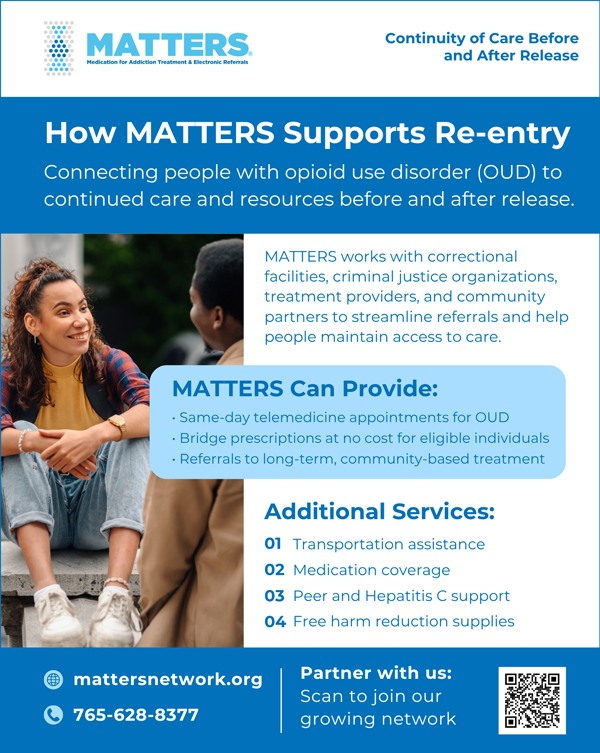
MATTERS partners with jails, prisons, and other criminal justice organizations to facilitate rapid referrals to treatment for opioid use disorder. The program helps bridge gaps in care during re-entry, including delays in Medicaid reactivation or access to a community treatment provider. Understanding the diversity across correctional settings, our team has developed facility-specific workflows across NYS to address the complex needs of different facility types and provide seamless linkage upon release. For example, MATTERS program staff have worked closely with the Erie County Sheriff’s Office Correctional Health Division (ECSO) to support their correctional health staff in the re-entry process. Prior to the implementation of the MAT program, individuals received little or no guidance related to reintegration into community MAT treatment programs, with discharge education focused on naloxone training and abstinence.
Stigma and lack of education related to the effectiveness of treatment with buprenorphine and methadone were the greatest barriers to implementation of effective comprehensive MAT programs. Today, while the individual is still incarcerated and beginning the release process, an RN at ECSO trained in substance use disorder (SUD) provides discharge education. This includes harm reduction supplies, an appointment with MATTERS telemedicine, if needed, and a referral to a community-based provider, facilitated via the referral platform. The ECSO Correctional Health Division has provided comprehensive care to more than 200 incarcerated individuals daily throughout the 2026 calendar year. This represents more than 25% of the average daily jail population receiving counseling, medication, and discharge planning.
MATTERS referrals can occur at multiple points across the criminal justice system, including in courts, jails, and prisons, as well as during community re-entry. The program provides a vital safety net during a high-risk period as individuals on MAT transition from incarceration back into the community. In a corrections landscape where time and resources are limited, MATTERS offers a timely and effective tool that streamlines workflows and increases the likelihood of a successful connection to care. Linkage to treatment is supported through various wraparound services, including financial assistance for medication and transportation, peer connections, harm reduction resources, telemedicine, and more.
In 2026, MATTERS expanded to accommodate referrals to community HCV testing and treatment, in addition to OUD referrals, through a partnership with UBMD telemedicine. Studies have shown that recent incarceration has been linked to a 62% increase in the chance of contracting an HCV infection (Stone et al., 2018). In NYS jails, a recent study found that only 29% of facilities that were surveyed (46 out of 58 located in NYS, excluding the NYC region) initiated treatment for those who were newly diagnosed with HCV. Further, only half of these facilities (51%) had agreements with a community-based provider for post-release treatment and cited rapid test kits and HCV education resources as barriers (Riback et al., 2026).
Facilitating linkage to methadone treatment is a recent addition made to the program, including dose verification questions for certain referral partner categories (such as emergency departments). Individuals who are referred through MATTERS can filter for additional treatment needs while choosing an outpatient program, including mental health, additional SUD, and medical services. Care continuity is vital for those re-entering the community after a period of incarceration, especially for those with SUD. Evidence supports the utility of comprehensive MAT programs in jails and prisons that include robust re-entry support to improve outcomes for this population. Providers, policymakers, and communities must work together to create supportive environments for justice-involved individuals. MATTERS serves as a framework for other communities to develop partnerships with their local correctional institutions and improve connections to community-based care. To learn more about MATTERS’ work supporting individuals with SUD and our work in communities in New York, Pennsylvania, and New Jersey, please reach out using the contact information below.



Raven Manchester is Regional Outreach Coordinator and Joshua Lynch, DO, FACEP, is Chief Medical Officer, at MATTERS Network. Kevin McGee, DO, FACEP, is Chief Medical Officer at the Erie County Sheriff’s Office. For more information, email [email protected], call (765) 628-8377, or visit mattersnetwork.org.


