

Florida incarcerates more children than any other state in the country. Even while research shows harsh punishments and long sentences don’t rehabilitate kids — they keep them coming back. There needs to be another way to hold kids accountable because, right now, we are manufacturing the outcomes we claim to be fighting against.
A child under 17 who spends time behind bars is 70% more likely to reoffend within three years, according to research from the Department of Justice and The Sentencing Project. That statistic reinforces the belief held by many that Florida has invested in a “school-to-prison pipeline.” In fact, Florida’s minimum age of incarceration and prosecution is seven years old, which is the youngest age among the states that have one.
Additionally, the use of the Baker Act, a law allowing law enforcement to involuntarily detain someone for mental health challenges, on children has increased 128% during the last two decades. These factors create a perfect storm for funneling kids into the system instead of out of it.
Nationally, almost 32,000 children and teens are confined in facilities on any given day. So, while this problem presents itself at its worst in Florida, it’s a nationwide challenge we all have the responsibility to address.
Why exactly does incarceration backfire? It’s a combination of several factors: peer influence, brain development, and developmental disruptions. Prison is designed to punish adults, and exposing children to such conditions further sets back a brain that hasn’t even finished developing.
Prison as a punishment doesn’t have the same effect on adolescent brains, as the prefrontal cortex isn’t fully developed until the age of 25. This part of the brain is responsible for impulse control, weighing consequences, and regulating emotions. The Sentencing Project found that most youth age out of “lawbreaking” naturally as their brains develop, but incarceration introduces them to factors that otherwise break the normal coming-of-age process.
Time spent in confinement means more time spent around delinquent peers. We also know youth are more easily swayed by peer influence than adults. When they spend time with others who committed more serious crimes, it normalizes and reinforces the behavior we’re supposedly trying to correct.
Additionally, prison time disrupts important developmental milestones. Detention derails school enrollment, job prospects, and family stability. Normal experiences like school, work, and friendships — linked to brain maturation — are no longer part of their day-to-day. Instead, children are exposed to social environments that reward attention-seekers and impulsiveness. The very conditions that put them in the system are reinforced, not corrected.
It’s also important to address that almost two-thirds of youth in correctional settings have a diagnosable mental health or substance use disorder, according to the Center for Health Care Strategies. It’s another gap that sends youth deeper into the system.
Access to mental health care in correctional settings is a legal right in the United States, yet many states fail to provide it. A 16-year study of detained youth found fewer than 20% who needed mental health services ever received them in the last two decades, according to a Journal of the American Academy of Child and Adolescent Psychiatry study. Untreated disorders lead to low educational achievement, difficulty maintaining employment, drug overdose, and death.
Most recently, U.S. Sen. Jon Ossoff of Georgia and Rep. Jen Kiggans of Virginia launched a bipartisan investigation into the incarceration of children with mental health conditions in juvenile detention facilities. The investigation found that 75 facilities were incarcerating children who were eligible for release to mental health care programs. These children remained there because the care they needed was simply not available. Often, these facilities incarcerate children for at least a month before discharging them — some waited as long as a year.
The missteps in the system are evident, yet proven alternatives are sitting largely unfunded and underused — such as restorative justice diversion. This method is about reframing crime from “breaking the law” to “harm done to people and relationships.” Restorative justice focuses on: who was harmed, what do they need, and whose obligation is it to make things right?
It’s about accountability over punishment, voice and participation, addressing root causes, and reintegration — never exile. Studies show higher victim satisfaction and perceptions of fairness, improved victim mental health, and higher rates of restitution compared with court processing. So why is it underused?
Restorative justice diversion isn’t a blanket alternative to incarceration. It’s specifically designed for non-violent, lower-level offenses, where the goal is repair rather than removal. Only seven states provide significant funding or support for these programs. Florida is notably not one, even though the evidence — victim satisfaction, cost, reduced severity of reoffending — favors this approach.
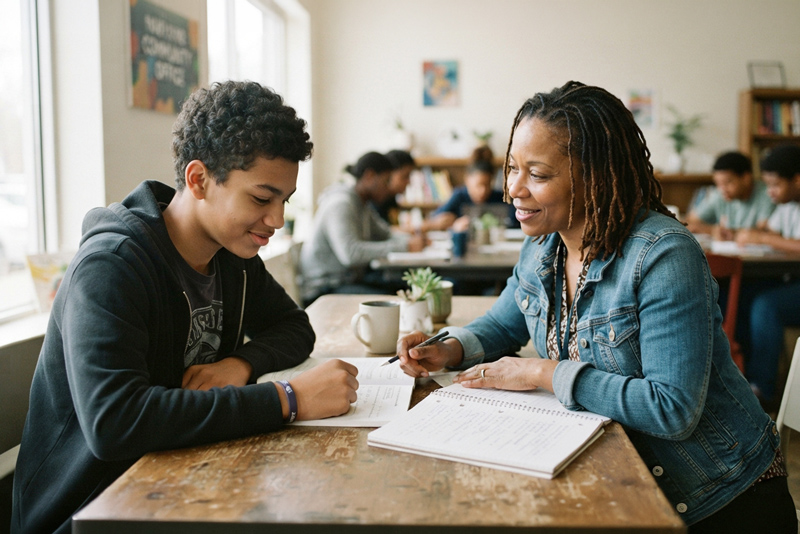
At The LJD Jewish Family & Community Services, our At Hope Youth program is a free, voluntary wraparound advocacy program for minors who’ve received civil citations or been referred to a diversion program for non-violent offenses through the Department of Juvenile Justice and Duval County Courts. We also serve kids and teens who are at a high risk of system involvement before any citation occurs.
At Hope assigns each child to a case manager who oversees their court sanctions. These are like community service hours or check-ins tied to the terms of their diversion agreement. Beyond that, case managers provide coordinated wraparound services such as additional mentoring, counseling referrals, school tutoring, and more. It starts with addressing the root causes and holding the child accountable. We focus on repairing the whole situation and not just punishing the incident — all while keeping them out of jail.
Restorative justice programs like ours work within the confines of an undeveloped brain. They keep children away from bad influence and ensure adolescents still meet developmental milestones.
Florida doesn’t need to lock up more kids. It needs to fund alternatives that not only work but also better our community as a whole. Let’s move the focus away from punishment and start funding second chances.

Jeanie Burton, MBA, JM, is Program Director of the At Hope Youth Program at The LJD Jewish Family & Community Services. For more information, call (904) 448-1933 and visit JFCSjax.org.


