These are not kids in crisis. This observation grew increasingly certain as the conversation lingered, and so did the feeling that the conversation would remain painfully unfinished. After we wrapped up our workshop titled Resisting (dis)order and Reclaiming Neuroqueer Body Trust, some of the middle school-aged students who participated stayed behind to chat before heading to the closing plenary of the conference. One of the students explained that they appreciated this space because they felt surrounded by people that see “truths” about the world in the same way they do. “It’s hard for me to comprehend that so many people live their whole lives totally oblivious about all the interconnected issues that create the standards we need to stick to.” Yes, this was a middle school-aged child. “I’m thankful for my friends who I dragged to do this workshop with me because we all see it together.”
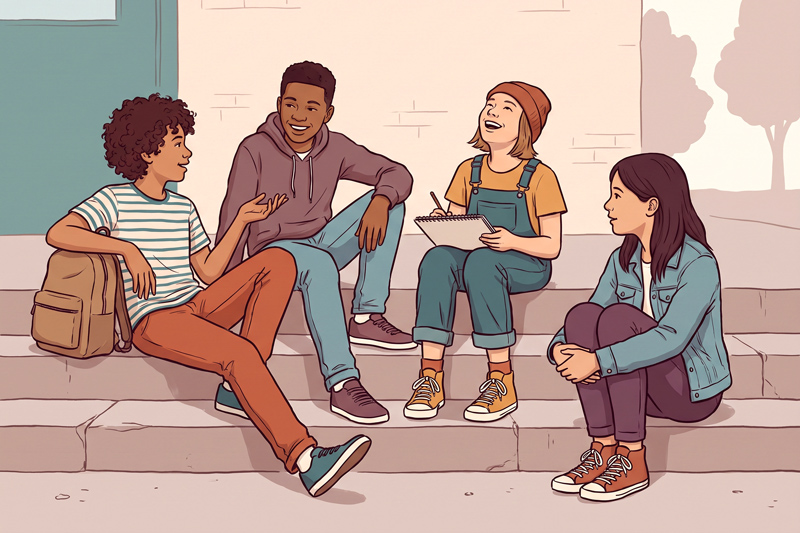
When youth mental health and body image are discussed by providers, educators, and policymakers, the dominant narrative is that youth are in crisis. It is important to clarify: systems that impact youth mental health are indeed in a state of crisis—healthcare and education policies specific to youth mental health are legislated from a state of panic, and so the crisis is a self-fulfilling prophecy. However, to paint youth themselves as being in a state of crisis requiring immediate intervention from providers ignores the reality that youth are already caring for each other in a world that has failed to care for them. The youth at our workshop are evidence of this. Middle school-aged children have knowledge about how to care for themselves and for each other; as providers and caring adults, our efforts may be best spent in creating spaces to claim their own agency, knowledge, and care.
Spaces centered around Body Trust® serve that purpose. Body Trust is a healing modality and framework developed by Hilary Kinavey, LPC, and Dara Sturtecant, RD,that equips people in reclaiming our right to exist, take up space, and care for our bodies, ourselves, and each other. These are truths that live in our bodies, but are often difficult to access because we have internalized so many harmful messages about who we are supposed to be. The experience of disconnecting with this embodied knowledge is one that queer people know deeply from our experience of growing up in heternormative societies. We must disconnect from the parts of ourselves those around us deem “abnormal” or “wrong” to adhere to standards and expectations. Living in a world that assigns hierarchical value to bodies at all means that everyone is disconnected from their body trust. We begin internalizing messages about what is wrong with our bodies as children and learn not to trust them. This impacts the way we show up in the world throughout our lives, and we ultimately reproduce the internalized standards we were once taught. Thus, messages youth hear about their bodies uphold body standards on a societal level. The same is true for messages youth hear about their minds. The more we tell youth that they are in crisis and that adults need to step in to “save” or “protect” the mental health of their entire generation, the more they lose trust in their own ability to engage in care. So, if we really want to support youth mental health, we must create space for youth to reconnect with what they know about both their bodies and their minds.
Our workshops and the Body Trust® framework are a response to this call, but by no means are they complete solutions. Spaces for youth to work through the messages projected onto their bodies must respond to the specific messages they receive, and thus they must be specific to their communal contexts. If the spaces where youth already spend their time become more supportive places for youth to reconnect with their embodied knowledge, or at the very least mitigate the harmful messages they receive about their bodies, then we are meeting youth where they are at. Given their role as sites of identity-formation, schools offer a wonderful place to start.
There are plenty of actions that can be taken at a policy level to move toward making schools more supportive and affirming spaces for youth to practice honoring their inherent wisdom, knowledge, and capacity. These are small actions that could be easily funded and implemented in existing social-emotional curriculum and after-school programs or clubs. However, it is essential to address the policies that make schools deeply unsafe spaces for youth, especially those who are already vulnerable to being told the way their bodies look and function are wrong. This is particularly true in the age of GLP-1s, where the thin ideal and disordered eating have become normalized under the guise of “health.” This is reinforced within school health curriculum and in the revival of the Presidential Physical Fitness Test, which foster endless opportunities for students to internalize harmful messages about their bodies. In Body Trust workshops and clinical practice, youth and adults often point to their experiences of the Presidential Physical Fitness Test and health class as traumatic sites of disconnection, shame, and beginning a life-long project of trying to control or fix their bodies. In moving the conversation away from a “youth mental health crisis” and toward a “mental health policy crisis,” it is essential to consider the role of policies and practices that impose harmful messages onto youth about their bodies. Offering youth the tools to understand, externalize, and then unlearn the pervasive shame of dominant culture allows them to connect to their own knowing, freedom, and to move toward a world where all bodies have what they need to thrive.

Sophie Szew (she/they) is a youth mental health and disability justice advocate, writer, and organizer. She graduated from Stanford University in 2026 with a Master’s degree in Policy, Organization, and Leadership Studies, and a Bachelor’s degree in American Studies with a concentration in American Mental Healthcare Systems. She was appointed by the Secretary of Health and Human Services to advise the federal government on mental health policy as the youngest member of the Substance Abuse and Mental Health Services Administration (SAMHSA) National Advisory Council. Sophie’s storytelling first gained national recognition during the MTV Mental Health Youth Action Forum at the White House, where she met with President Biden and his administration to advocate for systemic mental healthcare justice. Sophie’s lived experience, expertise, and activism have also led them to advise numerous organizations on youth mental health issues, including Mental Health America, Born This Way Foundation, the National Alliance on Mental Illness, and Project Unloaded. In March of 2023, she testified in front of the California State Senate about the impact of algorithmic injustice on youth, and since, her advocacy has been covered by the Today Show, the LA Times, NBC, CBS News, and has landed her a spot on the 2025 Forbes 30 Under 30 Social Media List. Sophie combines her calls for policy change with poetic storytelling, and performed original poetry at the Los Angeles Mayoral Inauguration. She has community health partnership experience working with the Mount Sinai Hospital System and views her community-building, artistic, and advocacy work as deeply interconnected.

Christina Borel, LCSW, LICSW (they/them) is a queer, non-binary clinician, writer, and teacher practicing in Connecticut and Massachusetts. They have worked as a practitioner-scholar-activist since 2005, bringing a commitment to dignity-centered, trauma-specific, non-carceral care across over two decades of clinical practice, teaching, and movement work. Christina is a Certified Body Trust® Provider and the founder of Kaleidoscope Growth, where they offer therapy to LGBTQIA+ folx and facilitate experimental spaces for radical, embodied collective care — built by, with, and for the queer and trans community. Learn more at www.kaleidoscope-growth.com.