

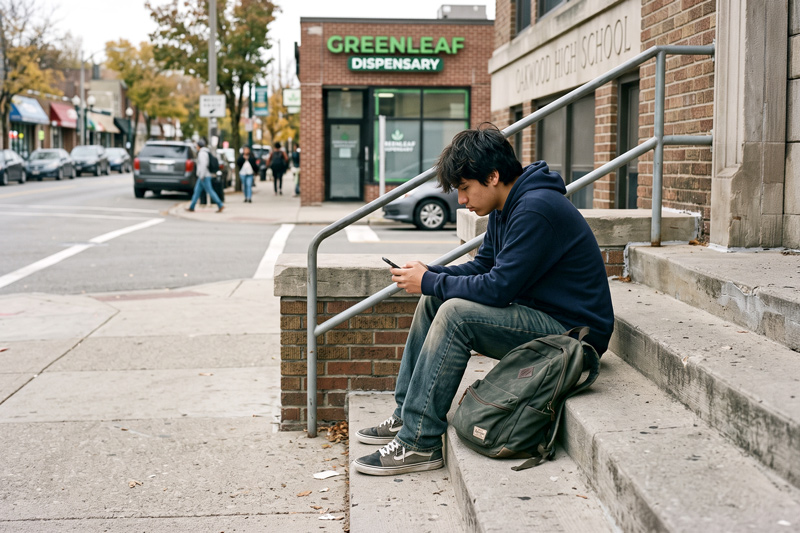
The rapid expansion of cannabis legalization across the U.S. has raised growing concerns about its impact on adolescents. Cannabis remains the most commonly used recreational drug among U.S. youth (Young-Wolff et al., 2026), and while cannabis use is not legal at the federal level, medical use has been legalized in 40 states and recreational use (for individuals 21 and older) has been legalized in 24 (Los Angeles Department of Cannabis Regulation [DCR], 2026). Following state-level legalization, we are seeing several unintended adverse effects among adolescents. Previous studies have reported increases in dangerous patterns of use, including frequency, potency, and likelihood of experimentation, as well as a reduced perception of risk (Ladegard & Bhatia, 2023; Mital & Nguyen, 2025; Yang et al., 2024).
Effect of Cannabis Legalization on Adolescent Patterns of Use and Perception of Risk
In a study of Canadian students in grades 7 to 11, researchers determined that between 2018 and 2022, there was a 26% increase in the overall prevalence of cannabis use, a 43% increase in edible cannabis use, and a 34% increase in cannabis smoking in provinces that legalized cannabis edibles and extracts (Mital & Nguyen, 2025). A nationwide study demonstrated “that people aged 12 to 20 years old were more likely to experiment with cannabis if living in a state in which medical cannabis was legal” (Ladegard & Bhatia, 2023, p. 636). It is also well-documented that the legalization of cannabis has significantly reduced the perception of risk of using the drug (Mennis, 2023). The perceived risk of regular cannabis use among 12th grade students declined from 58% in 2000 to 36% in 2024 (Bhangu et al., 2025). As a result, youth attitudes toward cannabis have been trending toward greater acceptance of use, and “adolescent perceptions of cannabis as a harmful substance is at an all-time low” (Ladegard & Bhatia, 2023, p. 637). Equally concerning are the results from a Boston College study that found that among teens who already used cannabis, their frequency of use increased after legalization (Gloudemans, 2024).
While some additional sources indicate that legalization of cannabis has not triggered an increase in teen usage (Martinelli, 2025; Mejia et al., 2023), this data must take into account the overall decrease in substance use among teens during the same time period (Ladegard & Bhatia, 2023; Miech et al., 2025). These trends are particularly alarming given that evidence suggests that cannabis use among adolescents can cause social withdrawal, has detrimental effects on brain development, and increases the risk of mental health disorders such as anxiety, depression, and psychosis (Bhangu et al., 2025).
Adolescent Dependency and Mental Health
As cannabis becomes increasingly accessible and normalized, health professionals and those opposing cannabis legalization have significant concerns about the serious mental health risks, especially for adolescents who are more susceptible to the negative effects (Young-Wolff et al., 2026; Mital & Nguyen, 2025). Research has found that 10% of cannabis users develop a dependence, increasing to 16–17% for those who start using the drug before age 18 (Bhangu et al., 2025). Similarly, adolescents who use cannabis are more likely to use it in greater amounts and with greater frequency than those who start using the drug later in life (Bhangu et al., 2025). Even more alarming is the impact of use on the developing brain. Regular and heavy cannabis use during adolescence, which is a critical time for neural development, is associated with impairments in learning, attention, memory, motor skills, and executive functioning (Bhangu et al., 2025; Mejia et al., 2023), as well as “being 2–3.5 times more likely to report a lower grade point average” and a lower IQ (Bhangu et al., 2025; Yang, 2024, p. 872).
More recent studies are focusing on how adolescent cannabis use is specifically associated with psychotic disorders (Alam et al., 2025; Bhangu et al., 2025; Hetrick, 2026; Young-Wolff et al., 2026). A decade-long study (that concluded in August 2025) evaluated 463,396 adolescents aged 13 to 17 through age 25 and concluded that adolescents reporting past-year cannabis use had about “double the risk of being diagnosed later with psychotic and bipolar disorders” (Hetrick, 2026, p. 1). Earlier research supports this finding, citing that cannabis use increases the risk of developing a psychotic disorder by approximately 2 to 4 times (Bhangu et al., 2025). Additional findings determined that “starting cannabis use at a younger age increases the risk of developing psychosis later in life” (Alam et al., 2025, p. 410).
Impact of Adolescent Cannabis Use on Socialization
While there is evidence to suggest that cannabis may facilitate social connection, there is also evidence that it has adverse social effects, depending on the potency of the cannabis and the personality and tolerance of the individual (Stone, 2021). When taken in high doses, cannabis is capable of provoking anxiety in social settings (Alam et al., 2025; Stone, 2021), which can lead to social withdrawal and loneliness for children and adolescents (United States Department of Health and Human Services, 2023). Furthermore, studies suggest a correlation between regular cannabis use during adolescence and negative academic outcomes, such as increased risk of high school dropout, which may also lead to isolation and loneliness (Lynskey et al., 2003).
These findings suggest that adolescent cannabis use does not consistently promote healthy social connections and, in fact, could create anxiety and social withdrawal. Although cannabis-related gatherings bring people together, they may be counter-productive to fostering healthy social connections by reinforcing harmful behavior through peer influence (United States Department of Health and Human Services, 2023). According to the United States Department of Health and Human Services, people are more likely to engage in harmful behavior when surrounded by people who are also engaged in such behavior (2023). Therefore, it is important that adolescents are protected from cannabis and cannabis-related social environments that could reinforce harmful behavior.
Conclusion
With 53% of adults supporting the legalization of cannabis and ongoing efforts by the federal government to reclassify cannabis from Schedule I to Schedule III (Helmore, 2026), it is unlikely that cannabis state laws will be repealed. To that end, proponents of cannabis legalization point to the more than $24.7 billion in state tax revenue generated from sales since 2014 (Hasse, 2025). Further, legalization at the state level has addressed longstanding issues of racial inequities in drug enforcement (Mennis et al., 2023). Advocates are also in favor of the therapeutic benefits for certain medical conditions and social anxiety (Bhangu et al., 2025; Stone, 2021).
As cannabis legalization becomes an accepted part of our legal and social landscape, some states are working toward safeguards and regulations for adolescents similar to those used for alcohol and tobacco (American Public Health Association, 2020). In several states, cannabis regulation prohibits outdoor signage within 500 feet of schools, places of worship, or playgrounds and bans cannabis possession on school property (Bhangu et al., 2025). Other regulations prohibit advertisers from targeting minors and people under 21 from entering cannabis dispensaries (Bhangu et al., 2025). Despite these efforts, adolescents still have increased exposure and access to cannabis as a result of legalization because of factors such as “adult normalization, media coverage, dispensary visibility in high traffic areas like sports arenas, and a strong presence on social media” (Bhangu et al., 2025, p. 2). Therefore, to adequately protect young people, policymakers need to implement stricter restrictions beyond the current age and marketing regulations, including controlling the concentration of THC in cannabis products and requiring comprehensive and targeted educational programs exposing cannabis-related health risks. Ultimately, we cannot continue to expand the legalization of cannabis until we have properly addressed the gaps in the current system that jeopardize the well-being of our adolescent population.

Brooke Jadon is a high school student, peer counselor, and youth mental health and education advocate. She founded her school’s NAMI on Campus club, teaches social-emotional learning to students in underserved communities, and serves on the Los Angeles County Department of Public Health Youth Advisory Council.
References
Alam, T., Riegal, C., Saadeh, N., Gushken, F., Snyder, H., Jenks, B., & Anand, A. (2025). Recreational cannabis legalization: Potential implications for individual and community health. Cleveland Clinic Journal of Medicine, 92(7), 407–413. https://doi.org/10.3949/ccjm.92a.24086
American Public Health Association. (2020, October 23). A public health approach to regulating commercially legalized cannabis (Policy Statement No. 20206). https://www.apha.org/policy-and-advocacy/public-health-policy-briefs/policy-database/2021/01/13/a-public-health-approach-to-regulating-commercially-legalized-cannabis
Bhangu, G. K., Singh, A., Shah, A., & Malhi, N. (2025). Cannabis use in adolescents. Delaware Journal of Public Health, 11(3), 6–13. https://doi.org/10.32481/djph.2025.09.03
Gloudemans, P. (2024, May). BC researchers explore effect of cannabis legislation on teen substance abuse. Boston College News. https://www.bc.edu/bc-web/sites/bc-news/articles/2024/spring/study-explores-cannabis-legislation-effect-on-substance-abuse.html
Hasse, J. (2025, June 22). Legal weed is working, data suggests: $24.7 billion in taxes, teen use down in most states. Forbes. https://www.forbes.com/sites/javierhasse/2025/06/22/legal-weed-is-working-data-suggests-247-billion-in-taxes-teen-use-down-in-most-states/
Helmore, E. (2026, April 23). Trump administration moves to reclassify marijuana as Schedule III drug. The Guardian. https://www.theguardian.com/us-news/2026/apr/23/trump-administration-reclassify-marijuana-schedule-iii
Hetrick, C. (2026, March 2). Study: Teen cannabis use doubles risk for psychotic and bipolar disorders. USC Price School of Public Policy. https://priceschool.usc.edu/news/teenage-cannabis-use-mental-health-study/
Ladegard, K., & Bhatia, D. (2023). Impact of cannabis legalization on adolescent cannabis use. Psychiatric Clinics of North America, 46(4), 635–646. https://doi.org/10.1016/j.psc.2023.03.008
Los Angeles Department of Cannabis Regulation. (2026, February 10). The divided states of cannabis. https://cannabis.lacity.gov/articles/divided-states-cannabis
Lynskey, M. T., Coffey, C., Degenhardt, L., Carlin, J. B., & Patton, G. (2003). A longitudinal study of the effects of adolescent cannabis use on high school completion. Addiction, 98(5), 685–692. https://doi.org/10.1046/j.1360-0443.2003.00356.x
Martinelli, A. (2025, January 16). New data shows recreational cannabis legalization corresponds with drops in teen use. The Marijuana Herald. https://themarijuanaherald.com/2025/01/new-data-shows-recreational-cannabis-legalization-corresponds-with-drops-in-teen-use/
Mejia, M. C., Adele, A., Levine, R. S., Hennekens, C. H., & Kitsantas, P. (2023). Trends in cigarette smoking among United States adolescents. Ochsner Journal, 23(4), 289–295. https://doi.org/10.31486/toj.23.0113
Melchior, M., Nakamura, A., Bolze, C., Hausfater, F., El Khoury, F., Mary-Krause, M., & Azevedo Da Silva, M. (2019). Does liberalisation of cannabis policy influence levels of use in adolescents and young adults? A systematic review and meta-analysis. BMJ Open, 9(7), Article e025880. https://doi.org/10.1136/bmjopen-2018-025880
Miech, R. A., Johnston, L. D., Patrick, M. E., & O’Malley, P. M. (2025, December 17). Reported use of most drugs remains low among US teens [Press release]. University of Michigan News Service. https://news.umich.edu/reported-use-of-most-drugs-remains-low-among-us-teens
Mennis, J., McKeon, T. P., & Stahler, G. J. (2023). Recreational cannabis legalization alters associations among cannabis use, perception of risk, and cannabis use disorder treatment for adolescents and young adults. Addictive Behaviors, 138, Article 107552. https://doi.org/10.1016/j.addbeh.2022.107552
Mital, S., & Nguyen, H. V. (2025). Legalizing youth-friendly cannabis edibles and extracts and adolescent cannabis use. JAMA Network Open, 8(4), Article e255819. https://doi.org/10.1001/jamanetworkopen.2025.5819
Stone, E. (2021, October 20). Can cannabis build social interactions? The Cannigma. https://cannigma.com/physiology/can-cannabis-build-social-interactions/
Office of the Surgeon General. (2023). Our epidemic of loneliness and isolation: The U.S. Surgeon General’s advisory on the healing effects of social connection and community. U.S. Department of Health and Human Services. https://www.hhs.gov/sites/default/files/surgeon-general-social-connection-advisory.pdf
University of Michigan. (2025, December 17). Reported use of most drugs remains low among US teens. Michigan News. https://news.umich.edu/reported-use-of-most-drugs-remains-low-among-us-teens/
Yang, J., Mejia, M. C., Sacca, L., Hennekens, C. H., & Kitsantas, P. (2024). Trends in marijuana use among adolescents in the United States. Pediatric Reports, 16(4), 872–879. https://doi.org/10.3390/pediatric16040074
Young-Wolff, K. C., Cortez, C. A., Alexeeff, S. E., Silver, L. D., Pacula, R. L., Slama, N. E., Padon, A. A., Satre, D. D., Campbell, C. I., Koshy, M. T., Does, M. B., & Sterling, S. A. (2026). Adolescent cannabis use and risk of psychotic, bipolar, depressive, and anxiety disorders. JAMA Health Forum, 7(2), Article e256839. https://doi.org/10.1001/jamahealthforum.2025.6839


Great article by Ms. Jadon. Surprised to learn that 53% of adults support the legalization of cannabis. First and foremost, the legalization of Cannabis has been a disaster for our youth as well as the adult population. Cannabis has proven to be a gateway drug for so many other horrific drugs. Having our youth and others walking around half anesthesized does not lead to a happy, healthy or productive society.
I applied my gratitude with this issue. I like how you first hand explained this issue and how you make it came alive. I too believe that this cannibalism business is devastating our youths and I hope that we can all learn something from this article. Thank you for this level of wisdom and insight in such a matter that is affecting our country. Thank you