Key Takeaways:
- Overdose Prevention Centers (OPCs) are harm reduction facilities that provide many addiction services including medical supervision for those using pre-obtained drugs
- OPCs have consistently shown that they dramatically reduce overdose mortality and the spread of communicable diseases like hepatitis and HIV, while increasing engagement in treatment and decreasing costs for the city
- Wider implementation of OPCs across the US has been politically fraught, requiring grassroots advocacy on local, state, and federal levels
- Read more about the status of your state’s OPC legislation here: https://opcinfo.org/states/
Drug overdoses remain a leading cause of death in the United States, and despite recent improvements in mortality rates, the opioid crisis continues to devastate communities across the country. The response to this crisis has been multifactorial, but one avenue that has yet to see major investment at a national level is overdose prevention centers (OPCs). OPCs, sometimes referred to as safe injection sites, are harm reduction facilities that provide medical supervision for those using pre-obtained drugs like fentanyl and heroin. Staff onsite are able to provide naloxone and other medical interventions should someone overdose. However, rescue services are only one of the many services that OPCs provide. By integrating themselves in communities, OPCs are able to provide services like wound care, needle exchanges, confirmatory drug testing, counseling, and medication-assisted treatment as soon as people are ready. Importantly, OPCs serve as a first point of contact for people to receive or be referred to mental health and addiction treatment. As opposed to a crowded emergency room after an overdose, OPCs are able to meet people where they are and initiate care before an emergency while taking pressure off of our overburdened healthcare system.

OPCs have existed for decades both in the United States and abroad. The first opened in Switzerland in 1986. Now, almost 200 OPCs are operating across 14 countries. Studies from OPCs in Canada, Australia, and the US have consistently shown that they dramatically reduce overdose mortality and the spread of communicable diseases like hepatitis and HIV, while increasing access and engagement with treatment (Boyd, 2022). OPCs have also been shown to not increase crime or drug use, or negatively impact local foot traffic and businesses (Allen et al., 2026). In Vancouver, OPC expansion was shown to reduce both public drug use as well as needle sharing (Kennedy et al., 2022). One study found that every dollar spent on OPCs yields $5.12 in savings for the city (Andresen & Boyd, 2010). All evidence points to OPCs being a positive impact on communities, and, when implemented thoughtfully, prevent deaths while connecting people to treatment.
Nevertheless, OPCs have struggled to gain traction in the United States due to the tenuous legal and political landscape. Legally, the main barrier is 21 U.S.C. §856(a) of the Controlled Substances Act, often referred to as the “crack house statute,” which makes it illegal to operate or maintain a place for the purpose of using controlled substances. While not designed to prevent public health interventions, this statute has become the central legal argument against OPCs. New York City currently has two locally sanctioned OPCs; however, these are technically illegal on a federal level. San Francisco had an OPC, the Tenderloin Linkage Center, open for 11 months before it was closed down. Politically, the difficulty in maintaining OPCs and the threat of federal intervention discourages politicians from pursuing and supporting legislation that would enable their construction. It is also important to acknowledge here that stigma against people who use drugs and suffer from addiction undoubtedly serves as a major obstacle to OPC advancement.
As it stands, there exist two primary mechanisms via which OPCs are able to operate in the United States. The first is local authorization, as seen in New York City, where municipal support allowed OnPoint NYC to open the country’s first locally sanctioned OPCs in 2021 despite federal law (Giglio et al., 2023). The second is state-authorized pilot legislation, as seen in Rhode Island, which opened its first OPC in December of 2024.
In the case of OnPoint NYC, the impetus came after a feasibility study was completed in 2020 by the New York Department of Health on establishing OPCs in the city. Using the findings of this study and other testimony, Mayor Bill de Blasio wrote a letter to the then US Attorney General Merrick Garland asking for the DOJ not to authorize and not prosecute OPCs in the city. While never explicitly endorsing OPCs, the Biden administration did support exploration of new harm reduction approaches to tackle the opioid epidemic. Two locations were constructed and received significant input in their operations from the Department of Health, law enforcement, and the mayor’s office. Local police officers had, at times, daily meetings with OnPoint staff and were given frequent tours of the facilities. Since 2021, the DOJ has maintained a non-prosecutorial stance on the OPCs in New York. Although, given the new administration, other states have been wary in implementing a locally sanctioned approach.
In regard to Rhode Island, it was the first state to implement OPCs via a pilot program. This was achieved via the passage of a legal exemption to federal law at the state level, which allowed an OPC to be constructed. Through a strict regulatory framework, the pilot program will be required to gather local data, assess effects on public safety, and refine operations before broader implementation. Rhode Island’s pilot OPC must also provide housing, legal, and employment services in addition to medical and counseling services. Similarly to the OPCs in New York, the Rhode Island pilot program has had to build trust and a working relationship with municipal authorities and law enforcement to be successful.
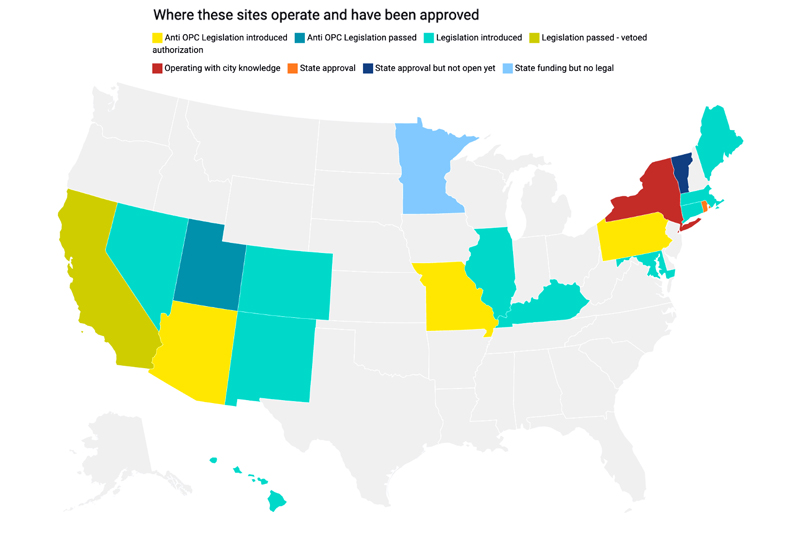
Overdose Prevention Center legislation status by state.
Multiple states have had OPC legislation introduced (Figure 1), with Vermont set to be the next state to establish a functioning OPC after it approved a pilot program in 2024. In Connecticut, my home state, the fight to pass OPC legislation has been complicated by tension between legislative support in the Senate and hesitation from the governor’s office. A previous healthcare bill in 2025 included a provision for an OPC pilot program, but when Governor Ned Lamont threatened to veto the whole bill, this provision was removed. A separate bill, SB 195, has been introduced this year specifically to address the creation of an OPC pilot program (Golvala, 2026); however, it faces the same political tension as the year before.
As a medical student in Connecticut, my own support for OPCs comes not only from the literature, but from what I have seen in my research on opioid use disorder management in hospitals. Our research team, led by addiction medicine physician and President of the Connecticut chapter of the American Society of Addiction Medicine (ASAM) Dr. Sijie Wang, reviewed over 1,000 patient encounters at Hartford Hospital. The data is clear: our healthcare system is not designed to provide adequate care at the scale the opioid crisis necessitates. OPCs would make an immediate impact on the public health and safety of a city like Hartford, which is why this pilot program bill is so important. However, there is concern from many in the addiction medicine space that even if such a bill were to be passed, it would be vetoed by the governor, just as it was in California.
So where do we go from here? While locally sanctioned OPCs may be able to move more quickly by bypassing the delays of state-level politics, they lack the legal durability and regulatory structure that state-authorized pilot programs provide. At the same time, waiting for perfect political consensus has its own cost. Each delay represents another missed opportunity to prevent deaths and connect people to care. Federal intervention would be the strongest step, whether through Congress amending the Controlled Substances Act, formally restricting federal prosecution of OPCs, or simply the Department of Justice acknowledging the life-saving work that OPCs provide every day. While state governments wait for a change to federal policy, it is critical that grassroots work continues. The progress that has been made so far has been from the collaboration of people with lived experience, their families, and behavioral health professionals fighting together to get this life-saving, community resource. Whether through advocacy, community education, or direct patient care, communities depend on those who see inaction as unacceptable.


Calvin Bohner is a 4th year medical student at the Frank H. Netter MD School of Medicine at Quinnipiac University. Email [email protected].
Samuel Jackson, MD, serves as the Clinical Director of Psychiatry at Erie Family Health and is an Assistant Professor of Psychiatry at Rush, Loyola, and University of Illinois Chicago. For more information, email [email protected].
Sources
Allen B, Basaraba C, Chambers LC, Behrends CN, Marshall BDL, Cerdá M. Overdose Prevention Centers and Neighborhood Commercial Activity in New York City. JAMA Netw Open. 2026;9(2):e2559863. doi:10.1001/jamanetworkopen.2025.59863
Andresen, M. A., & Boyd, N. (2010). A cost-benefit and cost-effectiveness analysis of Vancouver’s supervised injection facility. The International journal on drug policy, 21(1), 70–76. https://doi.org/10.1016/j.drugpo.2009.03.004
Boyd, C. (2022). The policy landscape of overdose prevention centers in the United States (R Street Policy Study No. 265). R Street Institute. https://www.rstreet.org/research/the-policy-landscape-of-overdose-prevention-centers-in-the-united-states/
Drug Policy Alliance. (2025, April). Overdose Prevention Centers (OPCs). https://drugpolicy.org/
Giglio, R. E., Mantha, S., Harocopos, A., Saha, N., Reilly, J., Cipriano, C., Kennelly, M., Landau, L., McRae, M., & Chokshi, D. A. (2023). The Nation’s First Publicly Recognized Overdose Prevention Centers: Lessons Learned in New York City. Journal of urban health : bulletin of the New York Academy of Medicine, 100(2), 245–254. https://doi.org/10.1007/s11524-023-00717-y
Golvala, K. (2026, February 19). Advocates revive fight to open overdose prevention center in CT. CT Mirror. https://ctmirror.org/2026/02/18/advocates-revive-overdose-prevention-centers-bill-ct/
Kennedy, M. C., Hayashi, K., Milloy, M. J., Compton, M., & Kerr, T. (2022). Health impacts of a scale-up of supervised injection services in a Canadian setting: an interrupted time series analysis. Addiction (Abingdon, England), 117(4), 986–997. https://doi.org/10.1111/add.15717
OPC Info. Graphic. A Map of OPC Legislation. https://opcinfo.org/states/