This summer, I had the opportunity to attend a roundtable discussion at the National Co-Responder Conference (CorCon), which brings together some of the best minds in law enforcement, social work, and case management. Conferences like CorCon provide a rare opportunity to learn about municipal response on a more granular level than a website might offer.
One anecdote has stuck with me. A young clinician shared that she was the only clinician, the only trained voice for de-escalation, embedded in a department of 12 police officers. Just her, left to divert patients to the proper resources after a crisis.
This made me think about something I hadn’t considered before: clinicians who work in law enforcement need to understand police culture. Police personality is a well-documented phenomenon. A career in law enforcement doesn’t just affect your work life; it is likely to shape your values and personality as well. Sociologist Jerome Skolnick’s foundational research first named this the “working personality,” tracing it to three environmental pressures unique to the job: danger, authority, and efficiency. Over the course of a career, these pressures don’t just influence how an officer acts on shift — they tend to produce a durable divide between insiders (fellow officers) and outsiders (everyone else), reinforced by repeated exposure to hostility, deception, and violence on the job. Officers come to rely on each other as the only people who really understand the work, while approaching the public with a more guarded, wary stance.
With this backdrop in mind, I wanted to create a guide for clinicians to follow when integrating into a police environment, as I believe their presence is purely additive in the majority of response scenarios involving mental illness and substance use. This is that guide.
Why the Culture Discrepancy Exists
Officers and clinicians are trained with different core obligations, and co-responder work rarely provides training for either practitioner to understand and interact with one another. Policing runs on threat assessment and legal authority. Social work runs on confidentiality and consent, obligations spelled out clearly in guidance.
Almost no one is trained for the seam between those two systems. A Penn LDI research brief found only 13% of emergency physicians knew of any guideline to inform police of emergency department (ED) interactions, while 73% identified a need for a policy. A related Penn LDI symposium noted that with more than 18,000 police agencies nationwide, standardizing officer training for clinical settings is close to impossible. In short, social work and policing share very few protocols.
Navigating Police Department Culture as a Clinician
Reflection – An important starting point in the clinician-police relationship is humility, respect, and collaboration. A clinician is not a police officer and should not pretend otherwise. The relationship will be strained, perhaps permanently, the moment a clinician tries to be an all-knowing expert. Officers can smell it, and months of groundwork can be undone in a single conversation. The better path is honesty about what you actually know and what you don’t, and knowing when to hand someone off to another channel instead of holding onto a case that is beyond your scope.
That handoff matters more than most clinicians expect. Peer support specialists, chaplains, and other officers who’ve been through something similar can be valuable resources or, depending on the circumstances, channels to which a case should be directed. These links exist for a reason, and a clinician who treats them as competition rather than partners is working against their own goal: serving people in need.
Part of this comes down to a basic mismatch in how the two professions operate. Clinicians talk and feel their way through a problem. Officers are doers. Expecting an officer to switch into a clinician’s register or vice versa is not realistic. The two need to meet each other where they are.
One more important procedural piece that often gets skipped is debriefings. After a response, set aside real time for the full team, including clinicians, peer support, and chaplains, to talk through what just happened. Prioritize this step and make it routine, and you will see a real reduction in burnout and compassion fatigue that can cut a responder’s career short.
Presence – I almost called this section trust. Trust isn’t wrong. Officers won’t adopt a technique or tactic that a clinician gives them if they don’t trust the person handing it over. But presence is a wider net that encompasses trust as well. Presence isn’t only what happens on scene with a patient. It’s what happens in rooms with no patient at all, just responders. Ride-alongs, roll call, and citizen police academies are the entry points that let a new clinician start building a track record before working side by side with police in a crisis.
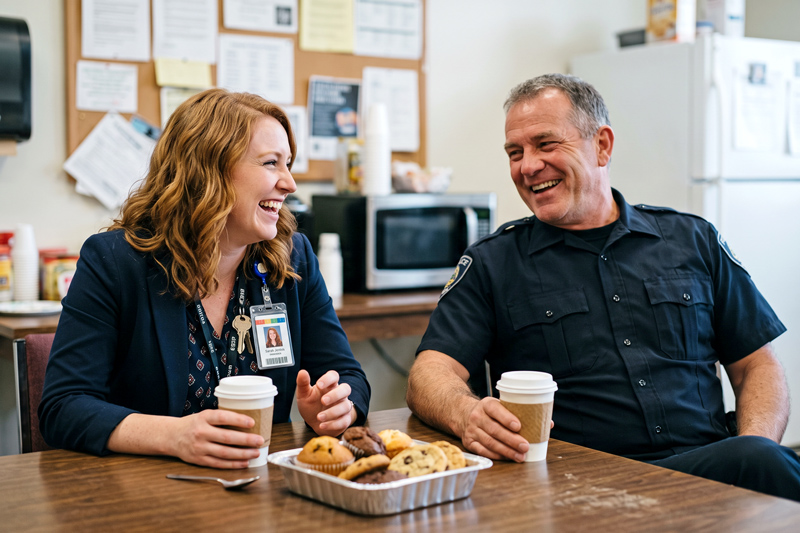
The police personality doesn’t necessarily clock out entirely when officers are off duty, but the protective shield may not be held as high. That’s where a lot of the real relationship-building happens: community events posted on an agency’s social media, charity drives, a coffee with a police officer. Clinicians can also invite police to their own events. None of this requires clinical language. Showing up with food. Sending a card after a rough call. The clinician I heard speak at CorCon described running potlucks with her department, inventing running jokes with individual officers, even a mock chemistry test as an icebreaker. Presence has to run both ways between clinicians and police, and you know it has landed when even the most guarded officer starts treating you as one of their own.
Some of the most valuable presence happens where you’re not strictly needed. Show up to responses even when there’s no clear clinical task waiting for you. In a seminar on this exact question, Dr. Medina Baumgardt described learning that just “being present” at a chaotic scene had a real effect on the people working in it, even when she felt like she wasn’t doing anything meaningful at all.
Why Embed a Clinician with Police?
Officers are the first point of contact for many individuals in crisis, and these calls are growing in complexity. We have the same crises, but the– response has changed to account for the context, not just the time spent on scene. Crises can stem from mental illness, domestic incidents, trauma, or substance use, among other things. As such, officers may find themselves in scenarios where they need skills beyond traditional law enforcement training. A police officer can only wear so many hats, and officers are increasingly thrust into situations they were never formally trained to handle.
A 2024 lawsuit against Washington County, Oregon alleges that over one year, the county sent armed officers as first responders to 100% of calls coded as behavioral health incidents, welfare checks, or suicide threats, despite having a mobile crisis team meant to be available around the clock.
For the health of both officers and patients, as well as for the sake of community trust, a change needed to be made. Embedding a clinician within a law enforcement team is an effective way to take stress off law enforcement officers while transitioning to more human-centered care. The goal is not to replace law enforcement officers, but to share the burden of responsibility.
A clinician is often a psychologist, social worker, counselor, or registered nurse
Here is a breakdown of their responsibilities:
Clinician
- Assess mental status, risk level, and capacity
- Lead verbal de-escalation and rapport-building
- Connect to social services, follow-up, and warm handoff
Officer
- Establish and maintain scene safety
- Secure weapons or address active threats
- Execute legal authority (holds, custody, warrants)
- Arrange transport when legally required
Clinicians help boost trust, cooperation, and the overall perception of law enforcement while providing support that preserves lives. However, as noted above, clinicians and law enforcement come from very different backgrounds, and failing to integrate the two properly can lead to negative consequences.
What the Wrong Law Enforcement Interactions Can Lead To
A police officer and clinician must be in complete alignment on their scope of practice and protocol when dispatched in the field. After a scene is declared safe by an officer, the clinician can then step in as needed to oversee interaction with the patient. During this time, the officer must think about their role placement in the scene. A Canadian analysis in IDPC describes how a lingering police presence can pressure patients into agreeing to care just to appear cooperative, and can leave patients believing their care team is aligned with police priorities rather than with them.
Unclear protocols can escalate into public conflict. The aforementioned Penn LDI brief cites a case in Utah where a nurse was arrested for refusing to draw blood, without a warrant, from an unconscious patient who could not provide consent. The fallout led the state legislature to limit when police can request blood samples, and the hospital system banned law enforcement from patient care areas.
In rarer cases, clinicians aren’t sent at all when they are needed most. The Joshua Wesley case in Washington County is one example. Disability Rights Oregon and the ACLU of Oregon sued the county and its 911 dispatch agency, arguing that by failing to make mental health professionals the primary responders to non-violent behavioral health crises, the county violated the Americans with Disabilities Act.
Conclusion
A clinician’s technical skills are an invaluable and much-needed tool in law enforcement, where calls are becoming more complex and mental health crises are increasingly common. But successfully integrating clinicians into law enforcement depends on understanding, alignment, presence, and culture-building, which begin months before a clinician even steps foot in the department. Without them, teams are unlikely to succeed, and neglecting culture can also doom a team. It is my hope that this article gives both officers and clinicians a starting point for building common ground. That is what turns the co-responder model into a unit with shared purpose and understanding instead of two distinct responders merely traveling to a call together.
The solution isn’t to transform a clinician into a police officer or a police officer into a clinician. Instead, success depends on both practitioners excelling at their unique responsibilities, trusting each other to perform theirs, supporting each other, and yielding to one another’s expertise. When that works, it protects the person in crisis, the officer’s career, and the clinician’s ability to keep doing the job without burning out.
This article was originally published by Policing Insight and is republished here with permission.

Noah Weinberg is based in Ontario, Canada, and is a Marketing Manager at Julota, where he focuses on elevating the alternative response space, specifically mobile integrated healthcare (MIH), community paramedicine, and co-responder models. He writes about the intersection of law enforcement, healthcare, and community wellbeing, drawing on real-world experiences with community paramedicine programs in Ontario and across North America. For more information, email [email protected] and visit julota.com.