Meeting people where they are is a core principle of harm reduction, yet traditional service models can’t reach everyone. Many obstacles still prevent people from accessing services, including transportation challenges, geographic isolation, limited hours, and concerns about stigma (“Encyclopedia of Social Work,” 2014). Applied to harm reduction, we propose that the environment falls short in four specific ways: access, information, coordination, and connection. This perspective article examines how technology-enhanced harm reduction serves to fill those gaps.
What Technology Enables
Access
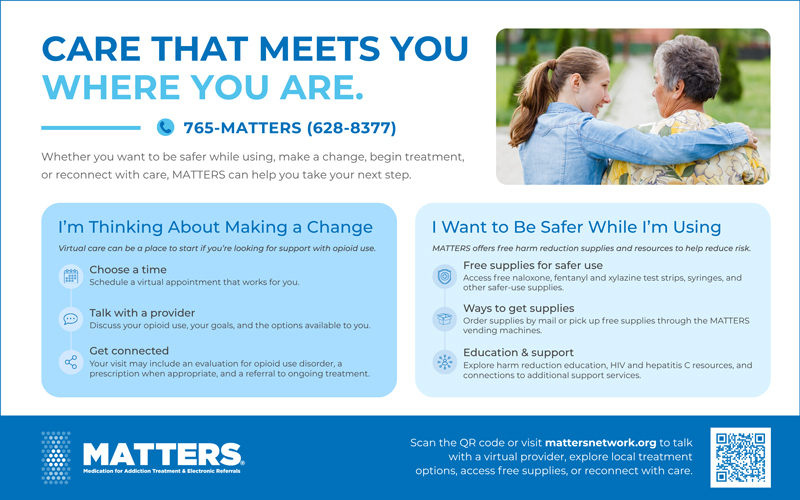
Accessing harm reduction services can require transportation, attendance during limited hours, or entering a setting where individuals may fear being recognized or facing stigma. Online ordering and mail-based distribution of harm reduction supplies allow individuals to request supplies without visiting an in-person site. Technology-enhanced programs like NEXT Distro combine online harm reduction education with mail-based distribution of naloxone and safer injection supplies (Yang et al., 2021). Similarly, MATTERS offers online pathways to obtain drug testing strips, naloxone, and safer injection supplies across New York State (MATTERS, 2026). However, this method depends on internet access, a reliable and safe delivery address, and the ability to wait for supplies to arrive.
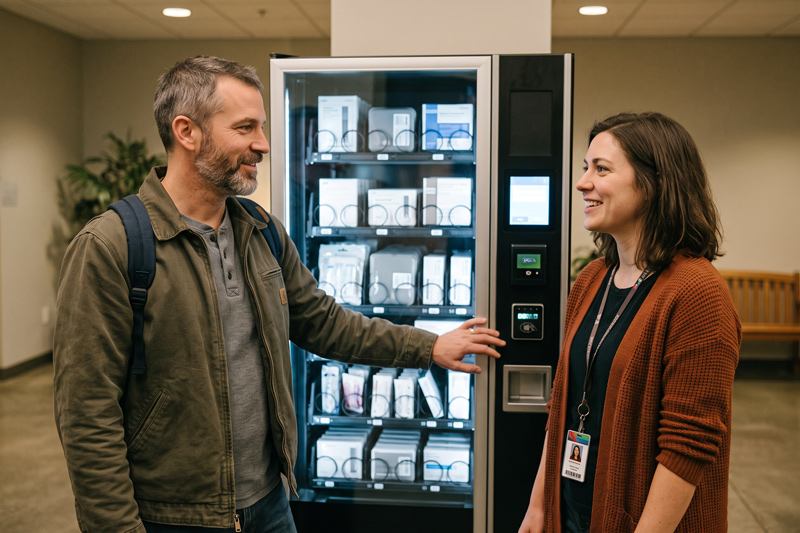
Harm reduction vending machines (HRVMs) provide another way to reach people who may be unable or unwilling to engage with traditional, face-to-face services. By extending supply access beyond staffed hours and avoiding the barriers related to technology access and shipping, these machines can provide a more convenient and discreet way to obtain supplies. Caracole in Cincinnati showed that automated distribution can complement existing services and reach people who are not yet established with harm reduction services (Arendt, 2022). MATTERS HRVMs showed that after-hours availability expands access, as almost half of all transactions (48%) happened during evenings and weekends (Thomas et al., 2025). However, machine placement, registration requirements, maintenance, and restocking all influence accessibility.
Information
Timely, accessible drug checking services support autonomy by allowing people to make more informed decisions about their drug use. Test strips can help identify certain substances, while more advanced equipment can provide additional information about what a sample contains. One example is the Fourier-transform infrared spectroscopy (FTIR), which can provide a broader analysis of a sample’s composition. Combining these technologies in community settings can bring drug checking closer to where and when people use drugs (Ti et al., 2020). In one study, 43% of surveyed participants reported changing their drug-use behavior after using fentanyl test strips, suggesting that drug checking can inform harm reduction decisions (Peiper et al., 2018).
Drug checking also has limitations. Detection thresholds and the substances each technology can identify mean that drug checking on its own cannot always determine potency, purity, and presence of various adulterants and cuts (Ti et al., 2020). Pairing drug checking with clear education and practical harm reduction support is essential.
Coordination
People who use drugs, especially those with co-occurring conditions such as HIV or hepatitis C, often rely on multiple services that may operate independently. This can require navigating different eligibility, intake, and documentation requirements. This fragmentation represents another gap in the environment that technology may help address.
Technology can reduce this fragmentation by improving coordination between harm reduction programs, treatment providers, and other support services. Systems that manage supply requests, treatment referrals, shipment tracking, and inventory can reduce administrative work and allow staff to spend more time engaging directly with participants (Zeremski, 2013). At MATTERS, an integrated platform supports harm reduction supply ordering, treatment referrals, and other service requests. This integration allows staff to have a holistic view of how a person is using the system and can more easily identify gaps in service without requiring a person to repeat themselves for each new resource. Leveraging these systems to do operational tasks like supply orders and reminder emails frees up staff time for the important work of relationship building. Aggregated data can also inform program planning, evaluation, and resource allocation, especially when combined with participant feedback.
The trade-off with enhanced record connection is the risk of sharing more information than is needed and requires enhanced security systems and staff protocols. Syringe service programs are anonymous by design, so programs should make it clear what data is being collected and linked and avoid any requirements that can make access more complicated.
Connection
Social isolation and previous experiences with stigma or unsuccessful attempts to access services can discourage people from seeking support. These experiences may also increase vulnerability to drug-related harm (Beck et al., 2024), so people who are wary of in-person services may find virtual access safer. At MATTERS, mail-based supply ordering can create opportunities for ongoing, low-pressure engagement with staff. When a participant expresses a need for additional support — whether that be additional supplies or a referral to treatment — this can be done without an in-person visit (Torres-Leguizamon et al., 2023). Technology can also connect people to one another. Safe Spot and Never Use Alone connect people using alone with peers by phone, who remain available while they use and can initiate an overdose response if the person becomes unresponsive (Rider et al., 2023).
Virtual Community Advisory Committees engage people with lived and living experience in identifying service barriers and informing program development, while online networks facilitate the exchange of harm reduction knowledge, resource information, and peer support among geographically dispersed communities (Brothers et al., 2024). Technology can make the initial connection easier, but meaningful engagement depends on the trust and relationships developed through ongoing interactions with clinicians, peers, and support staff.
Conclusion
Technology creates new pathways to harm reduction but does not remove every barrier, and in some cases, creates new ones. Mail-based and online ordering systems depend on internet access and a reliable delivery address and are not an immediate resource for people who need supplies now, which can make these programs unsuitable for individuals with unstable housing or limited connectivity. Data systems introduce additional risks that challenge anonymity, especially if programs are collecting more information than they need. For these reasons, technology-enhanced harm reduction works best as part of a larger system of care. The goal is not for tech to replace existing systems but to give more people a way in the door.
Through a person-in-environment lens, technology closes gaps that impact access to harm reduction services. We recommend that programs choose technology-based interventions that address the specific gaps in their environments, only collect the data they need, and build these programs to complement, not replace, existing services. Funders and policymakers can support the expansion of harm reduction by investing in technology-based infrastructure and amending laws that limit the reach of mail-based distribution. Researchers should examine how these programs are addressing environmental gaps and whether they are truly supplementing existing resources rather than replacing them. Technology can open more doors, but it is the staff and relationships that keep them open.




Shelby Arena, LMSW, is Harm Reduction Manager, Jenni Thurston, LMSW, is Harm Reduction Coordinator, and Mia Dickinson is Harm Reduction Program Lead at MATTERS. Joshua Lynch, DO, FACEP, is Professor of Emergency and Addiction Medicine at the University at Buffalo.
References
Arendt, D. (2022). Expanding the accessibility of harm reduction services in the United States: Measuring the impact of an automated harm reduction dispensing machine. Journal of the American Pharmacists Association, 63(1), 309–316. https://doi.org/10.1016/j.japh.2022.10.027
Beck, K., Pallot, K., & Amri, M. (2024). A scoping review on barriers and facilitators to harm reduction care among youth in British Columbia, Canada. Harm Reduction Journal, 21(1), 189. https://doi.org/10.1186/s12954-024-01063-1
Brothers, S., Simon, C., & Vincent, L. (2024). Community-Driven Research with People Who Use Drugs: A Virtual Project During Multiple Epidemics. Sociological Methodology, 55(1), 155–181. https://doi.org/10.1177/00811750241281063
Encyclopedia of Social Work. (2014). In Oxford University Press eBooks. https://doi.org/10.1093/acrefore/9780199975839.001.0001
MATTERS. (2026, July 15). Home – MATTERS Network. MATTERS Network. https://mattersnetwork.org/
Peiper, N. C., Clarke, S. D., Vincent, L. B., Ciccarone, D., Kral, A. H., & Zibbell, J. E. (2018). Fentanyl test strips as an opioid overdose prevention strategy: Findings from a syringe services program in the Southeastern United States. International Journal of Drug Policy, 63, 122–128. https://doi.org/10.1016/j.drugpo.2018.08.007
Rider, N., Safi, F., Marshall, T., Jones, S., Seo, B., Viste, D., Taplay, P. E., Rioux, W., & Ghosh, S. M. (2023). Investigating uses of peer-operated Virtual Overdose Monitoring Services (VOMS) beyond overdose response: a qualitative study. The American Journal of Drug and Alcohol Abuse, 49(6), 809–817. https://doi.org/10.1080/00952990.2023.2271642
Thomas, M., Vest, B., Arena, S., Painter, O. B., Chambers, M. K., Kirk, H., Clemency, B. M., & Lynch, J. J. (2025). Evaluating Community-based Harm Reduction Vending Machine Utilization in New York State. Journal of Addiction Medicine. https://doi.org/10.1097/ADM.0000000000001626
Ti, L., Tobias, S., Lysyshyn, M., Laing, R., Nosova, E., Choi, J., Arredondo, J., McCrae, K., Tupper, K., & Wood, E. (2020). Detecting fentanyl using point-of-care drug checking technologies: A validation study. Drug and Alcohol Dependence, 212, 108006. https://doi.org/10.1016/j.drugalcdep.2020.108006
Torres-Leguizamon, M., Favaro, J., Coello, D., Reynaud, E. G., Néfau, T., & Duplessy, C. (2023). Remote harm reduction services are key solutions to reduce the impact of COVID-19-like crises on people who use drugs: evidence from two independent structures in France and in the USA. Harm Reduction Journal, 20(1), 1. https://doi.org/10.1186/s12954-023-00732-x
Yang, C., Favaro, J., & Meacham, M. C. (2021). NEXT Harm Reduction: an online, Mail-Based naloxone distribution and Harm-Reduction program. American Journal of Public Health. https://doi.org/10.2105/AJPH.2020.306124
Zeremski, M. (2013). Hepatitis C virus control among persons who inject drugs requires overcoming barriers to care. World Journal of Gastroenterology, 19(44), 7846. https://doi.org/10.3748/wjg.v19.i44.7846