Nearly a million New Yorkers cannot access the mental health care they need. A broken workforce, a fraying safety net, and deep inequities are forcing the nation’s largest city to reimagine how — and for whom — mental health care is delivered.
The Emergency Room at Midnight
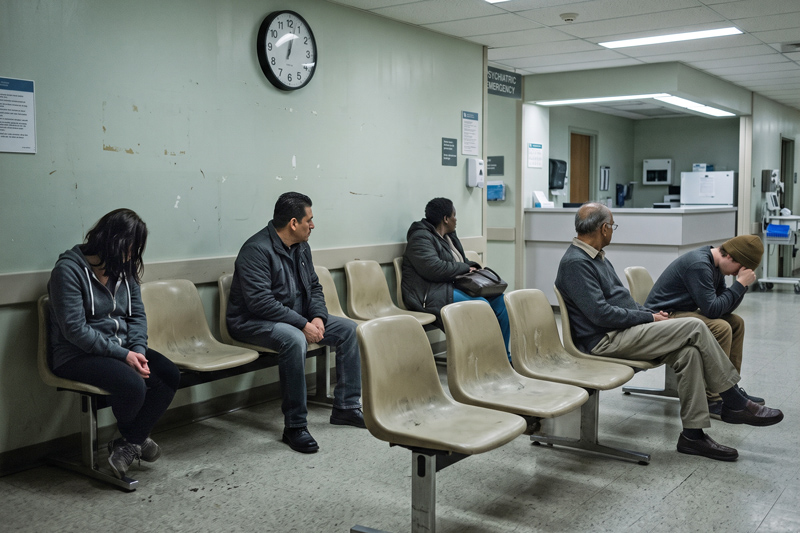
The fluorescent lights in the psychiatric wing do not distinguish between midnight and noon. They simply burn—flat, indifferent—over a row of molded plastic chairs that have not emptied for as long as the triage nurse can remember.
On a Tuesday evening in January, the waiting area of one of New York City’s large public psychiatric emergency units holds seventeen people. Some slump against the walls. Others sit rigidly upright, staring at nothing. A young man in a hoodie rocks forward and back with slow, metronomic persistence. A woman in her sixties speaks quietly but urgently to someone who is not there.
The staff—two nurses, a social worker, and a physician’s assistant—move through the room with the contained urgency of people doing three jobs at once. The attending psychiatrist is conducting simultaneous evaluations behind a closed door. A bed may not become available for hours, perhaps not until morning. The seventeen people in the chairs are not admitted. They are not refused. They are waiting, and waiting, in New York City’s public mental health system, has become a condition of its own.
This scene is not exceptional. It plays out nightly across the city’s Comprehensive Psychiatric Emergency Programs, in the hallways of Bellevue, Kings County and Elmhurst, and in neighborhoods where the nearest outpatient clinic may have a months-long waitlist.
New York City—the nation’s wealthiest and most densely resourced metropolis—is in the middle of a mental health crisis that is massive in scale, unequal in its burdens, and resistant to easy solutions.
The central problem is increasingly clear: the gap between the mental health care New Yorkers need and the care the system can actually deliver.
The Scope of Unmet Need
The numbers are staggering.
According to the New York City Department of Health and Mental Hygiene, approximately 945,000 adult New Yorkers—about 14 percent of the adult population—reported an unmet need for mental health treatment in 2023. Among adults who had already been diagnosed with a mental illness, 34 percent reported an unmet need for treatment.[1][2]
The same data provide an important counterpoint: 70 percent of adults with a diagnosed mental illness did receive treatment. But the remaining population represents tens of thousands of people cycling through crises, losing employment, straining families, and, too often, ending up in emergency rooms.
The geography of that unmet need is not random. The highest-poverty neighborhoods experience nearly three times as many psychiatric hospitalizations per capita as the lowest-poverty neighborhoods.[2] The disparity reflects not simply higher levels of mental illness, but the absence of earlier, less acute points of intervention.
When outpatient care is unavailable, inaccessible, or unaffordable, psychiatric emergencies become the default mode of treatment.
The emergency room becomes the clinic.
Among adults reporting unmet needs, barriers are layered. Fifty-seven percent reported multiple barriers to care, while 15 percent reported four or more.[1] Cost, inadequate insurance coverage, uncertainty about where to seek help, stigma, inconvenient hours, and difficulty navigating telehealth can each become an obstacle.
Individually, these barriers are manageable. Together, they form a wall.
The Workforce Crisis
Behind every unmet appointment is a missing clinician.
The workforce shortage is not new, but since the pandemic it has intensified. In fiscal year 2024, mental health positions within the NYC Department of Health and Mental Hygiene carried a 40 percent vacancy rate.[3][9] Four of every ten budgeted positions were unfilled.
The problem extends throughout the nonprofit sector, which delivers much of the city’s community-based mental health care. Human service organizations reported average workforce vacancy rates of 15.6 percent, with some clinical positions experiencing vacancy rates of 30 to 45 percent.[4] The consequences are predictable: fewer clinicians, larger caseloads, longer waits, and less time with each patient.
The practitioners who remain face burnout, secondary traumatic stress, and what clinicians increasingly call moral injury—the anguish of knowing what patients need but being unable to provide it. Higher-paying private-sector jobs offer an escape. Those who remain in the public system inherit the caseloads left behind. The cycle feeds itself. Patients receive insufficient care, conditions worsen, and emergency departments absorb the consequences.
There are, however, reasons for optimism. NYC Health + Hospitals reported that behavioral-health staff turnover fell to 8 percent in 2025, from nearly 18 percent in 2022, following targeted recruitment and retention efforts.[5] That improvement demonstrates something important: investment in the workforce can produce measurable results.
The question is whether the city will invest at the scale required.
Racing to Close the Gap
Against this backdrop, New York has begun constructing a more responsive crisis system.
One of its most visible initiatives is the Behavioral Health Emergency Assistance Response Division (B-HEARD), a program in New York City that pairs mental health professionals with emergency medical personnel to respond to certain 911 mental-health calls that historically might have received a police-only response. The philosophy is simple but consequential: a person experiencing psychiatric distress is not automatically a police problem.
The early results are encouraging. According to NYC Health + Hospitals, 91 percent of B-HEARD recipients said the response was more appropriate for their needs than traditional EMS, while 99 percent said they were treated with courtesy and respect.[5]
The city’s Comprehensive Psychiatric Emergency Programs served approximately 11,400 patients and recorded 20,300 crisis visits in 2025.[5] A new Behavioral Health Transfer Center completed more than 600 patient transfers, an effort intended to reduce the prolonged waits associated with inpatient placement.
But the numbers also reveal how little slack exists in the system. New York City maintains approximately 1,090 inpatient psychiatric beds, with an average daily census of about 950.[5] A relatively modest surge in demand can therefore create significant pressure.
Outpatient services have shown improvement as well. Scheduled behavioral-health visits increased 12 percent in 2025, while completed individual visits rose 9 percent.[5] Crisis Follow-up Services, designed to support patients after discharge and prevent repeated emergency visits, are now operating at Bellevue, Elmhurst, Kings County, and Queens, with additional hospitals planned for expansion. These are genuine improvements, but they should not be confused with resolution.
New York has built a better crisis-response system while still confronting a shortage of the community-based care that might prevent those crises in the first place.
The Equity Divide
The crisis is not experienced equally.
Black, Latino, and Asian American and Pacific Islander New Yorkers are less likely to be connected to mental health care than white New Yorkers, reflecting differences in access, stigma, language, culture, and economic security.[1][2] Latino adults were nearly twice as likely as white adults to identify stigma as a barrier to treatment—17 percent compared with 10 percent. Among AAPI adults, the figure was 22 percent.[1] Cultural and language mismatch presents another barrier. Ten percent of Latino adults and 15 percent of AAPI adults identified it as an obstacle, compared with only 4 percent of white adults.[1]
The inequity becomes especially stark among children.
More than half of New York City residents—56.2 percent—reported difficulty accessing mental health care for children ages three through seventeen. Among families with at least one foreign-born parent, the figure rose to 64.6 percent. For families whose first language was not English, it reached 69.3 percent.[3][10] The supply problem is particularly acute in child psychiatry. Child and adolescent psychiatrists are concentrated heavily in Manhattan, leaving many outer-borough communities underserved.[3][8]
A city cannot claim an equitable mental health system when geography, language, and income determine who can reach a clinician.
The Budget Battlefield
Ultimately, reform depends on money.
New York City’s FY2026 budget allocates $512.3 million for mental health services, along with $159.1 million for alcohol and drug-use prevention and $9.5 million for developmental-disabilities programming.[6]
Yet the broader fiscal picture is troubling.
The Department of Health and Mental Hygiene’s proposed Mental Hygiene budget totaled $713.7 million—$83.5 million below the FY2025 adopted budget.[6] The reduction comes as federal American Rescue Plan funding that supported pandemic-era mental health programs expires. This creates a fundamental problem: programs developed with temporary federal money must now find permanent funding or contract, even though the need they were created to address has not disappeared.
The City Council called for $183 million in additional FY2026 mental health funding, including support for Mobile Treatment Centers, Mental Health Clubhouses and intensive case management.[7] Most of those requests were not included in the Executive Budget.
The staffing picture is equally troubling. The NYC Department of Health and Mental Hygiene’s (DOHMH) FY2026 budgeted headcount was 591 full-time positions; actual headcount in January 2025 was 489, with 194 vacancies.[6] A department charged with protecting the mental health of more than eight million New Yorkers is operating with a substantial portion of its authorized workforce missing.
What Comes Next
The Mayor’s Office of Community Mental Health has laid out a credible roadmap: clearer career paths for community health workers and peer specialists, expanded access to clinical training, greater investment in BIPOC-led organizations, expanded telehealth, and continued growth of B-HEARD.[3]
Supportive housing is also critical. Stable housing is not merely a social benefit; for people living with serious mental illness, it can be a prerequisite for sustained treatment and recovery.[2] But reform will be slow, and political commitment is not guaranteed.
The fundamental imbalance remains: New York continues to devote enormous resources to responding to mental health crises while struggling to provide enough community-based services to prevent them. The past several years have at least produced something valuable: clarity.
The city’s own data now reveal the scale of unmet need, the workforce shortage, the racial and geographic inequities, and the budgetary constraints. New York knows where the gaps are. It knows who is most likely to fall through them. The question is whether the city has the political will and sustained financial commitment to close those gaps. The answer will not be found in another report or another strategic roadmap. It will be measured in something much simpler: whether the seventeen people sitting in those plastic chairs—and the hundreds of thousands of New Yorkers they represent—finally have somewhere to go.

Bruce Collins, PhD, is a retired Professor of Economics at Fordham University and a Senior Financial and Investments Writer at MLC Financial Consulting. He can be reached at [email protected] or on LinkedIn at linkedin.com/in/brucemcollins.
References
- NYC Department of Health and Mental Hygiene. Barriers to Mental Health Treatment among New York City Adults, 2023. NYC Vital Signs, Vol. 22, No. 2. May 2025.
- NYC Mayor’s Office of Community Mental Health. 2025 Annual Report. January 2025.
- NYC Mayor’s Office of Community Mental Health. Bridging the Gap: Challenges and Solutions for a Thriving Behavioral Health Workforce. January 2025.
- Center for an Urban Future. Cited in OCMH, Bridging the Gap White Paper, 2025. Original report: 2024.
- NYC Health + Hospitals. Behavioral Health Blueprint: Second Year of Achievements. 2025 Annual Report. Published 2026.
- NYC City Council, Finance and Health Committees. Department of Health and Mental Hygiene—Mental Hygiene: Fiscal 2026 Preliminary Plan Budget Report. March 2025.
- NYC City Council. Fiscal 2026 Budget Response: Department of Health and Mental Hygiene. 2025.
- American Academy of Child and Adolescent Psychiatry. State data on child and adolescent psychiatrist supply, 2023. Cited in OCMH, Bridging the Gap White Paper.
- NYC Comptroller’s Office. Government Vacancy Report. June 2024. Cited in OCMH, Bridging the Gap White Paper.
- National Survey of Children’s Health, 2022. Cited in OCMH, Bridging the Gap White Paper.