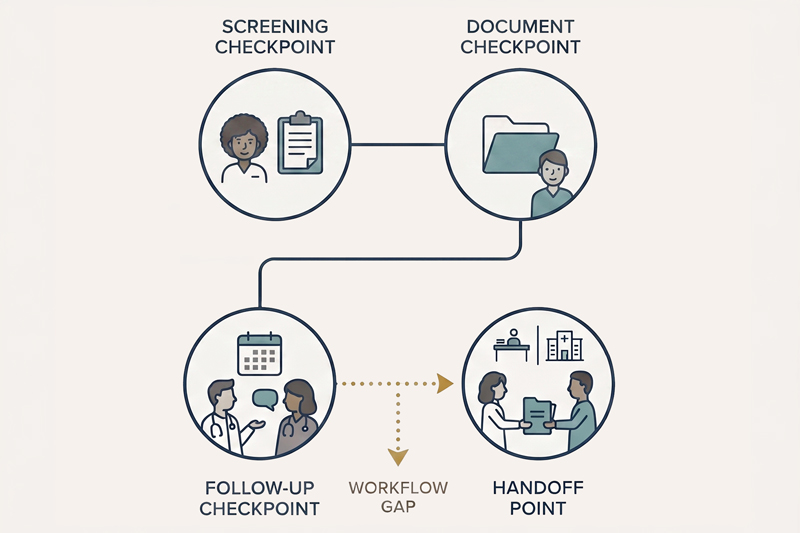
Many frontline behavioral health teams are expected to deliver suicide-safer care inside systems that were not built to support it. Staff are asked to screen for suicide risk, complete additional assessment when needed, create or update safety plans, coordinate handoffs, complete follow-up, and document what happened. But too often, the electronic health record does not make those steps easy to see, complete, or track. A positive screen may be buried in a note. A safety plan may be scanned into the chart where it is hard to find or revise. A follow-up task may live on a spreadsheet outside the record. A person may move from one program, clinic, emergency department, inpatient unit, or community-based service to another without the next team clearly seeing the current risk concern, safety plan, or follow-up need. This is not a problem of motivation. Most people delivering care want to do the right thing. The problem is that the system may not support them. Suicide prevention policy can say what should happen, but daily workflow determines whether it actually happens. People delivering care should expect their systems to support suicide care, and when those systems do not, that gap needs to be named, shared, and fixed.
Good suicide care should not depend on memory, workarounds, extra clicks, scanned forms, or one staff person keeping track of everything alone. The need is urgent. CDC’s National Center for Health Statistics reports 48,824 suicide deaths in the United States in 2024, with suicide ranked as the 10th leading cause of death.¹ The Joint Commission’s suicide risk reduction expectations include many of the steps organizations are trying to make reliable, including validated screening, evidence-based assessment after a positive screen, documentation of risk and a mitigation plan, policies for care and reassessment, counseling and follow-up at discharge, and monitoring of implementation and effectiveness.² For frontline teams, these are not just compliance requirements. They are real care steps that require a working system around them. So the practical questions become: When someone screens positive, does the system make that visible? Does it guide the next step? Does it help document the assessment or safety action? Is the safety plan easy to find, review, update, print, or share when appropriate? Is follow-up assigned to someone? Can the team tell whether follow-up actually happened? If the answer is no, the issue is not just documentation. It is a care gap. SPiER works in this gap between what suicide care should include and what current systems actually make possible. SPiER does not replace clinical judgment, create a new suicide care model, or tell every organization to use one exact tool. The field has already identified many of the essential elements of high-quality suicide care. SPiER helps translate those elements into practical technology guidance: what systems need to capture, what should be visible, what should prompt the next step, what should be easier to track, and what information should follow the person across settings when allowed by policy and consent.
Frontline teams do not need to solve the entire electronic health record or health technology system to begin advocating for improvement. Start by naming where the workflow breaks. A useful question is not only, “Do we screen for suicide risk?” It is, “What happens after someone screens positive?” A useful question is not only, “Do we have a safety plan form?” It is, “Can staff find it, review it, revise it, and use it with the person when they need it?” A useful question is not only, “Do we require follow-up?” It is, “Can we tell who owns follow-up, whether it happened, and what we do when it does not?” Those questions can become concrete requests to supervisors, quality improvement teams, informatics staff, electronic health record support teams, and organizational leaders: We need the positive screen to trigger the next assessment task. We need the safety plan to live somewhere staff can find it later. We need a way to review and update the safety plan, not just scan it once. We need follow-up tasks to have an owner and a status. We need a report that shows whether people identified at risk received the next step in care. These are not abstract technology requests. They are patient safety requests.
Evidence-based practices can make a difference when they are implemented reliably. Safety planning with structured follow-up, for example, has been associated with reduced suicidal behavior and increased treatment engagement among patients treated in emergency department settings.³ But the value of any evidence-based practice depends on whether staff can reliably know who needs it, where it lives, whether it was completed, and what still needs to happen. Technology will never replace human connection, judgment, or relationship-based care. People save lives. But systems can either support people in doing that work or leave them to carry the burden alone. If your electronic health record supports suicide care well, that example matters. If it makes suicide care harder, that matters too. SPiER wants to hear from people delivering care about what is working, what is missing, and what needs to change so suicide care can happen more reliably in everyday practice.

Kelly Samuelson, MSW, LADC, is the Project Director of SPiER at Zero Overdose. She can be reached at [email protected] or theSPiERproject.org.
Footnotes
- Centers for Disease Control and Prevention, National Center for Health Statistics. Suicide and Self-Harm Injury. FastStats.
- The Joint Commission. Suicide Risk Reduction Resource Center.
- Stanley, B., Brown, G. K., Brenner, L. A., et al. Comparison of the Safety Planning Intervention with Follow-up vs Usual Care of Suicidal Patients Treated in the Emergency Department. JAMA Psychiatry, 75(9), 894–900 (2018).