When our behavioral health, housing, and social service systems are unable to adequately meet the needs of people with serious mental health challenges, those individuals too often find their way into the criminal justice system without the treatment and support they need.

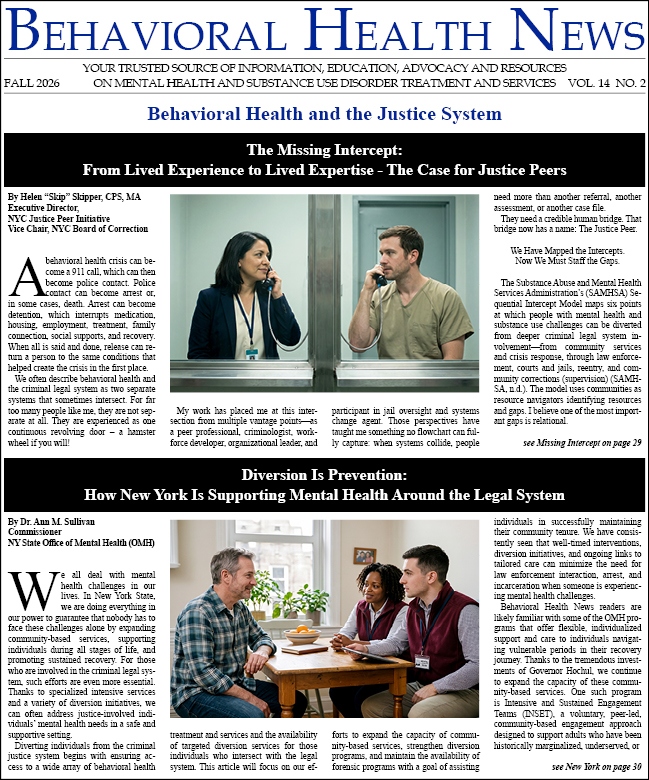
Institute for Community Living staffers and participants inside ICL’s East New York HUB. Photo courtesy of ICL.
The path to incarceration often begins with months or years of instability, repeated hospitalizations, difficulty engaging in traditional treatment, or gaps between levels of care. When the right support is not available at the right time, a behavioral health crisis can escalate into a 911 call, a police encounter, and, ultimately, an arrest.
In New York and other municipalities across the country, there is an ongoing effort to respond to 911 calls involving behavioral health crises with services instead of cuffs, but those efforts, I believe, come too late.
If we want to reduce the number of people with serious mental health challenges encountering law enforcement and the criminal justice system, we need to pay much more attention to what happens before that encounter. We also need to pay attention to what happens after someone becomes stable following a crisis.
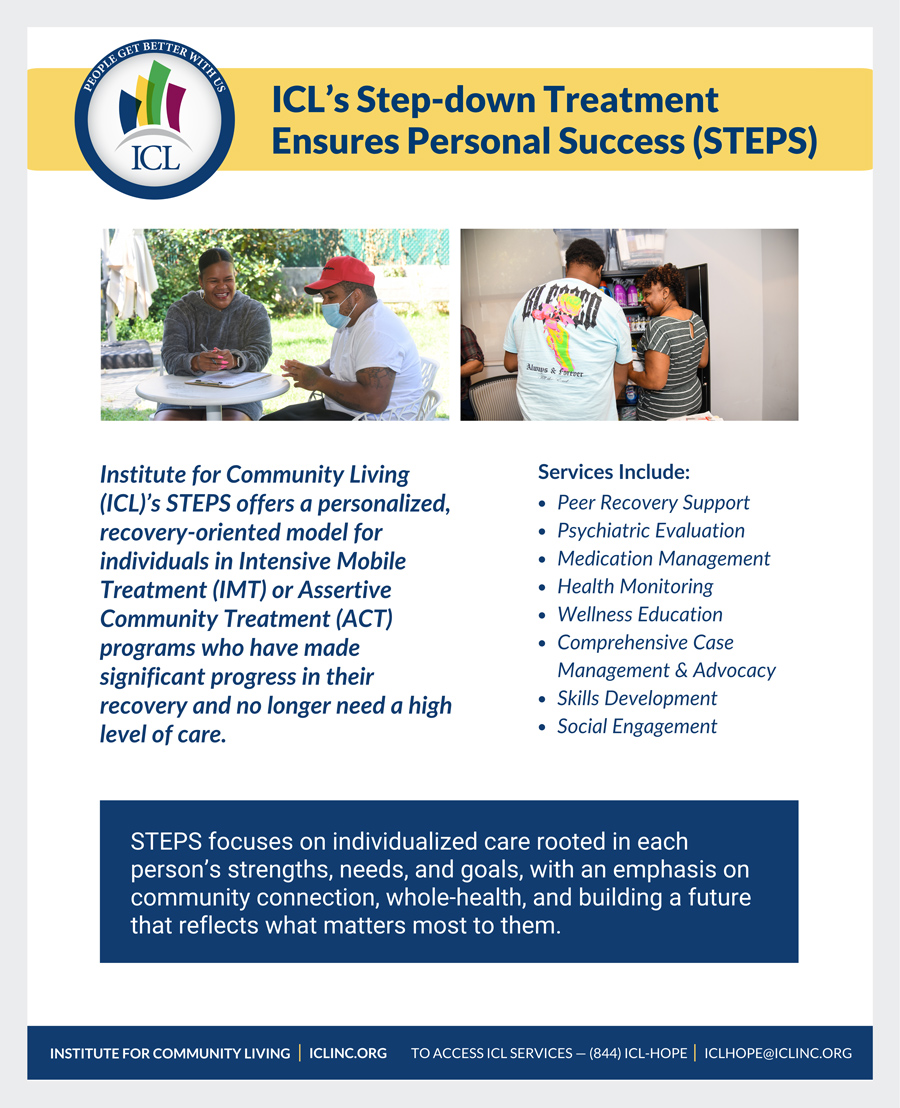
At the Institute for Community Living (ICL), I oversee Assertive Community Treatment (ACT), Intensive Mobile Treatment (IMT), and Step-down Treatment Ensures Personal Success (STEPS), among other community-based programs. Overseeing these programs has given me a close view of the work our staff does every day and the importance of having different levels of care available as people’s needs change.
No single program can prevent every crisis or instance of justice involvement. But when the continuum of care is strong, we have more opportunities to reach people before a crisis escalates, provide intensive treatment in the community, and help them maintain stability as their needs change.
Reaching People Others Cannot
For some people with the most complex behavioral health needs that have gone unaddressed for years, the first challenge is establishing a connection to care. Two intensive care models help reach this population in New York: the City’s IMT program and the State’s ACT program. Thousands of New Yorkers need this level of care.
Our 13 IMT and ACT teams bring multidisciplinary behavioral health care directly into the community, reducing the need for people with serious mental health challenges to navigate multiple offices, providers, and systems on their own.
The funding models for these programs allow us to provide ongoing support without an arbitrary cutoff date. IMT teams maintain smaller caseloads, allowing them to provide the most intensive level of community-based care and support, while ACT teams provide similarly comprehensive care at a lower level of intensity. Staff work with people wherever they are — in hospitals, shelters, apartments, coffee shops, parks, or on the street — and can continue supporting them for years as their needs change. After hours, people can access their team via an emergency on-call phone for additional support. This flexibility helps connect people not only to behavioral health treatment and medication, but also to physical health care, food, family connections, public benefits, clothing, and other essential supports.
But one of the most important things we provide is time.
Many people we serve through IMT and ACT have experienced trauma and difficult interactions with institutions. Police encounters, incarceration, involuntary hospitalization, and years of difficult experiences navigating systems can make someone understandably reluctant to trust yet another person offering help.
IMT gives our teams the flexibility to start by building a relationship with the person in our care. Sometimes that process takes weeks. Sometimes it takes months or even years.
That persistence matters. Once we establish a relationship, we can provide the care a person needs and help them rebuild their lives. As a result, people in IMT and ACT experience greater stability, while IMT data also show reduced justice-system involvement.
According to New York City Department of Health and Mental Hygiene data from 2025, jail admissions among IMT participants declined from 18% in the year before enrollment to 13% in their most recent year in the program, while the percentage who were stably housed increased from 38% in their first year of IMT to 61% in their most recent year. ICL’s 2025 data similarly show that 74% of ACT participants avoided recent psychiatric emergency room visits and 77% adhered to their medication.
But even effective programs like ACT and IMT cannot fulfill that role if people cannot access them. Today, approximately 1,300 New Yorkers are on waitlists for ACT or IMT services. At the same time, some people enrolled in these intensive programs have become stable enough that they no longer require the same level of support.
For years, there was nowhere appropriate for many of them to go next.
The result was a bottleneck: people who had stabilized remained in intensive services because stepping down could mean losing too much support, while people with more acute needs remained on waitlists.
The Missing Step
ICL created STEPS in 2023 to fill that gap.
STEPS supports people transitioning from ACT and IMT who have achieved greater stability but are not yet ready for traditional outpatient care. The level of support changes, but their connection to care does not.
That distinction is critical. Becoming more stable should not mean suddenly losing the services that helped someone get there.
We have seen promising results. During their time in STEPS, 97% of participants were housed, 89% were not hospitalized, and 86% did not visit an emergency room. And, remarkably, 100% avoided incarceration while participating in the program.
STEPS allows people who no longer need the intensity of ACT or IMT to move forward while creating capacity for others who urgently need those services. New York City recently invested $4.5 million to expand the model citywide.
STEPS has allowed us to expand the behavioral health continuum so people have somewhere appropriate to go as their needs evolve.
STEPS is just one example. Because recovery is not linear, we need more types of “right-sized” interventions available to meet people’s evolving needs and help them remain stable.
Before the Justice System Intervenes
Conversations about behavioral health and the criminal justice system often focus on moments of crisis: What happens when police respond to someone experiencing psychiatric distress? How can we divert people from jail? What services are available when someone returns to the community after incarceration?
Those questions are critical. But in my work, I have learned to ask another set of questions.
What happened in the weeks, months, or years before someone reached that point? Could they access intensive community treatment when they needed it? Was there a team willing to spend months building trust? Did someone help them maintain housing, connect with a doctor, or navigate benefits? And when they became more stable, was there somewhere for them to go without losing support altogether?
Community-based behavioral health care cannot eliminate every interaction with the criminal justice system.
But too often, jails become places where behavioral health needs are parked. That can be more disruptive and traumatic, further destabilizing someone in crisis.
We can do better by investing earlier and staying involved longer.
Our experience at ICL has shown me that this requires a continuum. IMT gives us the time and flexibility to build trust with people traditional systems have struggled to reach. ACT provides intensive treatment where people live their lives. And STEPS allows people who have achieved greater stability to move forward without asking them to navigate recovery alone.
These are different levels of support for different moments in a person’s life. Together, they reinforce a larger lesson: reducing unnecessary justice involvement cannot be the responsibility of the justice system alone.
Sometimes, one of the most meaningful ways to keep someone from entering the criminal justice system is to make sure the behavioral health system never loses them in the first place.

Laura Savino, LCSW-R, is Senior Vice President of Care Management at Institute for Community Living (ICL). For more information, email [email protected] or visit iclinc.org.
References
New York City Department of Health and Mental Hygiene. (2025, December 17). Testimony before the New York City Council Committee on Mental Health, Disabilities and Addiction: Evaluating and Measuring Outcomes and Equity in Mental Health.