

For decades, jails and prisons have functioned as the nation’s largest, and least appropriate, providers of mental health and substance use treatment. People with untreated serious mental illness (SMI) and substance use disorders (SUD) often move repeatedly through arrest, incarceration, release, and re‑arrest — a cycle driven by the absence of consistent, community‑based treatment that could interrupt this pattern. The Certified Community Behavioral Health Clinic (CCBHC) model was designed in part to change that trajectory, and a growing body of evidence suggests it is working.
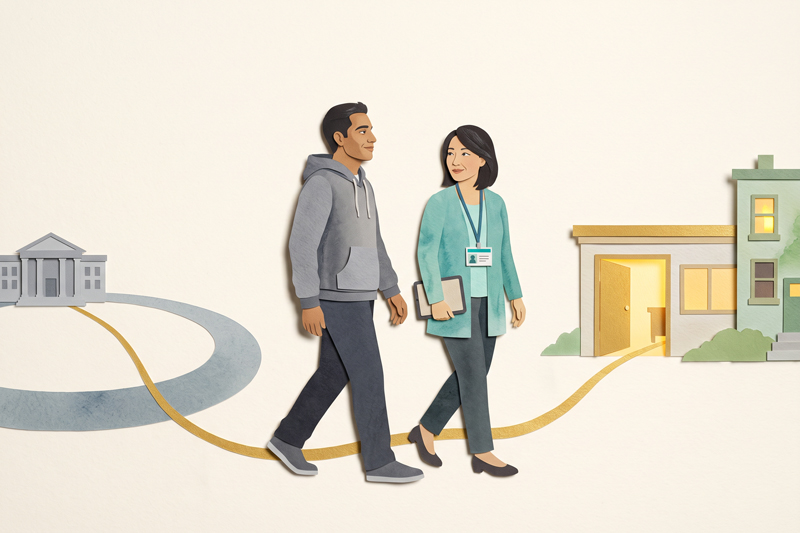
What Is a CCBHC?
CCBHCs are community behavioral health organizations that receive enhanced, cost-based Medicaid reimbursement or federal grant funding in exchange for meeting rigorous federal standards. Unlike traditional community mental health centers, CCBHCs are required to provide a defined scope of nine core services — including 24/7 crisis services — to anyone who walks through the door, regardless of ability to pay, insurance status, or age.
That “no wrong door” mandate matters enormously for justice‑involved populations, who are disproportionately uninsured, underinsured, or experiencing inconsistent coverage. The CCBHC model has grown rapidly, from an eight‑state demonstration to more than 500 clinics across 46 states.¹ As the model expands, its accessibility and coordination requirements have become increasingly important for justice‑system partners seeking alternatives to arrest and detention.
The Justice System Connection Is Built Into the Model
Justice system collaboration isn’t a peripheral benefit of the CCBHC model; it’s a structural requirement. CCBHCs are required to work with law enforcement agencies and other criminal justice partners specifically to help reduce incarceration, and the data on engagement reflects that mandate. Recent National Council for Mental Wellbeing impact reporting found that CCBHCs frequently focus their outreach on people involved in, or at risk of entering, the criminal justice system; nearly 81 percent report specialized programming for this group. This emphasis reflects recognition of the substantial behavioral health needs within justice‑involved populations and a deliberate effort to expand access, reduce barriers, and strengthen connections to care.1

This engagement spans the full Sequential Intercept Model (SIM), the framework used across the justice field to map opportunities for diverting people with behavioral health needs away from deeper system involvement:2
- Intercept 0 (Community Services): CCBHCs participate in mobile crisis response or co-response with law enforcement, giving 911 systems and 988 crisis lines an alternative to a police-only response.
- Intercept 1 (Law Enforcement): CCBHCs can engage in co-response efforts with law enforcement and many train law enforcement and corrections officers in Mental Health First Aid, Crisis Intervention Team practices, or other behavioral health awareness curricula, building the skills officers need to de-escalate and redirect rather than arrest.
- Intercepts 2 & 3 (Courts and Jails): CCBHCs collaborate with law enforcement, jails, and courts to divert people with behavioral health needs from the justice system. Through pre‑booking screenings, data‑driven identification, and partnerships with specialty courts and deferred prosecution programs, they connect individuals to treatment instead of further criminal justice involvement.
- Intercepts 4 & 5 (Reentry and Community Corrections): Continuity-of-care requirements mean CCBHCs are positioned to engage with individuals upon release, reducing the treatment gap that so often precedes reoffending.
These structured intercepts aren’t theoretical; they translate into measurable reductions in recidivism with justice involvement.
The Positive Impact
The logic linking behavioral health access to incarceration rates is straightforward: police and sheriff’s departments routinely absorb the cost of responding to and transporting people in behavioral health crises, a burden that falls on public safety budgets rather than health systems. At the individual level, a relatively small group of people drives a disproportionate share of these costs by cycling repeatedly through crisis, arrest, detention, and release.
Reducing incarceration is not primarily about diverting first‑time or low‑level offenders; it’s about disrupting the revolving‑door pattern within this high‑utilization population through sustained, coordinated treatment. CCBHCs are designed to do exactly that. Their care coordination requirements create a single point of accountability that follows a client across settings — crisis stabilization, outpatient care, primary care, and social service referrals — rather than leaving coordination to chance or to already overextended public defenders or probation officers.
While many behavioral health organizations, outside of and prior to the CCBHC model, have had community partnerships for outreach, evidence suggests that the CCBHC model has pushed organizations to deepen those partnerships for stronger impact in their communities.3 This shows up concretely at the state level.
Some states, such as New York, stipulate within their policies that the CCBHC is required to secure partnerships and establish protocols with justice system agencies for both adult and youth populations.4
In Missouri, the Community Behavioral Health Liaison (CBHL) model has substantially strengthened collaboration between behavioral health providers and justice‑system partners. CBHLs function as a direct conduit to care for individuals with behavioral health needs who frequently interact with law enforcement and the courts, helping connect them to timely, community‑based services that reduce repeated justice involvement.5
CCBHCs address housing instability, unemployment, chronic medical conditions, and other social determinants that increase the likelihood of justice involvement. Integrated care reduces risk factors for arrest and supports long‑term stability. As these partnerships expand, the operational demands on clinics grow as well, requiring careful attention to the infrastructure that supports cross‑system collaboration.
Compliance Considerations for CCBHCs Engaged in Justice-System Collaboration
Justice-system partnerships create real opportunities for CCBHCs, but they also introduce compliance exposure that clinics need to remain aware of. Cross-agency data flows, diversion-specific documentation, and justice-adjacent billing all raise the stakes for programs that may not have built these safeguards into their original compliance infrastructure.
Accurate Documentation of Crisis and Diversion Encounters – Clear, complete documentation is essential for capturing clinical decision-making, risk assessment, and diversion outcomes. Records must reflect the full scope of crisis services delivered, including stabilization efforts, safety planning, and referral pathways. This is particularly important where a diversion decision substitutes for an arrest or citation — documentation may later be reviewed by courts, oversight bodies, or auditors, and gaps can undermine both the clinical record and the defensibility of the diversion itself. Accurate documentation also supports defensible coding, appropriate reimbursement, and transparent reporting of justice system partnership activities to state CCBHC programs and SAMHSA.
Data-Sharing and Privacy Compliance – Cross-system collaboration requires strict adherence to HIPAA, 42 CFR Part 2, and minimum-necessary disclosure standards, and justice partners often operate under different confidentiality expectations than healthcare entities, which raises the risk of inadvertent overdisclosure. CCBHCs must maintain structured workflows for obtaining authorization and consent for disclosure, understanding that justice system partners are outside of defined treatment/payment/operations (TPO) pathways. Particular caution is warranted with SUD treatment records under Part 2, where consent and re-disclosure rules are more restrictive than general HIPAA requirements and where law enforcement partners may not be familiar with those distinctions.
Quality Metrics and Performance Reporting – CCBHC quality measures directly influence justice-related outcomes and are increasingly scrutinized by states and SAMHSA as justice collaboration becomes a more visible part of the model. Accurate reporting allows CCBHCs to demonstrate the impact of diversion strategies, identify gaps, and support continuous improvement, but it also means these metrics are audit-relevant. Clinics should treat justice-related outcome data with the same rigor applied to clinical quality measures more broadly.
In my work supporting CCBHCs, documentation and data capture around crisis and diversion encounters are areas where strong clinical practice isn’t always fully reflected in the record. Providers are doing the work, often at a high level, but the documentation, consent workflows, and reporting pathways don’t always keep pace with the complexity of cross‑system collaboration. Strengthening these processes is not only a compliance safeguard; it ensures clinics can demonstrate the full impact of their justice‑system partnerships to state programs, SAMHSA, and community stakeholders.
Conclusion
CCBHCs were created to improve access to care and alleviate fractured infrastructures in behavioral health — one being a long‑standing systems failure: the reliance on jails and prisons to absorb the consequences of untreated behavioral health conditions. By pairing comprehensive services with crisis response capacity and formalized justice‑system partnerships, the model replaces reactive, enforcement‑driven responses with coordinated, accountable care. The evidence emerging from states and national reporting shows that this approach is not only feasible; it is shifting outcomes for people who have historically cycled repeatedly through crisis, arrest, and incarceration.
As CCBHC adoption continues to expand, and as states refine expectations around diversion and performance reporting, clinics are positioned to play an even more central role in reducing justice involvement and strengthening community‑based treatment pathways. The model’s core design offers a durable framework for interrupting the revolving‑door pattern that has burdened individuals, families, and public safety systems for decades. Continued investment in these clinics, and in the infrastructure that supports their justice‑system collaboration, will be essential to sustaining this progress and realizing the full potential of a community‑driven alternative to incarceration.

Veronica Richardson, MHA, RHIA, CHPS, CHC is a Senior Compliance Consultant with First Class Solutions, Inc. Learn more at www.FirstClassSolutions.com or contact her at [email protected].
References
- National Council for Mental Wellbeing. (2026). 2026 CCBHC impact report. thenationalcouncil.org/resources/2026-ccbhc-impact-report/
- Beckerson, B. (2026, July). Certified Community Behavioral Health Clinics and criminal justice system collaboration. Substance Abuse and Mental Health Services Administration. samhsa.gov/sites/default/files/ccbhc-criminal-justice-system-pep26-01-019.pdf
- Wallace, N., Gelmon, S., Baker, R., Kihn-Stang, A., Crawford, A., & Young, E. (2023). Evaluation of the Oregon Certified Community Behavioral Health Clinic (CCBHC) Program: Final report. Oregon Health & Science University–Portland State University School of Public Health. oregon.gov/oha/HSD/BHP/Documents/CCBHC-Evaluation-Final-Report.pdf
- New York State Office of Mental Health. (2024). Certified Community Behavioral Health Clinic (CCBHC) provider manual. ny.gov/omhweb/bho/ccbhc-provider-manual.pdf
- Missouri Department of Mental Health. (2025, July). Community Behavioral Health Liaison (CBHL) infographic. mo.gov/media/pdf/cbhl-infographic


