

For decades, New Yorkers dealing with mental health and substance use issues have been funneled into our jails and prisons and denied the treatment they need to get better. Far too often, local correctional facilities end up serving as the default mental health provider. New York is not alone in this issue. Nationwide, an estimated 44% of people in jails and 37% of people in prisons have a mental illness, and an estimated 65% of people in prisons have an underlying substance use disorder (SUD). In the veterans’ community, 55% of the nearly 50,000 veterans incarcerated in local jails report experiencing a mental illness.
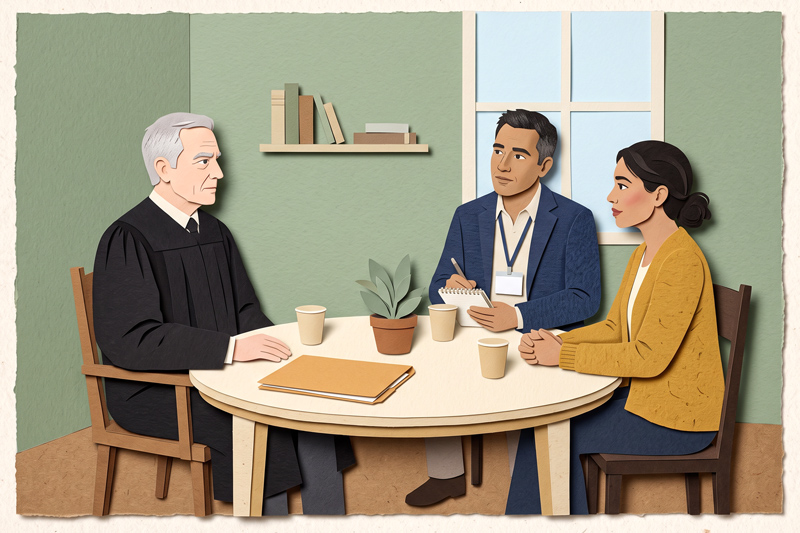
Mental illness is not a crime, but untreated symptoms and limited access to care lead many people to get caught up in the criminal legal system. A number of organizations are leading the charge to divert mental health calls away from law enforcement and to expand treatment options that offer opportunities for intervention before mental health issues decompensate into crisis — including efforts to enforce mental health parity and reduce delays in access to care. Still, instances of psychosis, crisis, substance use, and other behavioral health emergencies will inevitably arise. So the question remains: what happens when behavioral health and the justice system meet?
Mental Health Courts (MHCs) seek to improve safety, court operations, and the well-being of justice-involved individuals living with mental illness by linking them with court-supervised, community-based treatment. They provide off-ramps from the revolving door of jail and prison for those who become involved in the criminal legal system because of underlying mental health and substance use issues. Specialty courts, like mental health treatment courts and veterans courts, are an evidence-based tool that can reduce the number of people with mental illness in our nation’s jails and prisons by focusing on treatment instead of punishment. Yet almost half of all counties lack a mental health court, and many that do operate are limited by insufficient funding.
A New York State bill, the Treatment Court Expansion Act (TCEA), would look to address this disparity. Similar to the 2009 Drug Court Expansion, this bill would require mental health courts in every county, mandate state funding, and expand options for participation. Counties across the state used the opening created by the 2009 expansion to self-fund their own mental health courts, with 30 counties now operating some type of mental health court. Some have gone even further, standing up 35 veterans courts and 12 human trafficking courts. However, these remain ad hoc courts, operated using only county funds and grants. While recent legislation has opened courts to residents of adjacent counties, these courts still cover only half the counties in the state and only a fraction of eligible cases.
The TCEA would also change the requirements around guilty pleas for participation and around charge-based exclusions. Many people don’t participate in these courts because doing so would require them to plead to the top count and face the full sentence if they cannot complete the emotionally intensive treatment programs the courts often require. Faced with that risk, many opt instead for a plea deal with no treatment — leaving the underlying condition to continue untreated. Others are barred from participation by their charge alone, regardless of whether an underlying behavioral health need was the root cause.
One source of pushback has been the cost of expanding courts and treatment programs. The TCEA coalition estimates the expansion would cost roughly $150 million. Yet a study from Recidiviz estimated that New York would see roughly 1,300 people diverted from state prisons annually, along with another 2,200 diverted from New York City jails. At an average annual cost of $115,000 to incarcerate one person in a state prison, and $225 a day in New York City jails, the expansion of mental health courts could return $150 million annually in savings. Organizations like the National Alliance on Mental Illness (NAMI) contend that these savings could be reinvested in the mental health system to fund more community-based treatment programs. The TCEA also allows courts to limit participation based on the availability of treatment programs.
The TCEA expands the scope of existing drug courts to include mental health, intellectual disabilities, and other issues, or any combination of them. This has been a critical gap in access to diversion courts. In the 2026 budget, Governor Hochul included a single set of licensing standards in her State of the State address, which was subsequently passed as standalone legislation, S3051B/A3296C. Organizations like NAMI fought for this to ensure access to treatment for the nearly 60% of individuals with substance use disorders who have a co-occurring mental health issue — about 21.2 million adults nationwide. People with disabilities are about 4.6 times as likely to experience mental distress, with 32.9% of those with disabilities experiencing mental health issues. Veterans courts and human trafficking courts see similar overlap. All of this underscores the biggest barrier the TCEA is designed to address: access to care.
Equitable access to mental health support is the top priority of NAMI-NYS. Right now, the shortage of courts, the siloing of the behavioral health issues covered, the plea requirements that prevent participation, and the ad hoc nature of the courts operating in the opening created by the 2009 legislation all mean that the very court system meant to stop us from arresting our way out of the opioid crisis is still arresting its way out of the mental health crisis. These are not separate issues — the same underlying behavioral health needs that drug courts attempt to address are what should drive us to implement treatment courts that address the full range of issues affecting the mentally ill, veterans, and human trafficking victims alike.

James Norton, MCJ, is Government & Community Affairs Manager at National Alliance on Mental Illness of New York State. He can be reached at [email protected] or by phone at (518) 245-9165.
References
bjs.ojp.gov/content/pub/pdf/imhprpji1112.pdf
bjs.ojp.gov/content/pub/pdf/imhprpji1112.pdf
cdn.prod.website-files.com/5e7ff048d75a9b3c5df52463/65ba8945db912a6152de9012_NY_2023.12_DIV.pdf
nyhealthfoundation.org/resource/veterans-treatment-courts-new-york-state-past-and-future/
nysfocus.com/2026/08/04/mental-health-courts-new-york
www.cdc.gov/disability-and-health/articles-documents/adults-with-disabilities-mental-distress.html
www.governor.ny.gov/news/remarks-prepared-governor-hochul-delivers-2026-state-state-address
www.nycourts.gov/problem-solving-courts/human-trafficking-intervention-courts
www.samhsa.gov/substance-use/treatment/co-occurring-disorders


