On paper, behavioral health coverage in America has never looked better. Parity laws have teeth. A national crisis line exists. New clinic models are reaching communities that waited decades for them.
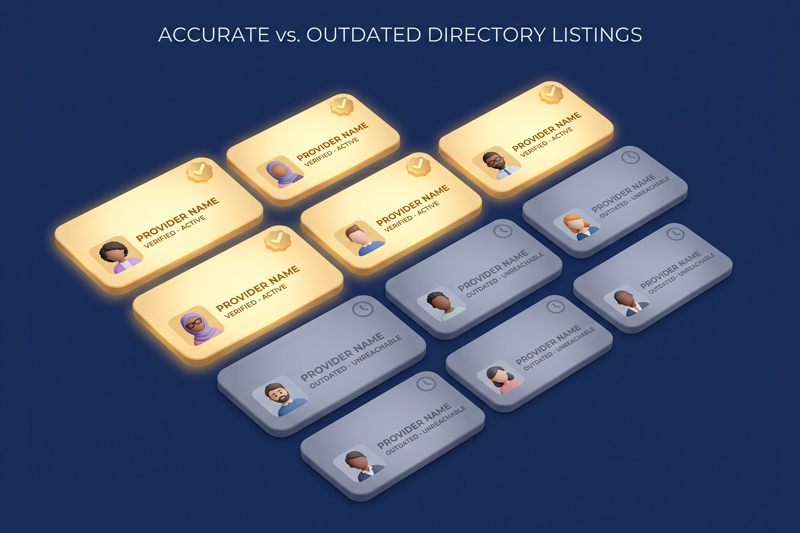
And yet a Senate Finance Committee investigation found that more than 80 percent of mental health providers listed in Medicare Advantage directories were either unreachable, no longer accepting new patients, or not actually in network.¹ That is a directory with almost no relationship to reality, the same directory millions of people are relying on at the exact moment they finally decide to ask for help.
The policy has outrun the infrastructure built to deliver on it. That gap is where people fall through.
The behavioral health field has earned these wins through sustained advocacy. Mental health parity enforcement has strengthened, 988 has created a national crisis infrastructure, and Certified Community Behavioral Health Clinics have expanded access in communities that have waited a long time for it. The REAL Health Providers Act, signed in February 2026, now holds Medicare Advantage organizations to the most rigorous provider directory accuracy standards in the program’s history. None of that happens without decades of work from clinicians, advocates, administrators, and people with lived experience.
What it doesn’t do automatically is close the distance between what a law requires and what a member finds when they pick up the phone.
Why Behavioral Health Feels This Gap More Than Most
Picture a mid-sized behavioral health network with 500 providers under contract. In an average year, roughly 150 of them will go through some kind of transition: a therapist joins a group practice, a psychiatrist scales back to part-time, a counselor adds a second state license for telehealth, someone leaves entirely. Multiply that by the dozen or more payers most networks are credentialed with, each wanting updates in its own format, on its own timeline, and the math gets unforgiving fast. That 150-transition estimate isn’t a worst case. It’s roughly what the data on workforce turnover suggests is normal, with annual turnover in community behavioral health agencies running between 30 and 60 percent.²
No other specialty moves quite like this. Provider mobility is constant, the payer mix is unusually broad, spanning commercial, Medicaid managed care, Medicare Advantage, TRICARE, and state-specific programs simultaneously, and telehealth has stretched many practices across state lines, each with its own license to track. Directory accuracy isn’t hard in behavioral health because anyone is careless. It’s hard because the underlying system never stops moving.
Three Places Where the Strain Actually Lands
Ask any operations team where the trouble starts and three answers come up consistently.
The first is rosters that quietly drift out of date. A provider who left six months ago is often still listed with two or three payers. A new hire might not appear anywhere yet. Reconciling that by hand, across hundreds or thousands of practitioners and multiple health plans, is one of the heaviest, most error-prone jobs on the calendar. The stakes are not abstract: patients who encountered inaccurate directory information were four times more likely to receive a surprise out-of-network bill.³
The second is the long silence between credentialing cycles. Most payers recredential every two to three years. A license can be suspended in month four of that window and nothing in the system will flag it until month thirty.
The third is the math of supply and demand colliding with bad data. As of December 2025, 137 million Americans — 40 percent of the population — live in a designated Mental Health Professional Shortage Area.⁴ In a market that thin, a dead-end directory listing isn’t a minor inconvenience. CMS clearly understood the stakes here: its new appointment wait time rule holds behavioral health to a tighter 10-day standard than primary care’s 15, requiring that 90 percent of a plan’s network actually deliver on it.⁵
What the Law Is Actually Asking Operations Teams to Build
The REAL Health Providers Act and the CMS wait time rule turn advocacy goals into something measurable. Plans must verify every provider record at least once every 90 days, drop departed providers within five business days, file annual accuracy analyses with HHS starting in plan year 2028, and post public accuracy scores from 2029 on.⁶ The wait time rule adds independent, third-party verification that 90 percent of a behavioral health network is genuinely reachable, not just listed.⁷
That is a real lift for teams still running this work through periodic batch reviews and manual outreach. The standard moved. The infrastructure underneath it has to move too.
Where Modern Provider Data Management Earns Its Keep
The shift underway is from checking data periodically to watching it continuously. Instead of waiting on providers to report changes themselves, modern provider data management platforms monitor primary sources around the clock: licensure status, sanctions, affiliations, location changes, all tracked in real time, with automated workflows firing the moment something shifts. For networks where a large share of providers are telehealth-credentialed across several states, that constant layer of monitoring closes the lag between a change happening and every system actually knowing about it.
Credentialing that once meant chasing documents and verifications by hand can run end-to-end instead, with primary source verification and NCQA-compliant processes handled systematically. Roster reconciliation, long one of the most labor-intensive tasks in network operations, becomes an automated comparison that catches every addition, change, and termination across every contracted payer at once. Payer enrollment can start the moment onboarding does, rather than waiting for credentialing to finish, shrinking the gap between a provider being ready to see patients and actually showing up correctly in the directory.
The result, for behavioral health organizations and the health plans covering them, is a directory that moves at the same speed as the workforce instead of trailing behind it.
Closing the Distance Between What the Law Promises and What People Find
The policy groundwork is the strongest it has ever been. What happens next depends on whether the systems behind the directory can finally keep pace with it. For organizations working through that transition now, purpose-built provider data management platforms designed for continuous, audit-ready verification offer a practical way forward.

John Lamb is VP of Provider Operations Management at Atlas Systems.
References
- United States Senate Finance Committee, Ghost Network Hearing — Secret Shopper Study Report. https://www.finance.senate.gov/imo/media/doc/050323%20Ghost%20Network%20Hearing%20-%20Secret%20Shopper%20Study%20Report.pdf
- PubMed Central. https://www.ncbi.nlm.nih.gov/pmc/articles/PMC8006068/
- Health Affairs. https://www.healthaffairs.org/doi/full/10.1377/hlthaff.2019.01501
- Health Resources and Services Administration, State of the Behavioral Health Workforce, 2025. https://bhw.hrsa.gov/sites/default/files/bureau-health-workforce/data-research/Behavioral-Health-Workforce-Brief-2025.pdf
- Veda, New in 2025: CMS Standards for Initial Appointment Wait Times. https://vedadata.com/cms-wait-time-standards/
- Requiring Enhanced and Accurate Lists of Health Providers Act, Pub. L. No. 119-4, enacted February 3, 2026. https://www.congress.gov/bill/119th-congress/house-bill/5281/text
- Centers for Medicare and Medicaid Services, Appointment Wait Time Requirements. 2025. https://www.cms.gov/files/document/awt-sss-tech-guide-qhp-ffe-508.pdf