When a student is struggling with anxiety or behavior, most schools turn to the counselor, the school psychologist, or the social worker. Speech-language pathologists and occupational therapists are doing that work too, every day, often without calling it behavioral health.
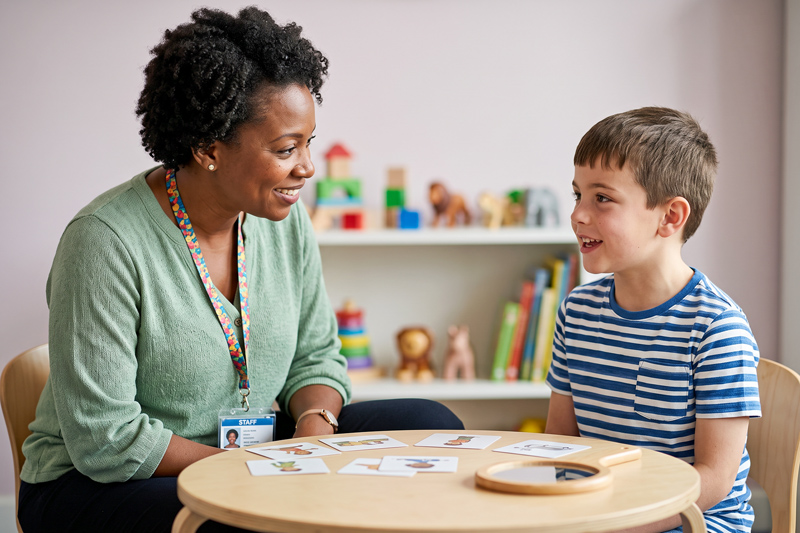
I’m an occupational therapist, and my colleague Sarah Plunkett is a speech-language pathologist. We both spent years working in schools before moving into our current roles supporting virtual providers. During that time, we saw it repeatedly: when a student learned to communicate, get through a hard moment, or make a friend, school started to feel different.
How We Ended Up in Schools
Neither of us initially planned on school-based work. Between the two of us, we’ve worked in skilled nursing, inpatient and outpatient rehabilitation, acute care, home health, hospital administration, and recruiting. Schools were the one setting we hadn’t tried.
For Sarah, it came down to her kids. She’d worked with adults for so long that kids weren’t really on her radar, until she picked up a few pediatric outpatient patients and liked it more than she expected. As her own kids got older, being on their schedule (summers and all) sounded pretty good.
My reasons were practical, too. I started in inpatient rehab, went back for a business degree while I was still working, and eventually recruited allied health staff for a hospital system in Oklahoma. When my daughter started first grade, I wanted to be home more. School-based OT let me do that, and it put me somewhere I didn’t expect. In 2015, my district assigned me to its K-12 virtual school, where OT had only ever been consultative. I was the first person there to provide direct virtual OT. I liked it so much that I started contracting teletherapy OT, logging on after my regular school day to see kids in another time zone.
Eligibility Made Us Look at the Whole Student
Coming from medical settings, one of our biggest adjustments was the idea of academic impact. In outpatient, we addressed anything that got in the way of a patient’s daily life. In a school, the concern has to be affecting the student’s education. With speech, that gets tricky.
Lots of kids had a lisp or a fluency issue that wasn’t affecting them academically. Sarah would then sit down with the parents, tell them she saw it too, explain why it didn’t qualify for school services, and walk them through other places they could go for help. Some parents pushed hard for support. Some didn’t want the label at all. She had both conversations so often that neither one caught her off guard.
Those conversations made us pay closer attention to a student’s overall progress. A speech or motor difficulty can show up in places you wouldn’t expect: a kid who never raises their hand, who eats lunch alone, who gets a stomachache every time a certain class comes around. Once you start noticing that, it’s hard to treat the skill on its own.
When Kids Can Communicate, Anxiety Eases
Sarah sees this most clearly in speech therapy. When she treats a communication disorder, she’s also helping a student find people to lean on, build strategies that work for them, and learn to speak up for themselves. Some studies have shown that students in speech therapy have higher rates of anxiety. In her experience, speech and language work builds a student’s social skills, confidence, and ability to regulate their emotions.
Her fluency students are a good example. Once they had strategies for handling stuttering in class and with friends, they got noticeably less anxious in those situations. They got more comfortable talking in front of people and better at advocating for themselves.
The same was true for her students with social and pragmatic language needs. A lot of them had a really hard time starting a conversation or keeping one going. As those skills came along, they started connecting with other kids and making friends. “Seeing a child approach a peer on the playground and ask to play might seem like a small thing,” Sarah said, “but it’s huge for someone who struggles with initiating, engaging in conversation, and interacting with others.”
Occupational Therapy Gives Kids Tools for the Hard Parts of the Day
Occupational therapy addresses the same thing from a different angle. A lot of what we do in OT comes back to regulation, even when the goal on paper is handwriting or fine motor skills. Think about a kid whose hand can’t keep up with what the teacher is saying, who falls apart in a loud cafeteria, or who melts down every time the class switches activities. OT gives them tools for those moments, like sensory strategies, movement breaks, and routines that make the day more predictable. When something stops feeling impossible, the shutting down or acting out tends to ease up, too.
The hard part is that the students who need this kind of support are often the least likely to get it. Schools are seeing more students who come in anxious, dysregulated, or struggling to connect, and there aren’t enough speech-language pathologists (SLPs), occupational therapists (OTs), or mental health providers to go around. Small and rural districts tend to feel it first. When a position sits open, the student’s individualized education program (IEP) still calls for those minutes, and somebody has to find a way to cover them. Whether a student gets steady support can end up depending more on where they live than on what they need.
Kids Do Better When the Same Provider Comes Back
We both saw what happens when a district can’t keep a position filled. In one district where I worked, there weren’t enough local providers, so they brought in contractors from a nearby city. It wasn’t a long drive, but it was far enough that people got tired of it and left. Then somebody new would come in, and the whole thing would start over. The rest of us picked up the slack as best we could. Groups got bigger, and sessions got shorter, even though session length was supposed to be based on what each kid needed.
Sarah’s first school contract was with a small district that had gone through several speech contractors in a short time. Nobody was doing a bad job. With people coming and going, though, things fell through the cracks during handoffs, and compliance slipped. It was also her first fully virtual placement, in a community that had never tried teletherapy, so that first year took a lot of work from everyone. The next year, the same two providers came back, and things went smoothly from the start. Nobody had to be won over again.
For students with anxiety, that kind of consistency is a big deal. Some take a while to trust a new adult, and when the adult keeps changing, it gets harder. When you know you’re coming back, you invest more. You find out who has a dog and what the dog’s name is. You really get to know students and their families, and school staff as well. None of that shows up on an IEP, but it’s a big part of actually knowing a kid. And returning students stopped acting like it was day one every fall. They’d come in wanting to tell you everything they did over the summer.
Some Kids Focus Better on a Screen
Teletherapy helped some students regulate, too. When clinicians are nervous about it, Sarah usually tells them about her old speech room. She’d spent years filling it with shelves of games and materials, and every kid who walked in got distracted before they even sat down. On a screen, all they saw was her and the activity. “You’re not looking at everything behind me going, ‘Oh no, I want that,'” she said. For kids who get overwhelmed easily, that made it much easier to settle in and focus.
Her days felt different, too. In a building, walking to get one kid from one classroom and another from down the hall usually meant a few quick questions along the way. She never minded, but sometimes she’d show up late to her own session. Online, she could just log on and start, and the time she used to spend in hallways and on duty went back to her students.
When Providers Stay, Students Keep Making Progress
Keeping the same providers year after year also depends on how those providers are doing. In schools, sessions are based on what students need, and clinicians have a say in how IEPs are structured. That balance is a big reason clinicians stay, and when they stay, students don’t have to start over with someone new.
Sarah and I got here in very different ways, but we saw the same thing in our sessions. A student who learns to handle a stutter during a class presentation, ask a classmate to play, or get through a loud cafeteria is also building the confidence and regulation that make school manageable. With a provider who keeps coming back, that progress has time to stick.


Kami Bible is an experienced school-based occupational therapist, and Sarah Plunkett is an experienced school-based speech-language pathologist. Both now support Provider Success at eLuma, which provides special education and mental health services to K-12 schools. To contact Kami, email [email protected] or call (385) 993-3419. To contact Sarah, email [email protected] or call (385) 446-8666.