Many South Asian adults describe childhoods filled with sacrifice, and high expectations. Parents worked tirelessly, emphasizing education, and pushed their children towards success. On the surface, these families often appear close and supportive. Yet in clinical settings, a quieter pattern emerges. Patients speak of feeling emotionally alone and valued primarily for their achievements rather than who they are.
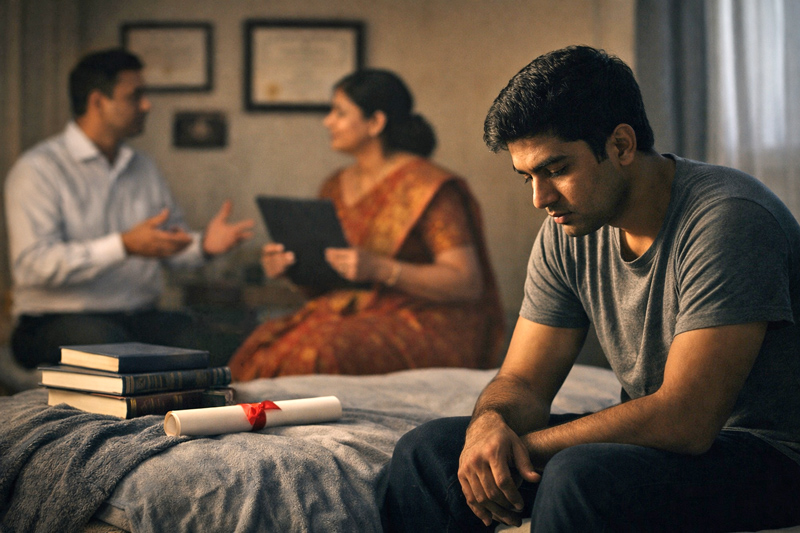
This experience is best understood as emotional neglect, not in the sense of absence or abandonment, but the absence of emotional attunement. Emotional neglect occurs when caregivers consistently fail to recognize, validate, or respond to a child’s emotional needs. Unlike abuse, emotional neglect is subtle. In South Asian families, it is frequently reinforced by cultural values that prioritize obedience, and collective success over individual emotional expression.
What Emotional Neglect Looks Like in South Asian Families
Many parents who emotionally neglect their children believe they are doing the right thing. Common patterns include minimizing distress, discouraging emotional expression, or redirecting vulnerability toward productivity.
Children may hear phrases such as “You have food and shelter, what more do you want,” or “Focus on your studies, fun can wait.” Emotional pain is often framed as weakness or lack of gratitude. Over time, children learn that emotions are inconvenient and not safe to express.
Research on emotionally dismissive parenting shows that children raised in such environments struggle with emotional awareness and interpersonal intimacy later in life. In South Asian contexts, this is intensified by collectivist norms that emphasize family reputation and sacrifice over individual emotional needs.
Conditional Love and Achievement Based Worth
A central feature of emotional neglect in South Asian families is conditional affection. Praise and approval are often tied to academic performance, professional success, or adherence to family expectations. Emotional needs that do not align with these goals are frequently invalidated.
Clinically, this manifests as adults who struggle with self-criticism, perfectionism, and the belief that love must be earned. Studies have shown that conditional positive regard in childhood is associated with increased anxiety, depressive symptoms, and unstable self-esteem in adulthood.
Many South Asian patients describe a fear of disappointing others and difficulty identifying their own desires. They may excel externally while feeling emotionally hollow inside. This pattern is especially common among eldest children and those labeled as the “responsible” or “good” child.
Emotional Neglect and Mental Health Outcomes
The psychological consequences of emotional neglect are well documented. Unlike trauma, emotional neglect often leads to chronic symptoms rather than discrete post traumatic responses.
Adults who have experienced emotional neglect are at higher risk for:
- Depression and persistent low mood
- Anxiety disorders
- Difficulty identifying and expressing emotions
- Attachment insecurity and relationship difficulties
A large body of research links childhood emotional neglect to long term alterations in stress regulation and emotional processing. Neurobiological studies suggest that emotional deprivation affects the development of brain regions involved in emotion regulation and self-awareness.
In South Asian patients, these symptoms are often under recognized or somaticized. Emotional distress may present as headaches, gastrointestinal complaints, chronic fatigue, or diffuse pain. This tendency to express psychological suffering through physical symptoms is well documented in South Asian populations and is often culturally reinforced.
Why Emotional Neglect Is So Hard to Name
One of the most painful aspects of emotional neglect is its ambiguity. Many patients struggle with guilt for feeling hurt by parents who provided materially and made visible sacrifices. Gratitude and grief coexist, creating conflict that can delay seeking help.
Cultural narratives emphasizing parental sacrifice can unintentionally silence adult children. Acknowledging emotional neglect may feel like betrayal or disrespect. As a result, many South Asian adults enter therapy believing that something is “wrong with them” rather than recognizing the impact of emotionally invalidating environments.
Clinically, it is important to differentiate blame from accountability. Understanding emotional neglect does not require vilifying parents. Many caregivers themselves grew up in survival, shaped by migration, poverty, or intergenerational trauma. Emotional suppression was adaptive in those situations. However, adaptive strategies can become harmful when carried forward.
Implications for Treatment and Healing
Addressing emotional neglect requires therapeutic approaches that emphasize emotional awareness, self-compassion, and relational repair. Evidence based modalities such as psychodynamic therapy, schema therapy, and emotionally focused therapy are particularly effective in helping patients identify unmet childhood needs and develop healthier internal narratives.
For South Asian patients, culturally responsive care is essential. This includes validating the complexity of loving one’s family while acknowledging emotional harm. Therapy can help patients learn that emotional needs are legitimate and not signs of weakness or selfishness.
Psychoeducation is often a critical first step. Naming emotional neglect allows patients to contextualize lifelong patterns of self-doubt, over functioning, and emotional disconnection. Over time, this awareness supports the development of boundaries, emotional literacy, and more secure relationships.
Conclusion
Emotional neglect in South Asian families is rarely intentional, but its impact is profound. When children are valued primarily for what they achieve rather than who they are, they may grow into adults who struggle to feel worthy of love, rest, or emotional care.
Recognizing emotional neglect is not about assigning blame. It is about expanding our understanding of mental health beyond crisis and pathology to include the absences that shape identity. By naming these patterns, clinicians, families, and communities can begin to foster environments where emotional presence is valued as much as success.

Vishwani’s opinions are her own and are for informational purposes only. They are not intended to diagnose, treat or provide medical advice. Please consult a qualified healthcare professional for personalized medical care.
Vishwani Sahai-Siddiqui is a residency- and fellowship-trained psychiatrist, now a medical writer and editor. For more information, email vishwanipsychmd@gmail.com.
South Asians and Mental Illness Series
- Therapy is for “Other People”: Why Many South Asian Parents Dismiss Mental Health Support
- The Burden of Being the ‘Good Child’: How South Asian Kids Suppress Mental Health Struggles
- Mental Health and Matchmaking: How Stigma Affects South Asian Marriage Prospects
- Spirituality Versus Psychiatry: Why Many South Asians Turn to Religion Before Therapy or Psychiatric Medication
- The Cost of Silence: How Ignoring Mental Illness in South Asian Families Leads to Physical Health Issues
- “The Son Belongs to His Mother”: South Asian Daughters-in-Law and the Mental Health Toll of Family Hierarchy
- Trapped by Tradition: The Anxiety of Being a ‘Good’ South Asian Daughter-in-Law
- The “Good Son” Trap: How Role Conflict Between Parents and Partners Causes Burnout and Depression
- Loved for What You Do, Not Who You Are: Emotional Neglect in South Asian Families
References
Assor, A., Roth, G., & Deci, E. L. (2004). The emotional costs of perceived parental conditional regard: A self-determination theory analysis. Journal of Personality, 72(1), 47 to 88.
Gottman, J. M., Katz, L. F., & Hooven, C. (1996). Parental meta emotion philosophy and the emotional life of families. Journal of Family Psychology, 10(3), 243 to 268.
Kirmayer, L. J., & Young, A. (1998). Culture and somatization: Clinical, epidemiological, and ethnographic perspectives. Psychosomatic Medicine, 60(4), 420 to 430.
Raval, V. V., et al. (2013). Socialization of emotion in Indian families. Journal of Family Psychology, 27(4), 605 to 614.
Teicher, M. H., Samson, J. A., Anderson, C. M., & Ohashi, K. (2016). The effects of childhood maltreatment on brain structure, function, and connectivity. Nature Reviews Neuroscience, 17(10), 652 to 666.