The integration of peer recovery support specialists represents a significant shift in behavioral health systems. Peers offer unique perspectives and authenticity that strengthen recovery-oriented systems of care (Davidson et al., 2021). Drawing on lived experience, they bring insights that support workplace transformation and engagement (Davidson et al., 2016). However, successful integration requires more than hiring peer staff; it requires intentional cultural shifts, clear role definitions, and systematic strategies for organizational transformation (Byrne et al., 2021).
Implementing Peer Supports in the Behavioral Health Workforce
People often ask: Why is this needed? Why a learning collaborative for peer support integration?
Our answer comes from decades of collective work, beginning in the early 1990s. For many years, we trained peer supporters and helped place them into traditional mental health systems. At first, there was excitement. Hope. A sense of possibility.
But too often, that hope faded.
Peer and lived experience workers often felt uncertain about their roles, and the authenticity and connection that made their work powerful did not always translate into organizational structures built around clinical hierarchies. They encountered unclear expectations, limited supervision models suited to their work, and roles that shifted unpredictably.
Organizations also struggled. The agencies that hired peers were unsure how to support or integrate them effectively. Many knew that peer support was important, sometimes required by funding or policy, but they were unsure about the why, the what, and the how. Job descriptions were vague, supervision models were poorly defined, and without intentional structures, the promise of peer support often went unrealized.
We realized we were doing a disservice to everyone.
From that realization, a new vision emerged. Early efforts to address these challenges began in Philadelphia under the leadership of former commissioner Dr. Arthur Evans, where initiatives focused on helping behavioral health organizations understand how to integrate peer support roles into traditional systems of care. Those experiences revealed many of the same barriers agencies continue to face today: a lack of role clarity, limited supervision models, and organizational cultures not yet prepared to fully embrace lived expertise. This early work was conducted in partnership with peer leaders, community advocates, and behavioral health organizations in Philadelphia who helped demonstrate the importance of organizational readiness for peer workforce integration.
Building on those lessons, in 2017, our work evolved into the first iteration of what is now known as the Recovery Workforce Learning Collaborative (RWLC). Central to this vision from the outset was the principle of co-creation. Peer and lived experience leaders have been essential partners in the design and delivery of the collaborative. They help shape the curriculum, co-facilitate training, provide technical assistance to agencies, and continuously refine materials to ensure they remain grounded in the realities of peer work.
What is the Recovery Workforce Learning Collaborative?
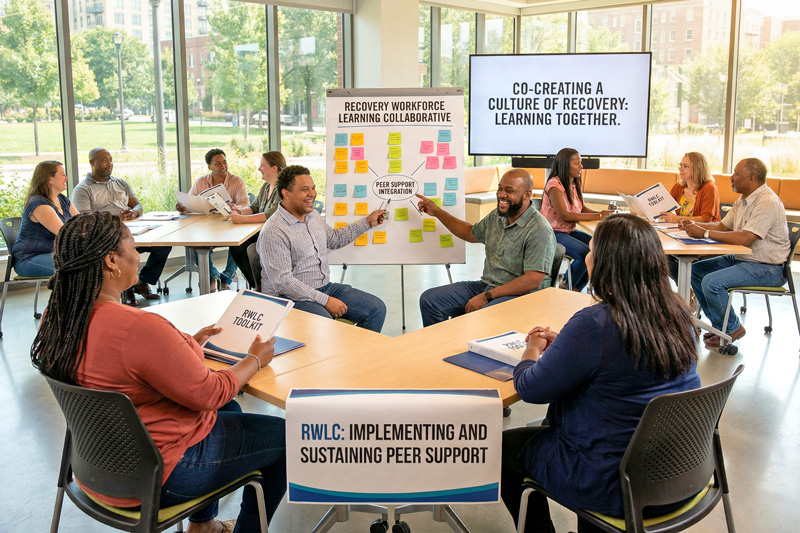
RWLC is a team-science approach to building organizational capacity through mutual learning among agencies committed to implementing peer support and recovery support initiatives with lived experience leaders. It invites agencies to engage fully, honor the strengths they already carry, and dream boldly about the future they want to create for their communities.
Learning collaboratives are designed to bring together diverse stakeholders to address shared challenges and develop practical solutions through collective learning. As Berwick (1998) underscored, collaborative learning facilitates the rapid dissemination and adoption of best practices within and across organizations. In healthcare contexts, learning collaboratives enable participants to share insights, develop new skills, and implement evidence-based strategies that improve service delivery and outcomes (Mittman, 2004).
The RWLC is a 12-month initiative that combines in-person and virtual learning sessions with customized consultation and technical assistance. Its goal is to help behavioral health agencies establish the organizational culture and administrative infrastructure needed to hire, retain, supervise, and effectively support the peer recovery and lived experience workforce.
The RWLC toolkit modules include:
- Module 1: Preparing the Organizational Culture
- Module 2: Role Clarity, Recruiting, and Hiring
- Module 3: Supervising, Retaining, and Advancing Peer Recovery Workers
The RWLC creates space for agencies to learn not only from facilitators and guest speakers but also from one another. Participants exchange experiences, share strategies, and collectively problem-solve. Peer leaders are embedded throughout the process, helping to reframe discussions, challenge assumptions, and model authentic integration.
Across three cohorts in Connecticut, 30 behavioral health agencies have participated in the RWLC. A parallel effort in Victoria, Australia, involving 21 agencies across two culturally adapted cohorts will be described in future work. Lessons from these agencies continue to inform and refine the collaborative model.
Grounded in Appreciative Inquiry
“We want to work towards earning the trust of individuals in our programs, so they see that we are not clinical staff but caring people with much in common.”
The RWLC is grounded in appreciative inquiry, an asset-based approach to change that focuses on identifying and building upon strengths within an organization (Cooperrider & Srivastava, 1987; Hawkins & Bellamy, 2011). Rather than beginning solely with problems, appreciative inquiry asks what is working well and how those strengths can be expanded.
Traditional approaches to organizational change often emphasize identifying root causes of problems. Appreciative inquiry instead focuses on possibilities and positive potential, encouraging organizations to identify what is true, good, and possible within their systems.
Within the RWLC, this perspective encourages agencies to build on existing assets as they integrate peer recovery workers and lived expertise into behavioral health services. It also shapes how peer leaders are engaged. Their lived expertise is recognized not as a challenge to be managed, but as a valuable resource for improving systems of care.
Using the RWLC Toolkit
The RWLC toolkit was developed in 2017 in response to concerns agencies and peers raised about hiring and supporting peer recovery workers. These concerns are often centered on role clarity, supervision, organizational readiness, and onboarding processes and sustainability.
The toolkit encourages agencies to address these questions before hiring peer staff, rather than waiting until challenges emerge. Early preparation helps organizations reduce resistance, clarify expectations, and establish supportive environments for peers.
The toolkit themes:
- Communicating the value of peer support early to support culture change
- Developing participatory leadership pathways and co-supervision models
- Preventing burnout and tokenism while supporting career advancement
- Promoting culturally responsive supervision and equitable hiring practices
- Supporting workers who may have nontraditional or interrupted employment histories
Importantly, the toolkit is a living document, continuously revised by peer leaders and participating agencies based on lessons learned from each cohort.
What We Have Heard from Participants
“The learning collaborative strengthens our commitment to inclusivity, recovery-oriented care, and cultural humility.”
“Peer support staff also want opportunities for advancement.”
These reflections highlight a consistent theme: the collaborative works because it values the expertise of everyone involved.
Agencies are not passive recipients of training. They actively contribute to the collaborative’s collective knowledge. When one agency develops an effective supervision model, others learn from it. When another improves its hiring process, those lessons spread.
Peer leaders play a vital role in this exchange. Their leadership ensures that lived expertise informs discussions, training materials, and consultation activities. Learning flows in multiple directions: agencies learn from peers, peers learn from agencies, and the collaborative evolves continuously.
This is the essence of mutual learning.
Conclusion: The Power of the RWLC Model
Promoting peer support and lived experience workforce development requires intentional infrastructure development that aligns with competency frameworks while remaining grounded in recovery-oriented values. The collaborative approach developed through the RWLC, combined with evidence-based implementation frameworks and a practical toolkit, provides behavioral health agencies with guidance for cultural transformation while honoring the contributions of peer support workers.
The RWLC demonstrates that meaningful change happens when organizations, peer leaders, and communities learn together.





For more information, contact Maria E. Restrepo-Toro at [email protected].
Maria E. Restrepo-Toro, BSN, MS, is the Director of Health Education, Training & Development at the Yale School of Medicine, Department of Psychiatry, Yale Program for Recovery and Community Health (PRCH). Her email is [email protected]. Chyrell D. Bellamy, PhD, MSW, is a Professor and Director of the Yale Program for Recovery and Community Health (PRCH) at the Yale School of Medicine, Department of Psychiatry. Her email is [email protected]. Graziela Reis, MPH, BS, is a Research Coordinator at the Yale School of Medicine, Department of Psychiatry, Yale Program for Recovery and Community Health (PRCH). Her email is [email protected]. Sai Snigdha Talluri, PhD, CRC, LPC, is a Postdoctoral Associate at the Yale School of Medicine, Department of Psychiatry, Yale Program for Recovery and Community Health (PRCH). Her email is [email protected]. Megan Evans, PhD, is an Associate Research Scientist at the Yale School of Medicine, Department of Psychiatry, Yale Program for Recovery and Community Health (PRCH). Her email is [email protected].
References
Berwick, D. M. (1998). Developing and testing changes in delivery of care. Annals of Internal Medicine, 128(8), 651–656.
Byrne, L., Roennfeldt, H., Wolf, J., Linfoot, A., Foglesong, D., Davidson, L., & Bellamy, C. (2022). Effective peer employment within multidisciplinary organizations: Model for best practice. Administration and Policy in Mental Health and Mental Health Services Research, 49(2), 283–297.
Cooperrider, D. & Srivastva, S. (1987). Appreciative inquiry in organizational life. In R. Woodman and W. Pasmore (Eds.), Research in organizational change and development, Vol. 1, pp. 129–169.
Hawkins, D. D., Stayner, D., & Bellamy, C. D. (2011). Organizational Development and Planning Guide: How to use your organization’s internal capacity to build sustainable change, programs, and practices: Using Appreciative Inquiry. Proceed, NJ: The National Center for Training, Support, and Technical Assistance (NCTSTA).
Davidson, L., Rowe, M., DiLeo, P., Bellamy, C., & Delphin-Rittmon, M. (2021). Recovery-oriented systems of care: a perspective on the past, present, and future. Alcohol Research: Current Reviews, 41(1), 09.
Davidson, L., Tondora, J., O’Connell, M., Bellamy, C., Pelletier, J.-F., DiLeo, P., & Rehmer, P. (2016). Recovery and recovery-oriented practice. In Yale Textbook of Public Psychiatry (pp. 33–47).
Heatly, M. C., Nichols-Hadeed, C., Stiles, A. A., & Alpert-Gillis, L. (2023). Implementation of a school mental health learning collaborative model to support cross-sector collaboration. School Mental Health, 15(2), 384–401.
Mittman, B. S. (2004). Creating the evidence base for quality improvement collaboratives. Annals of Internal Medicine, 140(11), 897–901.
Nadeem, E., Olin, S. S., Hill, L. C., Hoagwood, K. E., & Horwitz, S. M. (2014). A literature review of learning collaboratives in mental health care: Used but untested. Psychiatric Services, 65(9), 1088–1099.
Yale Program for Recovery & Community Health, Advocacy Unlimited, Inc., Connecticut Community for Addiction Recovery, & Connecticut Department of Mental Health and Addiction Services. (2019). Integrating recovery supports into your agency: A toolkit for facilitating cultural change. New Haven, CT: Yale University.
Zamiri, M., & Esmaeili, A. (2024). Methods and technologies for supporting knowledge sharing within learning communities: A systematic literature review. Administrative Sciences, 14(1), 17.