Before co-founding Dazos, we operated a multi-state behavioral health organization with 10 facilities across five states. We struggled with the lack of accountability and transparency in our operations, feeling as though we were running our business blindly. Ultimately, we realized the tools we needed didn’t exist. With our expertise in software development and behavioral health operations, we created our own technology and approach to marketing and revenue recovery. After helping to run a facility and assisting thousands of organizations with admissions, marketing, and revenue, here’s what we have learned about revenue capture.

Why do traditional behavioral health billing systems miss revenue opportunities?
Some behavioral health owner operators decide it’s a good idea to bring billing in-house. And it could be a good thing if there are economies of scale and they run a lean organization. Billing starts at admissions, when the admissions team determines a prospective client’s deductible and co-insurance are in place and the insurance policy is active; the clinical team needs to have the proper documentation.
Even though EMR companies with good AI solutions can enable that first claim to go through properly, the sheer manpower required to follow up on claims and collect every dollar is daunting. Let’s say a facility is a traditional behavioral health operator helping a client for whom it is out-of-network, or OON. The operator’s staff has to understand whether insurance should pay the claim at the local rate, allowable rate, or home state rate. Compounding this is that a lot of OON rates have third-party repricing. Because of these billing challenges, some operators think they should outsource the task. If they do, they still have to hold the billing company accountable. That requires tools to make sure the billing company files claims on time.
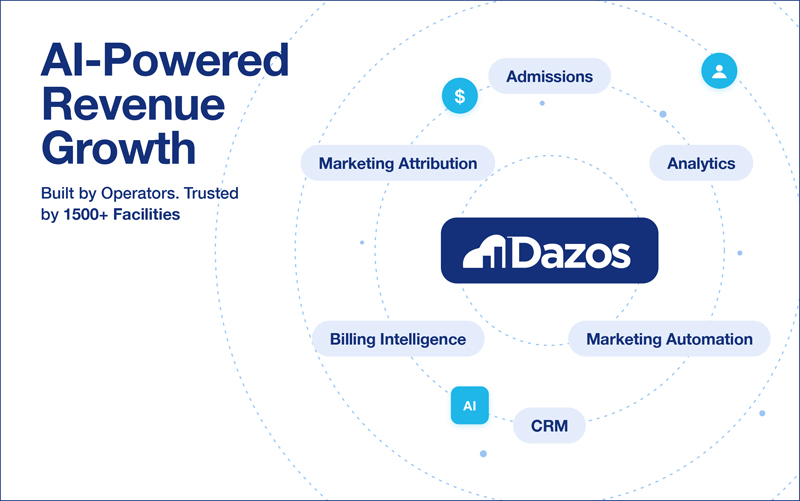
We see customers using functionality to track treatment days, update authorizations, and pre-populate billing data, so they don’t leave revenue unclaimed. If an operator can integrate their customer relationship management (CRM) with tools like Square, Stripe, or QuickBooks, they can collect payments, track balances, automate charges, and create reports. Without the right tools, an operator can miss the subtleties of billing, especially when they first enter the industry. When we operated a behavioral health facility, we had a billing company and almost went bankrupt because the firm couldn’t keep up with our growth.
We did two things. First, we looked for a new billing company, and second, we developed a tool to sit on top of our revenue cycle management software, RCM. The tool flagged claims and stayed on top of our billing company by examining why a claim paid out at X vs Y. For example, the tool might find that insurance repriced 10 OON claims, but the billing company failed to follow up on 5 of them. There are many intricacies like this.
The profit margins in behavioral health are very thin for agencies. A billing company may process 95 percent of claims properly. But when a billing company only charges six percent for the revenue it collects, they typically won’t go after the harder to track down opportunities because the financial incentive isn’t there. But those missed revenue opportunities can make or break an operator’s financial health. And even at the in-network level, we still see clients with in-network claims get paid by insurance companies at a rate that is for a lower level of care. Let’s say a facility provides PHP services to a client, but the insurance company mistakenly reimburses the claim at an IOP or standard outpatient rate. That’s an error that can occur across all claim types, whether medical, in-network, or OON.
What are the top three recommendations for Behavioral Health owner-operators when it comes to managing the revenue cycle?
First, understand your average daily revenue, or ADR. There’s a stigma among clinicians that an operator shouldn’t talk about the economics of care. Caring for and helping clients is job one, for sure. But unless you’re a non-profit, a facility needs a for-profit mindset. If operators aren’t profitable, they can’t afford to care for and treat clients. To keep providing great care, operators need to go into their facility and work with their team, so the team not only understands treatment but also knows the importance of ADR by client and facility.
Second, you can have the right clinical documentation in place. But if an insurer doesn’t see the proper progress notes by therapist, the insurance company won’t pay the claims. In fact, if an owner-operator’s team is not properly documenting care, an insurance company will see that there is a lack of clinical documentation; the pattern may even trigger an audit. Ensuring solid, regular documentation requires a good relationship between a facility’s clinical and operations teams, having all the departments aligned.
Third, whether billing is done inside or outside a facility, understand what is happening each day with claims submitted. That might include following up on claims every three weeks to assess what’s going on with the facility’s revenue; managing billing might require an automated system that holds a facility’s billing company accountable. For our facility, we initially handled billing internally. When we found it too difficult to keep up, we outsourced billing. We worked with two billing companies, until we picked one based on its performance and open-mindedness about allowing us to hold them accountable. We made sure not to get locked into an annual contract. We also made sure we could control the flow of communication through a billing liaison we requested. Our interactions were daily until we felt comfortable about moving to weekly calls. Also important for us was having access to all our billing data, including the ability to make changes.
How can technology help Behavioral Health organizations facilitate documentation, so they can recover as much revenue as possible?
There are EMRs doing innovative things with AI tools to streamline documenting and notetaking to help clinicians handle what they do best. Facilitating notetaking correlates to billing; we see clients with billing issues because their clinical notes aren’t properly documented. Insurers are becoming more demanding about the quality of notes. We’ve never directed our clients to pick a certain EMR. But we do tell them that whatever EMR they choose ought to work with a CRM built for behavioral health. When a facility admits a client, their data should go into a facility’s CRM and then, automatically, to the EMR. When a facility discharges the client, their data should go back to the CRM. That process is critical for engaging with alumni and managing your census through your CRM. The EMR and CRM have to work together.
Whether a facility has one location or dozens of facilities, creating revenue opportunities, in part, requires integration between an EMR and CRM. I know a facility that spent $1 million to integrate its EMR with a CRM and, ultimately, the project failed. The owner had to look elsewhere and start over.
What causes behavioral health operators to not succeed?
First, an owner operator may have a passion for behavioral health, but if they can’t find the right clinical staff, they’ll have problems. Another challenge for owners is being able to attract and draw from the right target audience with the right marketing mix. And to this second point, we’ve seen a lot of agencies, even large ones, go from profitable to shutting down locations because they don’t have the right marketing engine. The agencies are trying to fill beds, of course, but their marketing mix targets clients who rely on Medicaid as well as those who use private insurance.
This mixed marketing means they run different types of programs. So, they lack the ability to get granular with their ADR and break even. A lot of these organizations will say they have a census, but they can’t cover their variable costs.
To be profitable, an organization needs the right mix of business development, team structure, Google Ads and SEO, and a good technology stack. Their business development team will need to visit hospitals and private physicians’ offices and show why the client should pick the owner’s facility for care; they’ll need to show why alumni should return because helping alumni is super important. With our facility, before we mastered marketing, we sometimes relied too much on digital advertising. Some owner-operators will spend $1 million per month on digital advertising and smaller ones might spend as much as $2,000 per month on Google Ads. But an owner-operator must have a process and technology to understand how much to spend.
How can AI help behavioral health agencies with collection rates?
The key for owner-operators is using AI technology trained on real behavioral health admissions calls. With that kind of tool, an owner operator can deploy an AI agent to handle missed call opportunities. If someone can’t get help right away, they may hang up and call somewhere else.
Every missed call can mean up to $50,000 in lost revenue (i.e., average per-episode reimbursement). The traditional solutions tapped by behavioral health facilities range from answering services to on-call staff. But when people are looking for help, an owner’s staff needs to engage with a potential client right away, collect all the data from the person, and automatically input that into a CRM.
Imagine an AI agent pushing a live call to admissions or collecting the relevant data from the caller and prompting the call center to return the call. The AI agent is a win for the potential client because the caller can communicate their needs and get answers; the potential client can, for example, ask about the facility’s treatment protocols. For admissions coordinators, AI helps with conversion rates.
With a CRM built for behavioral health agencies and equipped with AI agents trained on real calls, marketing staff can reconnect with potential clients through compliant, personalized outreach. That turns sunk marketing costs into admissions. With integrated technology, every action taken by the AI agents lands in the CRM, so owner-operators and staff know the status of leads, staffing needs, marketing ROI, and lost revenue minute by minute.
What’s one of the biggest challenges you see operators facing with revenue?
The challenge is twofold. They’re looking at how to grow their census, and second, why their reimbursements are either shrinking or not keeping up with inflation. Payer mix matters a lot, but they’re also trying to keep up with rising labor costs (e.g., licensed clinicians). We’ve seen operators whose facilities are at 90 percent capacity, yet some are really struggling at the end of year with deductibles and coinsurance resets that kick in Jan. 1. To be profitable, they’ll go after digital leads, and that starts each year before Thanksgiving. That’s a growth strategy, but it’s one catering to insurance cycles instead of focusing on client needs.


David Farache, CEO, and Louis Devaleix, COO, are co-founders of Boca Raton, Fla.-based Dazos, a provider of software and technology designed by behavioral health leaders to accelerate admissions, recover lost revenue, and streamline operations for facility executives and staff. Prior to Dazos, Farache and Devaleix successfully operated a multi-state behavioral health organization on the East Coast.