Behavioral health crises require rapid response, specialized support, and seamless coordination across emergency systems to minimize unwanted outcomes. Yet, in many communities, traditional Emergency Medical Services (EMS) workflows delay behavioral health intervention until after transport or hospital admission (Crisanti et al., 2022). Postponing behavioral health engagement can reduce critical engagement opportunities and limit the effectiveness of crisis response efforts, particularly in rural communities where access to care and willingness to seek help are already reduced (Bolinski et al., 2019).
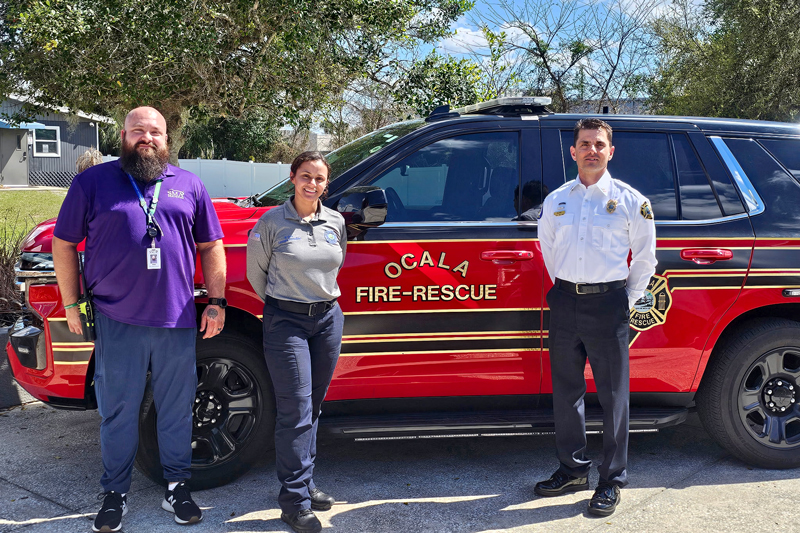
SMA Healthcare and Marion County Fire Rescue unite for crisis response.
Pictured from left to right: SMA team member Pete Fenchette, Ocala Fire Rescue- Maria Clark and Captain Jesse Blair.
Local data underscores why earlier, more coordinated intervention is essential. Over the past five years, Marion County EMS has responded to 6,974 suspected overdose incidents and administered naloxone to 5,339 individuals (Marion County Overdose Dashboard Report, 2026). These figures reflect a high-acuity environment in which behavioral health engagement at these critical moments can shape client outcomes. The volume and severity of these incidents demand crisis response models capable of mobilizing behavioral health support immediately and in coordination with EMS activity.
Marion County, Florida, is doing exactly that. SMA Healthcare’s Peer Support team has adopted a unique and highly coordinated model that integrates peer support specialists directly into EMS radio communications. This innovative approach allows peers to receive real-time dispatch information, coordinate side-by-side with first responders, and begin compassionate engagement before, during, and immediately after emergency encounters. The Marion County Hospital District has managed the collaboration and provided funding to support this coordinated program.
“Integrating peer support into the EMS radio system has changed the way we respond to behavioral health crises,” says Travis McAllister, Peer Support Director. “Our specialists can now engage individuals immediately, improving response times, reducing the burden on first responders, and making sure people receive help at the moment they need it most.”

EMS Radio Integration for Peer Support: Structure and Benefits
Traditionally, peer support specialists engage clients after transport, medical stabilization, hospital intake, or through scheduled follow-up services. Marion County, however, elected to refine this process. Through close collaboration with Marion County Fire and EMS leadership, peer support specialists can now directly access EMS radio channels, allowing:
- Simultaneous dispatch of peer specialists alongside EMS and fire personnel. By eliminating the communication lag previously caused by delayed notification, peer support specialists frequently arrive at emergency departments with or ahead of EMS transport to begin rapport-building.
- Earlier client engagement with peer teams. With peer support specialists able to receive calls in real time, community members receive support from the start. This early engagement is crucial for individuals in crisis, improving the likelihood of accepting support and minimizing the risk of overdose recurrence (White et al., 2023).
- Strengthening of interagency coordination and support. With shared communication channels, peer support becomes part of the coordinated emergency response alongside EMS, fire, law enforcement, and hospitals. This aligns closely with Marion County’s broader emergency operations model, which emphasizes multi-agency collaboration and unified communication.
- Increased support for first responders. Timely access to peer support services eases the burden on EMS and other first responders in coordinating care with peer support specialists. With support originating on scene, first responders can concentrate on medical care knowing follow-up and recovery supports are already in motion.
This real-time connection creates a seamless link between EMS operations, behavioral health supports, and clients, strengthening the entire crisis response continuum of care.
Alignment with Statewide and National Efforts
Florida’s Coordinated Opioid Recovery (CORE) Network emphasizes the transition from crisis response to treatment and ongoing support, with focus on a comprehensive response to the opioid epidemic (Florida Department of Children and Families, 2024). Real-time peer involvement reinforces this model by ensuring the client never leaves a supportive continuum of care. Florida’s behavioral health system has emphasized expanding peer-led networks, including regional and local peer coalitions designed to bring recovery supports to every area of the state.
Marion County’s approach is consistent with national best practices in crisis response, which prioritize immediate access to peer support, rapid referral to treatment, and reduction of service fragmentation (Substance Abuse and Mental Health Services Administration, 2025).
Looking Ahead: A Scalable Innovation for Crisis Response
Marion County’s innovative use of EMS radio to directly dispatch peer support specialists represents a transformative shift in behavioral health crisis response. By integrating peer support into emergency communication channels, the county has been able to enhance response speed, improve continuity of care, strengthen interagency collaboration, and reduce barriers for individuals with substance use disorders. Marion County’s radio-integrated model for peer support can serve as a template for:
- Embedding lived-experience practitioners directly into emergency workflows.
- Strengthening the communication infrastructure between emergency responders and community recovery systems.
- Reducing response strain on other emergency responders.
This model aligns strongly with Florida’s CORE vision and broader statewide peer support initiatives, offering an effective approach for other jurisdictions seeking to improve crisis outcomes in communities heavily affected by opioid use and behavioral health emergencies.

Brooke Goodenow, MS, is the Process Improvement & Research Manager and Haley Pegram, MS, is a Grant Evaluator at SMA Healthcare. For questions about this article, please contact Brooke Goodenow at [email protected].
References
Bolinski, R., Ellis, K., Zahnd, W. E., Walters, S., McLuckie, C., Schneider, J., … & Jenkins, W. D. (2019). Social norms associated with non-medical opioid use in rural communities: a systematic review. Translational behavioral medicine, 9(6), 1224–1232.
Crisanti, A. S., Earheart, J., Deissinger, M., Lowerre, K., & Salvador, J. G. (2022). Implementation challenges and recommendations for employing peer support workers in emergency departments to support patients presenting after an opioid-related overdose. International Journal of Environmental Research and Public Health, 19(9), 5276.
Florida Department of Children and Families. (2024). Coordinated Opioid Recovery (CORE) Network of Addiction Care: Program Guidance #41. Retrieved from myflfamilies.com.
Marion County Fire Rescue. (2026). Overdose Dashboard Report. Retrieved January 8, 2026.
Substance Abuse and Mental Health Services Administration. (2025). National Guidelines for a Behavioral Health Coordinated System of Crisis Care. PEP24-01-037: SAMHSA. Retrieved from https://www.samhsa.gov/mental-health/national-behavioral-health-crisis-care.
White, S., Bhattacharya, R., Bremner, S., Faulkner, A., Foster, R., Gibson, S., … & Gillard, S. (2023). Predictors of engagement with peer support: analysis of data from a randomized controlled trial of one-to-one peer support for discharge from inpatient psychiatric care. International Journal of Social Psychiatry, 69(4), 994–1003.