Peer Advocates have changed the way that we practice behavioral healthcare at Service Program for Older People (SPOP) – and have changed the lives of the older adults we treat.
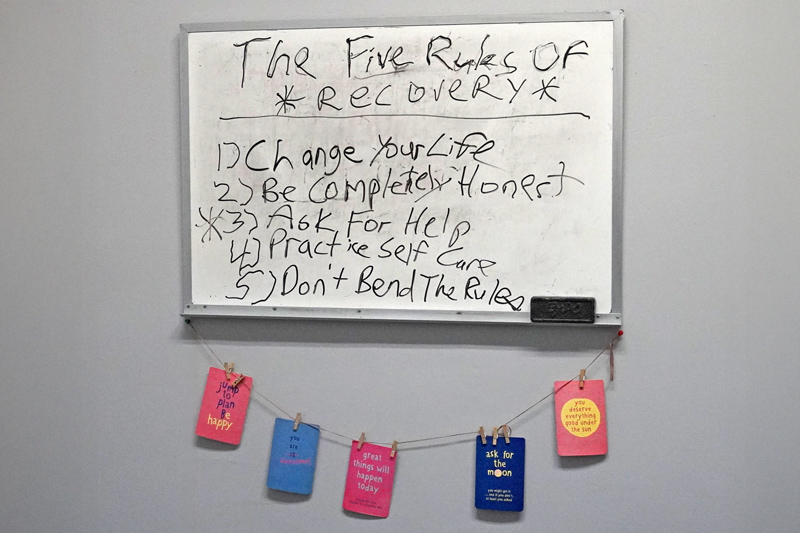
A poster in a psychiatric rehabilitation group room at SPOP, created by the Peer Specialist and group participants.
SPOP is a community-based behavioral health provider for older adults (55+) based in New York City. We serve 1,000 clients annually through an outpatient clinic and a psychiatric rehabilitation day program (PROS) for adults with serious mental illness. We offer a full range of services including individual and group therapy, psychiatry, medication management, assessments, bereavement support, group-based psychiatric rehabilitation services, creative arts therapies, social healthcare, and linkages to supports for housing, meals, and financial assistance. Since our founding in 1979, we have partnered with dozens of hospitals, older adult centers, aging services providers, and other agencies to reach out to adults across the city who might otherwise have no access to behavioral healthcare.
SPOP has used “older” Certified Peer Specialists (over age 55) in its PROS program for ten years and recently expanded peer engagement for the clinic population. The peer advocate who is also a contemporary of the client plays a distinctive role with older adults.
Living with mental health challenges while aging is no easy feat. By nature of age and experience, older adults may need to adapt to physical challenges, changes in cognitive function, loss of family members and friends, or social isolation, all while managing the stress of living in a turbulent time. With these barriers, one of the most valuable supports can be another older adult with shared lived experience of mental health struggles who teaches the client self-advocacy, helps them build stamina for navigating difficult systems, and demonstrates what success can look like.
Alice is an example of a client whose experience with a peer advocate was entirely different from that with her therapeutic team. She enrolled in our PROS program a few years ago, hoping to enhance her living skills to help navigate her diagnosis of major depressive disorder and post-traumatic stress disorder. When she joined the program, she found it difficult to make eye contact, spoke so softly that it was almost impossible to hear her, and shared that she was “at the bottom of a deep well, with no place to go but up.” She often sought out the peer advocate, who was her contemporary, to talk about their experiences and the challenges of recovery and aging. The peer repeatedly shared his story of depression and the long path to recovery and spoke of how his work helping others also supported his own recovery.
Over time Alice began to speak up more frequently in groups, often adding that it was difficult to discuss her mental health because of the stigma and shame she experienced in her youth. She shared that helping others with their mental health was important to her because “people should not feel ashamed or misunderstood. Society can make you feel so bad about your mental health and even doubt yourself. I want to help others find their voices like I did.” With the guidance of her treatment team, Alice applied for training as a certified peer advocate, and when she was accepted, she took her studies seriously. She graduated from SPOP while she completed her training and certification, and she moved across the country to work full-time as a peer advocate.
At SPOP the peer specialist is a confidant, empathic listener, problem solver, advisor, escort for medical appointments, and role model. The peer provides assurance that clients can recover, heal, form new friendships, and even pursue a new career – a goal many clients struggled to conceptualize until they saw the peer in action. These are roles that are beyond the scope of our therapists, social workers, and psychiatrists, and we have learned that they are an essential part of healing. Working with their peers, the clients don’t just hear that recovery is possible, they see it with their own eyes.
Peter is another SPOP client who is a long-time survivor of physical and emotional abuse. When he came to SPOP he was deeply mistrustful of others, particularly authority figures and those working at the agencies or hospitals he had visited, and he chose to live in a shelter because he was afraid to return home. The staff tried for two months to engage with him, with limited success.
It was only the peer specialist who was able to nurture and earn Peter’s trust, as they sat together, quietly sharing personal stories. The peer also met with Peter in the community to accompany him to medical appointments, often talking or just sitting together quietly during long subway rides. Working with the peer, Peter was able to complete applications for housing and meals assistance, and he expects to move to a safe apartment shortly. He continues to attend the SPOP PROS program and has recently started to participate in groups and engage in conversation during congregate meals.
Our clients often reflect on how they will be remembered and what they wish to leave behind. By leading by example, sharing experiences, and listening with compassion, the peer advocate has shown that each life story has value, and that each individual has the capacity to heal, form friendships, and find community. For an older adult whose life has been largely defined by illness or disability, that is a profound lesson.
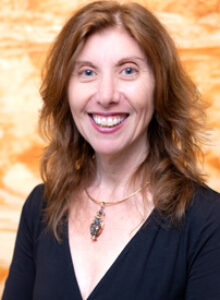
Catherine Thurston, LCSW, has served as Chief Executive Officer of Service Program for Older People (SPOP) since 2024, having previously served as Chief Program Officer. She has over 35 years of experience in gerontological social work. She has been a member of the Adjunct Faculty at the Silberman School of Social Work at Hunter College since 2016. She received her Master of Social Work from Hunter College School of Social Work.