Law enforcement officers are most often the first responders when individuals are experiencing a mental health crisis. Some research studies have estimated that at least 20% of police service calls involve a mental health or substance use crisis, and this demand has been increasing for many departments across the US. In a nationwide survey of over 2,400 senior law enforcement officials, approximately 84% reported an increase in mental health-related calls during their careers, and 63% noted that their departments now spend more time on mental illness calls than ever before.
Over the past few decades, the way that police agencies handle these encounters has come under increased scrutiny. Concerns have been raised by people diagnosed with mental illness and mental health advocacy groups, particularly regarding interactions that involve the use of force. One study estimated that one in four people with a mental health condition have been arrested at some point in their lifetime. This increase in mental health-related cases and incidents has progressively led leaders and policymakers to question the adequacy of officers’ training in responding to such mental health crisis calls, and progressively more communities have been developing programs wherein police and professional mental and behavioral health clinicians have been collaborating more closely on such emergency call responses.
Policymakers have shown a keen interest in improving police responses to individuals experiencing mental health crises through numerous hearings and more robust legislation. A joint report by the Vera Institute of Justice and Bazelton Center for Mental Health Law underscores the US Departments of Justice (DOJ) and Health and Human Services (HHS) strong support for federal laws mandating that individuals with behavioral health and other disabilities are to receive a health response—not a law enforcement response—in situations where others would receive a health response. In other words, when someone is experiencing a mental/behavioral health crisis, a team of workers with mental health expertise should be dispatched, similar to how an ambulance would be sent for a physical health emergency. Failing to provide this type of response can be considered a violation of the civil rights of the individuals involved.
In addition, the DOJ and HHS assert that deploying co-responder teams, which pair officers with clinicians, can be considered a “reasonable modification” in situations where a police response is necessary. However, continual reliance on co-responder teams and other police-led approaches will tend to “perpetate the criminalization of individuals experiencing behavioral health crises.” They also emphasize that ongoing federal guidance and support is available for communities that have historically depended heavily on police for mental crisis responses who want help in reducing police involvement related to such behavioral health situations.
While it may be fair to assume that of the approximately 18,000 US law enforcement agencies, few have actively followed the federal directives described above, it is also true that quite a number of communities have been successfully implementing effective models that follow the spirit, if not the exact letter, of the mandates regarding mental and behavioral health crisis incidents.
In exploring options for improving and enhancing their mental health incident responses, a number of agencies nationwide have adopted specialized approaches, often through directives from their local governments, such as Crisis Intervention Teams (CITs), involving specially trained law enforcement officers who respond to mental health crisis calls, in coordination with mental health providers, and Co-Responder Teams (CRTs), where law enforcement officers are paired with trained clinicians to jointly respond to emergency calls involving a mental health crisis.
While these approaches may fall somewhat short of the mandates described by the DOJ and HHS, the above models are arguably preferable to having only officers respond to such events with little or no specialized training in handling a mental/behavioral health crisis.
A third model seems closer to meeting the federal guidelines: Mobile Crisis Teams (MCTs), wherein community-based mental health professionals respond to such crises, with police being involved only when necessary. The Vera Institute and Bazelon Institute support this approach, where “jurisdictions should not assume that the proper response to a crisis is always to send law enforcement.” They advocate for law enforcement and 911 dispatch to divert calls to unarmed, properly trained behavioral health responders “whenever appropriate.”
According to the Congressional Research Service, CITs, CRTs, and MCTs may each improve certain outcomes, such as enhancing police officers’ perceptions of and responses to people with mental/behavioral disorders, and helping to connect individuals with mental health services. However, it is less certain whether these improvements will lead to tangible benefits in the long run for those with mental health needs, such as fewer arrests and reduced use of force overall.
One of the more forward-thinking communities to address these issues is Ithaca, NY, a city of some 31,000 residents in the Finger Lakes region, home to Cornell University. In the wake of a tragic mental health response several years ago that resulted in the death of a beloved local police officer, the city sought to reform how such events were handled. There were several different models attempted, and after struggling for some years with how to form a workable policy, a forward-thinking mayor, along with the city’s Common Council, developed the CARE (Crisis Alternative Response and Engagement) team approach, which had professional clinicians leading the response to mental health incidents, backed up by trained officers. Although a change of administration and police leadership led to a less robust program, in December 2023, the Re-imagining Public Safety initiative was introduced in Ithaca, and thereafter the Common Council passed a resolution to replicate the CARE Team response program.
In the Ithaca Police Department (IPD), mental and behavioral health clinicians collaborate with officers by responding to calls involving individuals who may be in dangerous situations due to their mental state. CARE services may include de-escalating situations and providing support after a crisis that may have involved violence or potential injury.
Harmony Ayers-Friedlander, the Deputy Commissioner for Mental Health Services of Tompkins County Whole Health, in Ithaca, explained that the CARE team was established based on research and data on the effectiveness of co-response teams. Friedlander noted that such research has also helped address the issue of people unnecessarily going to emergency departments for mental health crises.
Colorado Springs, CO, a community of just under a half-million, famous for being where the US Air Force Academy is located — as well as the US Space Force and Focus on the Family — may stand to represent the model closest to meeting the federal guidelines for handling such critical incidents.
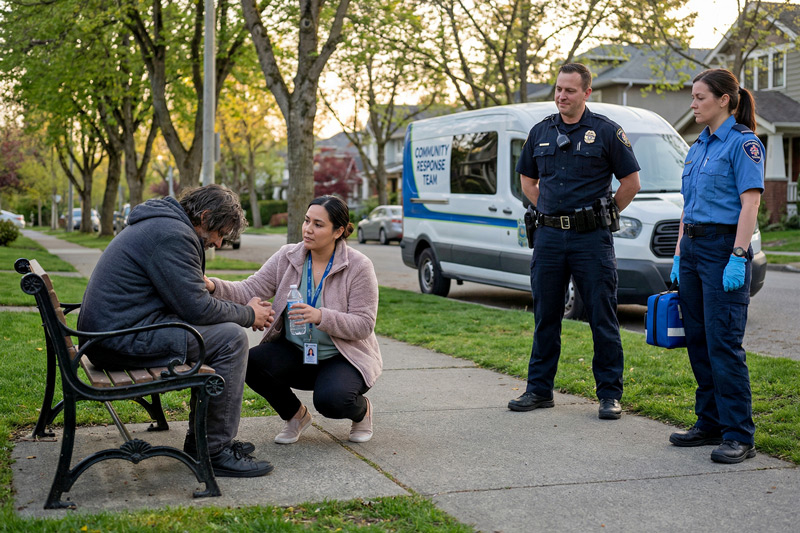
In Colorado Springs, the Community Response Team (CRT) is indispensable for managing mental health emergencies. When residents contact 911 or the state crisis line for a mental/behavioral health crisis, a team consisting of a Colorado Springs Fire Department paramedic, a Colorado Springs Police officer, and a mental health technician from Diversus Health responds. The CRT was established in 2012 to improve support for individuals experiencing behavioral health crises. This followed almost a decade of exploring and developing new models of handling such events, first initiated by Chief Fletcher Howard before the turn of the century.
One reason they believe their CRT has been so successful is that the clinician and the fire department personnel take the lead in such events, both of whom seem less frightening and authoritative to a distressed individual than a law enforcement officer.
Whichever appropriate approach the local legislature and police agency may adopt, it is well past time to leave such critical mental and behavioral events to be handled by officers with little or no training, and whose job it is to enforce the law, not to treat individuals with mental health issues.
One final word: law enforcement agency personnel across the US generally hold that there is a condition known as Excited Delirium which can ‘take over’ an individual going through a mental or behavioral health crisis, typified by extraordinary strength and almost superhuman capabilities. This is a myth. There is no such thing as Excited Delirium — it has never been recognized by the American Psychiatric Association, or any other legitimate professional organization. This misconception is peculiar to police professionals. Unfortunately, tragedy has followed from this myth, especially in situations where first responders call for medical assistance due to expected superhuman behaviors showing up in a mental or behavioral health crisis, and particularly in the unnecessary use of chemical sedatives, such as Ketamine, which has led to needless tragedy and death, underscoring the need for police agencies everywhere to collaborate with professionals better prepared to deal with such incidents.

Dr. Gene Ira Katz, DMCJ, DABS, LAC, LPCC, is Executive Director of Positive Pathways Institute. Contact Dr. Gene Ira Katz at [email protected] or 720-339-8174 (leave confidential message). Learn more about Dr. Katz here.
References
American Psychological Association, Building Mental Health Into Emergency Responses, https://www.apa.org/monitor/2021/07/emergency-responses
Carolina Cedraschi [Ithaca Week], CARE Team and police work together on mental health-related crimes, https://ithacaweek-ic.com/16036/community/care-team-continues-to-work-with-the-ithaca-police-department-to-assist-with-mental-health-related-crimes/
Colorado Springs.gov, Colorado Springs, the Community Response Team (CRT), https://coloradosprings.gov/fire-department/page/community-and-public-health-cares#
Congressional Research Services, Issues in Law Enforcement Reform: Responding to Mental Health Crises, https://crsreports.congress.gov/product/pdf/R/R47285
Vera Institute, New Federal Guidance for Alternatives to Police for People with Behavioral Health or Other Disabilities, https://www.vera.org/newsroom/the-vera-institute-of-justice-issues-statement-on-new-guidance-from-the-departments-of-justice-and-health-and-human-services