Beginning an Intensive Outpatient Program (IOP) is not just about addressing symptoms. Many participants enter treatment carrying uncertainty about the process, wondering whether it will work and how they will manage future challenges.
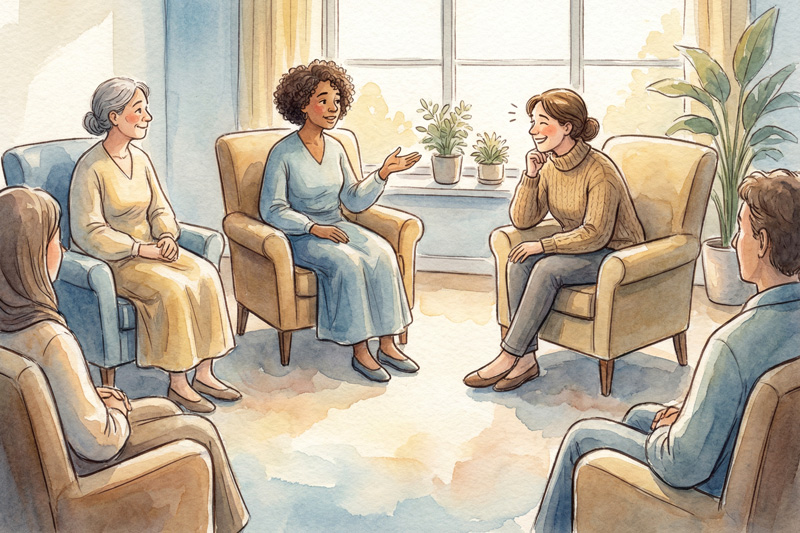
Even with strong therapeutic relationships and evidence-based care, many participants quietly question whether the progress made in the small-group therapy format of IOP will hold up when stress, conflict, or old patterns resurface.
Specialized IOP therapists provide structure, teach skills, and share their expertise. Family members often offer love and encouragement. Yet one of the most powerful elements of treatment is peer support, which often helps individuals move from simply understanding a skill to using it in real life, a concept known as skills generalization.
Peers as Partners in the Mental Health Recovery Process
Peer support is one of the most powerful mechanisms of change in an IOP. Research shows that peer involvement can help people stay engaged in treatment, reduce hospitalization, and increase feelings of empowerment and connection. This is largely because peers bring something unique: real-life experiences. They remember what it feels like walking into a group for the first time. They understand the mix of hesitation, hope, and tiredness that comes with starting over. When a peer says, “I’ve been there,” it carries authenticity. That honesty helps participants feel less alone and more able to continue their recovery after the program ends.
Why Peer Support Matters in IOP
IOPs provide a structured, effective, safe, and supportive environment, often meeting three to four days a week for three hours each day. This format offers a higher level of mental health care while still allowing participants to live at home and maintain aspects of their daily routines.
Within IOP, participants learn valuable skills such as:
- Changing unhelpful thought patterns
- Managing intense emotions
- Coping with stress
- Building healthier relationships
However, learning these skills in a group setting is only the first step. The real challenge comes when participants try to apply those tools during an argument with a partner, a stressful meeting at work, or a quiet evening when difficult thoughts return.
This is where peer support becomes especially meaningful.
Peers help bridge the space between insight and action – between learning new skills and applying them in everyday life. They normalize the difficulty of practicing new tools in daily living and offer practical examples from their own lives. Perhaps most importantly, they remind participants: You don’t have to figure this out alone.
1. Turning Theory into Usable Action
IOP participants absorb a great deal of information, but translating therapeutic concepts into real-world action can feel overwhelming, especially during moments of distress outside of group hours.
Peers help bridge that gap by:
- Modeling how they have used coping skills in their own lives
- Helping participants troubleshoot real-world situations
- Offering practical, relatable strategies
For example, rather than saying, “You should try grounding,” a peer might explain, “Here’s what grounding looked like for me when I was sitting in my car before work, trying not to panic.”
That level of detail matters. It makes theory practical.
For clinicians, peer support helps reinforce skill generalization across situations. For families, it increases the likelihood that progress continues beyond the program hours.
2. Increasing Engagement and Reducing Dropout
Participant engagement is one of the strongest predictors of positive outcomes in behavioral health treatment. Yet many individuals entering IOP feel ambivalent or uncertain about their ability to change.
Peers are often the first people they feel comfortable opening up to. Because they share similar experiences, peers may feel less intimidating and participants may feel less judged.
This sense of connection helps:
- Reduce stigma
- Build trust
- Strengthen engagement in treatment
When individuals feel understood by their peers, they are more likely to:
- Attend sessions consistently
- Actively participate in discussions
- Reach out during moments of distress
Research shows that having peers involved helps support IOP goals by improving treatment retention and reducing hospital admissions. Engagement then becomes about the relationships, not just following steps.
3. Supporting Transitions into and out of IOP
Starting IOP can feel intimidating. New settings, unfamiliar people, and unclear expectations can make participants hesitant.
Peers help new participants understand what to expect and normalize the discomfort that often comes at the beginning of IOP treatment. This reassurance can reduce early dropouts and help individuals feel safe entering the therapeutic environment.
Peer support is equally important when participants prepare to leave the program.
Peers can help by:
- Assisting with aftercare planning
- Identifying community support resources
- Sharing personal experience of maintaining progress after discharge
- Encouraging proactive follow-up care
This support helps participants view recovery not as something that ends when treatment ends, but as a process they can continue in their everyday lives.
The Impact on Empowerment and Identity
One of the most powerful aspects of peer support is how it helps individuals see themselves differently.
Mental health challenges can lead people to define themselves solely by their struggles, seeing themselves as anxious, depressed, broken, or failing. Peers offer a different narrative. They demonstrate that recovery is attainable, that setbacks can be overcome, and that growth continues over time. Seeing someone further along in their recovery expands what feels achievable. This shift fosters empowerment, giving participants a sense of control and hope. Over time, participants begin to internalize not only the new coping skills but also a renewed belief in their own resilience.
A Complement to Clinical Excellence
Family Care Center’s mental health IOP provides structured, evidence-based care in a small group format. Sessions are led by experienced behavioral health professionals and are designed to provide personalized support within a welcoming and collaborative therapeutic environment.
Program focuses on:
- Changing unhelpful thought patterns
- Symptom stabilization
- Trauma recovery
- Resilience building
- Developing practical skills for long-term recovery and wellness
Treatment approaches may include:
- Dialectical Behavior Therapy (DBT)
- Crisis stabilization strategies
- Symptom management
- Resilience training
Participants also receive support addressing factors that influence emotional health, including sleep, nutrition, pain, and substance use. Psychiatric services, along with close collaboration with primary care and mental health providers, strengthen continuity and coordination of care.
This structured, team-based approach leads to real results. Family Care Center IOP patients have reported major improvements in conditions like depression, anxiety, PTSD, and suicidal thoughts. Some of the outcomes are:
- 96% reporting reduced depression
- 82% reporting relief from anxiety
- 81% reporting fewer PTSD symptoms
In this clinically focused setting, peer support adds real value alongside professional treatment. Clinicians handle assessment, therapy, and medication management, while peers help participants use new skills, understand that recovery challenges are normal, and stay engaged.
Recovery Is Relational
In the end, mental health recovery and wellness are not just about reducing symptoms. It is also about connection, confidence, and believing that change can last.
Peer support can make IOP more effective because it focuses on the human side of healing:
- “You’re not the only one.”
- “It makes sense that this is hard.”
- “Here’s how I got through something similar.”
When these messages are shared honestly, they can be the difference between just understanding and actually taking action, between simply showing up and truly engaging, and between coping for now and building lasting strength.

Tasha R. Kalhorn, PsyD, is Senior Director of the Intensive Outpatient Program (IOP) at Family Care Center. For more information, visit fccwellbeing.com.