On January 14, 1980 (my birthday) I sat at a drafting board at Island Drafting and Technical Institute in Amityville, New York, beginning my journey as a mechanical draftsperson. One thousand hours later, I earned my certification and was placed through the school’s employment services at an engineering firm in Freeport, where I worked for four years. At the same time, I was pursuing my Associate’s Degree in Advertising Art & Design at SUNY Farmingdale.
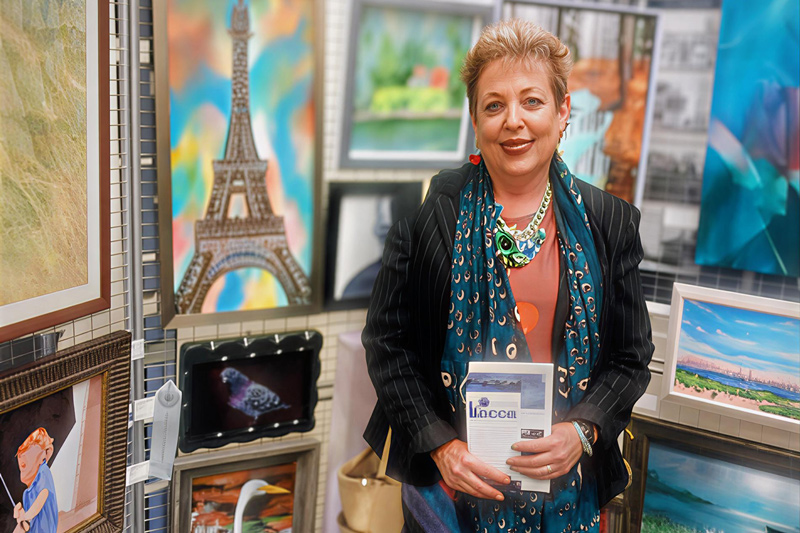
Patricia Masi at an art show in Babylon, NY, with her painting Eiffel Tower, 12″ × 24″, acrylic on canvas.
During my time at the Freeport firm, I learned to draw topographical maps, much of which supported the telecommunications industry. I spent countless hours drafting roadways, learning where to place conduit and how to develop the plans, profiles, and details that brought projects to life.
As the years passed, hand drafting gradually gave way to CADD. As an artist, however, I found computer-aided design to feel cold and impersonal. Eventually, I transitioned away from drafting and into a role as an Office Administrator. Over time, my attention to detail led me to specialize in assembling proposals. I worked for years under tight deadlines, coordinating documents from architects, engineers, surveyors, and subconsultants; typing, printing, and learning new design programs, priding myself on never missing a deadline. But that pace came at a cost.
After the birth of my son in 1988, while balancing part-time work in an architecture and engineering office while also working from home, I began experiencing what I would later understand as postpartum depression, along with panic disorder, anxiety, and agoraphobia. At the time, I didn’t yet have the language for what I was going through. In 1990, the diagnosis finally came, months after I had reached a point where even leaving my home felt impossible.
For the next 18 to 24 months, I faced daily challenges, trying to “climb out of a paper bag” while simultaneously “breathing into one,” overwhelmed by anxiety and relentless pressure. Difficult circumstances at home eventually led me to seek counseling, a decision that changed the course of my life and ultimately led to my divorce.
Through it all, I continued working while co-parenting my son with my ex-husband. I completed my Associate’s Degree in Advertising Art & Design and later took on two additional jobs to make ends meet. Determined to keep growing, I returned to college and earned my Bachelor’s Degree in Business, Management, and Economics at the age of 50. My son went on to build an international life, studying International Relations in the United States, having lived in Moscow, Russia, and eventually settling in Paris, France, where he currently resides.
In 1998, 2006, and 2016, I faced three separate diagnoses of early-stage breast cancer, ultimately undergoing a double mastectomy followed by multiple reconstructive surgeries. During that time, I was also illegally terminated from my job. After five months of unemployment, I secured a local position, though at a significant pay cut. Then COVID hit, and once again I found myself out of work. During that period, the Department of Labor offered a course to become an Addiction Recovery Coach, and I chose to pursue it. My instructor encouraged me to continue my education through the Academy of Peer Services in order to earn my certification as a New York Certified Peer Specialist.
When the world began to reopen, I secured a position at a local mental health clinic on Long Island. Although I had not yet completed my studies, my supervisor, a physician’s assistant, supported me in finishing my coursework while working as a Peer Bridger.
I began meeting with clients weekly and launched a painting workshop that met twice a week. Diagnoses were left at the door. Week after week, clients returned, sharing openly, supporting one another, and creating meaningful artwork. Over time, the group became a safe haven: a space for connection, expression, and healing through creativity.
When that grant ended, I transitioned into a CORE Educator role under a new program, helping clients in their homes and in the community work toward their educational and employment goals. I later spent nearly a year doing street outreach with the homeless with another agency. Ultimately, I realized how much I missed working directly with clients in a mental health setting.
For the last nearly two years, I have worked at another mental health clinic on Long Island, where I see multiple clients each day and co-facilitate three art groups, two for adults and one for children. I have also successfully launched two art shows, bringing pride, joy, and a sense of accomplishment to both the clinic and its participants.
My most difficult moments ultimately guided me to where I belong, using my experience, strength, and hope to support my clients each day. The path to peer support has been long and winding, but incredibly rewarding, allowing me to do what I truly love.
I am honored and privileged to meet with clients sharing their most vulnerable stories, yet, through art, we create, and unleash, only what the power of art can do: provide limitless opportunities to express oneself without even uttering a word. #yougottahaveart
Patricia Masi is a Peer Specialist. To contact the author, email [email protected].