

In 1995, a man named Ken Steele began what he described as his recovery from a “30‑year schizophrenic odyssey.” His story stretched across the United States — from Hawaii to New York City — through periods of homelessness, halfway houses, and profound disconnection. Everything changed when he arrived in Brooklyn and received compassionate, consistent mental health care at The Park Slope Center for Mental Health. That care sparked a desire in him to contribute something meaningful to others walking a similar path.
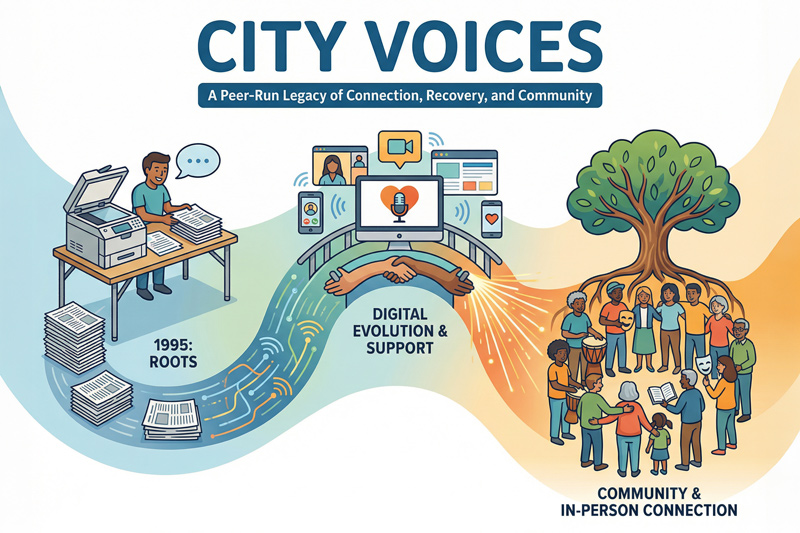
Ken began asking fellow patients to share their personal stories, opinion pieces, and poetry. He typed them up, photocopied them, stapled them together, and handed them out. That simple act of peer expression became the first issue of City Voices, a grassroots newspaper created by and for New Yorkers living with mental health challenges. Over time, the publication grew to reach an audience of more than 15,000 subscribers — a remarkable achievement for a peer‑run project born from a folding table and a photocopier.
When Ken passed away in 2000 at the age of 52, one of us (Dan Frey, who had been working as an assistant to Ken) stepped in as editor‑in‑chief and continued producing the newspaper for the next 20 years. During that time, City Voices published personal narratives, news coverage, event reports, opinion essays, poetry, and reflections from across the New York mental health community. The newspaper served as a platform for people whose voices were often overlooked, offering a space where lived experience was treated as expertise (digital versions of back issues are available online at cityvoicesonline.org/newspaper).
As the world changed, so did the needs of our community. When the COVID‑19 pandemic arrived, it became clear that City Voices needed to evolve beyond print media. Isolation was intensifying, and people needed connection as much as information. We transitioned to digital platforms and began expanding our mission from sharing stories to building community.
Two support groups, offered online through distance technology, emerged during this period and continue to this day. The first is a weekly spiritual discussion group, offering a space for people to explore meaning, grounding, and resilience. The second is a support group for peer specialists — professionals whose lived experience with mental health or substance use challenges allows them to build trust with clients in ways that traditional providers sometimes cannot. These groups became anchors during a time when many people felt adrift. Details on these groups can be found the City Voices website.
Of course, while distance technology can reduce barriers for connection, in person connection is still essential for all humans, especially people diagnosed with mental health conditions. When pandemic restrictions lifted, we began partnering with psychosocial clubhouse Fountain House to host monthly in‑person events in a centrally located, welcoming space. These gatherings have included Social Anxiety Mixers, Drum Circles, Black History Storytelling Circles, Friendship Storytelling events, Barter Bashes, and Storytelling Masquerades. Each event is designed to reduce isolation, celebrate creativity, and strengthen community bonds. In addition, Fountain House members can participate in our weekly meditation groups, often led by experienced instructors who generously volunteer their time.
Another important initiative that was developed during the pandemic was Companion Connections (originally called The Friendship Squad) a one‑to‑one companionship program for people experiencing loneliness and isolation. The need for this kind of connection is profound. According to the U.S. Surgeon General’s 2023 advisory, the United States is facing an epidemic of loneliness and social disconnection, with significant consequences for both physical and mental health. For people in mental health recovery, the impact can be even more acute. Many individuals face stigma, fractured support networks, or long periods of isolation that make it difficult to rebuild community. Companion Connections participants commit to connecting at least once a week — by phone, text, or distance technology — for six months. Over the past four years, we have watched many of these companionships grow into lasting relationships that continue well beyond the program’s formal structure. Although our focus is on people in mental health recovery, we do not turn away others who may benefit — including seniors who are often deeply affected by isolation. The online component of Companion Connections has also allowed City Voices to extend its reach beyond New York City. More than 120 people have participated in Companion Connections so far.
Concurrently with the development of the above services, in 2023 City Voices officially became a non-profit organization with a board (with professor and mental health advocate Philip Yanos joining on as recording secretary), allowing it to fundraise, support part-time staff, and apply for grant support. A recent grant from the Dammann Fund, will allow for the expansion of the Companion Connections program.
City Voices has changed dramatically since Ken Steele first stapled together those early pages, but the heart of the work remains the same: people with lived experience of mental health conditions supporting one another through shared experience, creativity, and connection. Peer‑run organizations like ours may be small and non‑traditional, but they can have a meaningful impact on the lives of individuals who often fall through the cracks of larger systems.
City Voices demonstrates what is possible when people with lived experience come together to build something for their own community and shows that peer-run initiatives can come in all shapes and sizes. Peer‑run initiatives are uniquely positioned to foster trust, reduce isolation, and create spaces where people feel seen and valued. City Voices is just one example of what can grow from that foundation.
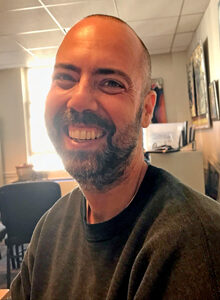
Dan Frey, President of City Voices, can be reached at 929-884-3564 or by email at [email protected]. Philip Yanos, PhD, Secretary of City Voices and faculty member at John Jay College of Criminal Justice, CUNY, can be reached at 212-484-1320 or by email at [email protected]. For more information about City Voices, visit cityvoicesonline.org.


This is an excellent example of what someone can do to support people in recovery. Very glad to be a part of this initiative. Go peers!