

Peer support has always been bigger than the box systems tried to paint it in. Long before it was codified, credentialed, or added into service plans, it was ordinary folk reaching for one another—standing in the front, behind and to the side of each other sharing hard-earned wisdom, offering dignity where systems offered labels, creating connection where isolation and stigma had taken hold and catching us when we fell. In behavioral health, peer support emerged from recovery, mutual aid, and consumer-survivor-led movements that insisted people are more than diagnoses, more than case files, and more than the worst moments of their lives. The field’s early scholarship reflects that foundation, describing peer support as rooted in mutuality, shared responsibility, respect, and the belief that lived experience is a legitimate source of knowledge, not a bare-bones substitute for professional expertise (Mead et al., 2001; Solomon, 2004). That foundation still matters. That foundation is our bedrock where our path is engraved with the footsteps of those who started this good trouble but are no longer here. But the truth is, peer support was never meant to stay in one lane — shackled and muzzled.
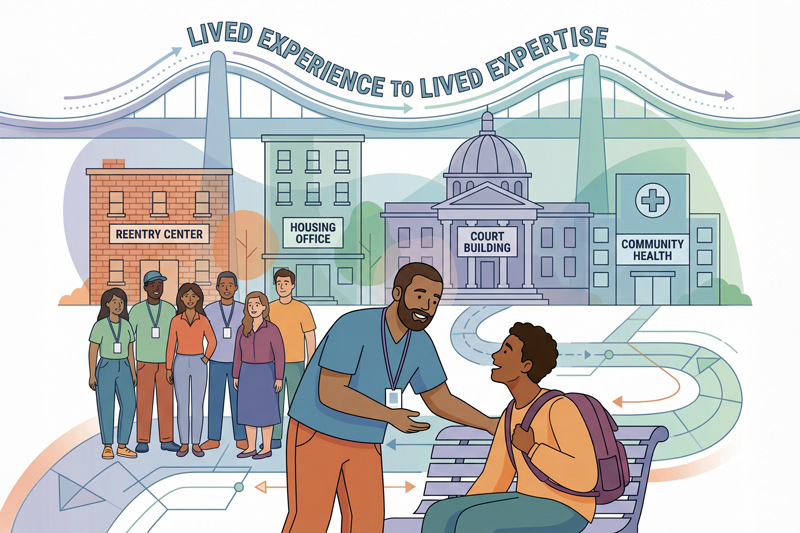
Today, peer support is moving well beyond its traditional beginnings solely in behavioral health and into multiple diverse settings. Places and spaces like the criminal legal system, housing, public health, crisis response, policy, legislative advocacy, and research. I shake my head in wonderment sometimes — we are forging ahead at the speed of light! I mourn (slightly at best) that this was not prevalent as I spent 25 years moving through systems — the behavioral health system (MH and Substance Misuse), homelessness, crisis, family court… all of these systems wrapped up in a big ugly red bow of the criminal justice system — it’s the kind of present or fancy gift that keeps on giving what you never wanted — everything you don’t need, and absolutely nothing you do need. The expansion of peer support is not mission drift — it is putting us in places and spaces where we are so very necessary and desperately needed. It is a mission matured. It is the realization that folks do not live their lives in neat service categories, so support cannot remain siloed either. A person navigating recovery may also be leaving jail, fighting for housing, parenting through trauma, facing food insecurity, addressing physical health conditions, and trying to survive the daily weight of stigma — yeah…check all the above. And add into that potent witches’ brew…struggling to achieve and maintain recovery and yes — wellness. Now there’s a word I never heard as I came up through these systems — wellness. In this reality, peer support works because it meets the whole person where they are rather than a single system-defined problem. Research continues to show that peer support improves engagement, hope, empowerment, and recovery-oriented outcomes, especially for people who have been failed or stigmatized by traditional systems (Chinman et al., 2014; Davidson et al., 2012). What peers often bring that institutions cannot manufacture is credibility.
That credibility is grounded in lived experience. And let me be clear: lived experience is more than valid — for me — it is the epitome — the pinnacle. It is not anecdotal fluff. It is not charity. It is not tokenism. It is knowledge forged through surviving and navigating systems that many decision-makers only know from reports, policies, or statistics — or yes — academia. As an academic myself — I’m not shooting myself in the foot — I’m just being authentic and real. I consider myself armed and truly dangerous because I have intimate knowledge of both sides of the coin. In my own public testimony, I described this as the move from “lived experience to lived expertise” (Skipper, 2024). That phrase matters because it names a transformation too often overlooked. Lived experience is the raw knowledge earned through surviving these traumatizing systems of care. Lived expertise is what happens when that knowledge is sharpened through reflection, practice, analysis, service, research, and leadership. It is not simply “having a story.” It is knowing how to use that story responsibly and strategically to support others, reshape systems, and inform policy.
That idea is also reflected in my published scholarship. In recent peer-reviewed work on peer support and reentry, my coauthor and I argue that peer support is effective precisely because people with lived experience can provide “unique and practical support” that traditional models often miss, especially where trauma, criminal legal involvement, and structural barriers intersect (Skipper & Ortiz, 2024, p. 542). That distinction matters because the people most impacted by system failures are often those least likely to trust systems that have repeatedly harmed, dismissed, or criminalized them. A peer can enter that space differently. A peer is often understood first as someone who has walked a similar road and learned how to keep going despite and also just because (only a peer will understand this last part!).
This is especially clear in the criminal legal system. Justice-involved individuals frequently return home carrying trauma, disrupted care, family strain, housing instability, untreated behavioral health needs, and the deep shame from being impacted. Traditional reentry structures often expect compliance before connection. Peer support reverses that logic. It begins with relationship and community building. It begins with trust and mutuality. It begins with the simple but radical message: I know something about this road, and you do not have to walk it alone. Research on credible messengers and justice-impacted peer roles underscores this point, showing that individuals with lived experience of criminalization bring forms of trust, legitimacy, and practical guidance that are deeply meaningful to the communities they serve (Urban Institute, 2022). This is not a soft extra or an “add-on.” It is often the very thing that makes engagement possible.
The same is true in crisis response and public health. Public systems are increasingly being forced to confront what peers have known all along: health, safety, and recovery are deeply interconnected. Mental health crises do not occur in a vacuum. Neither do overdose, community violence, homelessness, or the despair that grows when people are cut off from care and connection. Public health frameworks now emphasize social determinants and structural drivers, but peers have been translating those realities on the ground for years. We know what it means when a person misses an appointment because they have no MetroCard, no child care, no safe place to sleep, or no reason to believe anyone in the room actually sees them or even hears them. Peer support bridges those gaps because it translates both ways: it helps people navigate systems, and it helps systems understand the people they were supposedly designed to serve.
Housing is another place where peer support has become indispensable. Recovery cannot stabilize where housing is unstable. Hope is hard to hold onto when a person is facing eviction, shelter conditions, unsafe placements, or the crushing uncertainty of not knowing where they will sleep tomorrow. In housing settings, peers help reduce isolation, strengthen problem-solving, and reinforce self-determination. They do not exist to enforce compliance. They exist to help people build lives that can hold fast. In reentry and supportive housing, that distinction is crucial because too many systems still confuse surveillance with support.
Policy and legislative advocacy may seem further removed from traditional peer roles, but this is exactly where peer leadership belongs. Systems have long been designed around people without meaningfully including the people most affected by them. Peers change that. Nothing about us — without us! They bring grounded lived knowledge into conversations about diversion, treatment access, Medicaid reimbursement, workforce development, crisis services, jail policy, and community investment. They do more than tell personal stories. They expose the distance between policy language and lived reality. They ask sharper questions. Who was this policy built for? Who does it leave out? What does “access” mean if the front door is technically open but still impossible to enter? It’s not okay when you open the door and let us in without giving us the supports to stay in! When peer workers step into policy spaces, they bring insight that is both experiential, analytical and crucial. The hard questions are asked and answered by their testimony. That is lived expertise in action.
What excites me most about this moment is not simply that peer support is expanding. It is that the peer workforce is forcing a larger reckoning with what counts as expertise. For too long, expertise has been defined as something that comes only through formal training and education — far removed from lived struggle. But surviving incarceration, navigating recovery, rebuilding after crisis, advocating through systems that were not built for you, and learning how to transform pain into purpose also generate advanced knowledge. That knowledge deserves recognition, compensation, infrastructure, and leadership pathways. My own professional life—and the lives of so many peers I work beside—makes the case that lived experience is not adjacent to system transformation. It is central.
At the same time, expansion brings risk. As peer roles become more formalized, institutions may try to absorb peers without honoring peer values. They may want the labor without the philosophy, the optics without the power shift, the relatability without the critique. The literature is clear that peer support is strongest when it remains anchored in mutuality, clear role definition, adequate support, and organizational cultures that genuinely value lived experience rather than treating it as symbolic (Repper & Carter, 2011; Solomon, 2004). Professionalization strengthens the field through training, supervision, certification, and sustainability. But if we professionalize the soul out of peer support, we lose the very thing that makes it transformative and alive.
So yes, peer support began in behavioral health. But it didn’t stop there, and it should never. It belongs in hospitals, jails, courts, reentry programs, housing settings, schools, violence interruption efforts, community health work, policy tables, and research teams. It belongs anywhere people are being asked to heal, rebuild, navigate harm, or imagine a future larger than what systems have told them is possible.
When I say, “Oh the places peer support can go,” I am not talking about trendiness or a basic elevation for expansion’s sake. I am talking about what became possible when we finally recognized lived experience as valid, lived expertise as real, and peer leadership as essential. If behavioral health—and all the systems surrounding it—are serious about recovery, justice, and human dignity, then peers cannot remain on the margins. Trust, we are not asking for permission to matter. We already do!

Helen “Skip” Skipper, CPS, MA, is Executive Director, NYC Justice Peer Initiative and Vice Chair, NYC Board of Correction. For more information, email [email protected].
References
Chinman, M., George, P., Dougherty, R. H., Daniels, A. S., Ghose, S. S., Swift, A., & Delphin-Rittmon, M. E. (2014). Peer support services for individuals with serious mental illnesses: Assessing the evidence. Psychiatric Services, 65(4), 429–441. https://doi.org/10.1176/appi.ps.201300244
Davidson, L., Bellamy, C., Guy, K., & Miller, R. (2012). Peer support among persons with severe mental illnesses: A review of evidence and experience. World Psychiatry, 11(2), 123–128. https://doi.org/10.1016/j.wpsyc.2012.05.009
Mead, S., Hilton, D., & Curtis, L. (2001). Peer support: A theoretical perspective. Psychiatric Rehabilitation Journal, 25(2), 134–141.
Repper, J., & Carter, T. (2011). A review of the literature on peer support in mental health services. Journal of Mental Health, 20(4), 392–411. https://doi.org/10.3109/09638237.2011.583947
Skipper, H. (2024, September 23). Testimony by Helen Skipper, Executive Director of NYC Justice Peer Initiative, on B-HEARD program and peer support in crisis response. CityMeetings NYC.
Skipper, H. (2025). Elevating lived experience to lived expertise in criminological research. In C. P. Dum, J. J. Fader, T. P. LeBel, & K. M. Wright II (Eds.), Handbook on lived experience in the justice system. Routledge.
Skipper, H., & Ortiz, J. (2024). Conceptualizing peer support to mitigate the rural-urban divide. International Journal of Rural Criminology, 8(4), 537–562. https://doi.org/10.18061/ijrc.v8i4.10043
Solomon, P. (2004). Peer support/peer provided services: Underlying processes, benefits, and critical ingredients. Psychiatric Rehabilitation Journal, 27(4), 392–401.
Urban Institute. (2022, December 8). New York City’s wounded healers: A cross-program, participatory action research study of credible messengers.


This was an amazing article , I came across this the day after having this conversation on zoom. please view and share link with Peers… https://youtu.be/9NhAhRa8Wp4?si=YvPkwvJxu8G0Ug2J