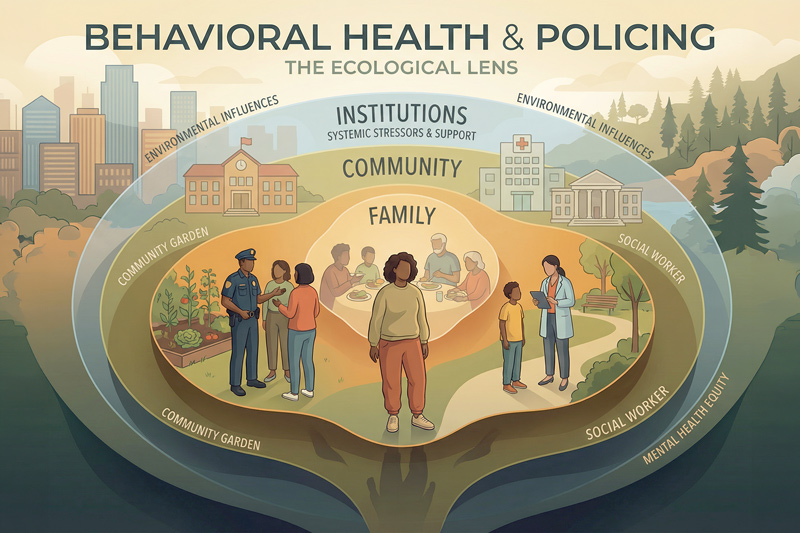
The ecological model helps us understand how people’s environments—from family systems to institutions like policing—shape behavioral health outcomes. Environmental determinants help explain how systemic and structural conditions contribute to mental health disparities. This article examines the ecological model’s capacity to account for environmental influences on mental health and discusses its integration into the biopsychosocial paradigm.
Integrating the Ecological Model
The ecological framework investigates the interactions between systems and the development of individuals, families, and groups within their environments. It examines immediate contexts, such as a person’s childhood home, alongside other influential systems that shape thoughts and behaviors in that environment. This model emphasizes core principles, including the relationship between environment and individual development, as well as the connection between the life course and the biopsychosocial framework.
Rationale for the Ecological Model
The ecological model provides a scholarly framework for analyzing systemic oppression through an anti-oppressive lens, offering context for the lived experiences of those from marginalized communities and for understanding human interactions within environmental settings at the individual, interpersonal, institutional, and structural levels. It emphasizes that human lives are shaped by lived relationships; however, the intersection of human identity in marginalized communities within institutional environments often reveals disparities. These environments tend to devalue humanity, enforce conformity, and restrict autonomy, identity, or safety among marginalized groups. When critical elements are missing, clinicians must intervene to deliver services and resources that support adaptation. Sometimes, this involves changing the environment, such as helping individuals returning from incarceration.
Ecological Factors in Policing Behavioral Health Crises
Banaji et al. (2021) explore how dehumanizing stereotypes related to marginalized groups influence policing behavior, leading to aggression and discrimination. These examples show that systemic oppression within the environment exists both between people and within organizations. The disparity in police shootings contributes to historical and generational trauma among marginalized communities. Police violence highlights the importance of critically evaluating law enforcement practices in marginalized communities. Ecological approaches support collaborative responses to behavioral health crises. Programs like Crisis Intervention Teams (CIT) foster partnerships between law enforcement, mental health professionals, and community groups to better address psychological distress, aiming to reduce escalation and improve access to care. Applying the ecological model through an anti-oppressive lens aligns with ethical principles and highlights the importance of assessing environmental risks that influence individual and family development.
Bio-Psycho-Social in Behavioral Health
The bio-psycho-social model explains how biological, economic, social, demographic, and cultural factors influence life transitions and key events (Gitterman & Germain, 2008). It clarifies the cause-and-effect link between environmental conditions and behavioral health. Engaging clients helps identify variables affecting decision-making and internal or external stressors, especially when environmental resources are lacking. Surroundings significantly impact psychological, emotional, and physical well-being. Natural and human-made environments—such as parks, oceans, transportation, and housing—are crucial for resilience and health. While some overcome adversity, others internalize stress, leading to issues like substance abuse or poor health. Understanding these challenges is vital for social workers, as they can trigger mental and physical health problems. Assessing both internal and external factors is key to addressing environmental risks systematically. Factors such as race, religion, age, gender, and emotional states shape how individuals interact with their environment. Clinicians must recognize how environmental influences impact diagnoses and symptoms. This perspective underscores the importance of incorporating environmental influences into a comprehensive biopsychosocial assessment.
Conclusion
The ecological framework emphasizes supporting vulnerable populations by assessing their strengths, stressors, resources, and environmental impacts on their life trajectories. This comprehensive approach provides detailed insights into how environmental factors influence individual and group development, making it essential in social work. Consequently, careful application of the ecological model is essential when conducting a bio-psycho-social assessment with clients, ensuring that health determinants influenced by the environment are accurately identified. Thus, the traditional bio-psycho-social format should be expanded to include more detailed information about the individual’s and family’s environment, capturing protective and risk factors that contribute to inequality. This allows clinicians to more effectively link clients with resources beyond their immediate environment. At the micro level, this involves changing bio-psycho-social factors within organizations and offering training to foster a comprehensive understanding. Integrating ecological assessment into behavioral health practice can help clinicians better understand how policing, community stressors, and institutional policies shape mental health outcomes.

Shane King, MSW, LCSW, is a psychotherapist and professor. He can be reached at (646) 450-4151 or [email protected]. For more information, visit www.psychologytoday.com/us/therapists/shane-king-new-york-ny/771629.
References
Banaji, M. R., Fiske, S. T., & Massey, D. S. (2021). Systemic racism: individuals and interactions, institutions and society. Cognitive research: principles and implications, 6(1), pg. 82. https://doi.org/10.1186/s41235-021-00349-3
Gitterman, A., & Germain, C. B. (2008). Ecological framework. In Y. Mizrahi and L. Davis (Eds.), Encyclopedia of social work (20th ed.) (20th ed., pp. 97–102). Oxford University Press.