“We’re not here to belittle you. We’re not here to down talk you. We’re not here to tell you what you should or shouldn’t be doing because that’s not our place.”
– Lavaughn Johnson, Peer Navigator at ReVive Center for Housing and Healing
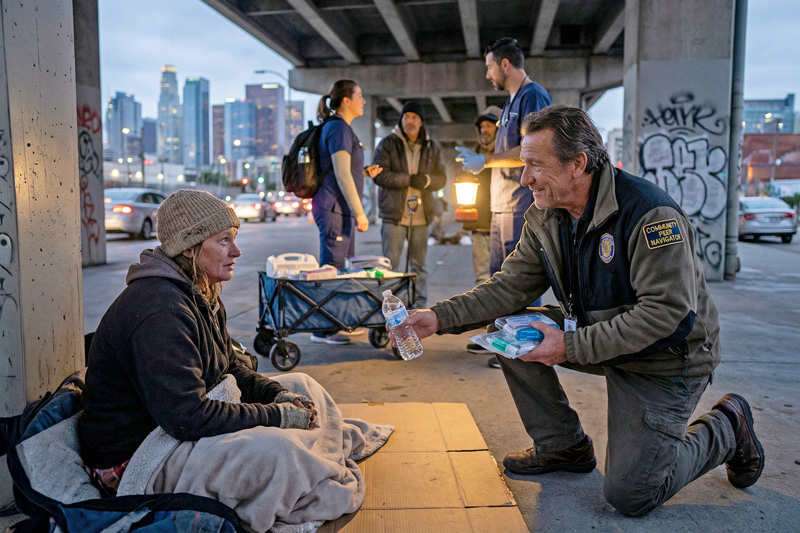
At the intersection of homelessness and substance abuse, the importance of peer specialists is undeniable. Research has shown that peer support in the realms of homelessness and substance abuse has the potential to effectively improve housing retention and reduce substance use-related harm, including overall reductions in drug and alcohol use (Miler 2020). The role of peer workers in this context can vary greatly, but it often involves building relationships with clients and acting as both an advocate and a mentor throughout the process of accessing medical and social services, such as substance abuse treatment and supportive housing (Miler et al. 2020, Barker et al. 2017, MacLellan et al. 2015).
Beyond being able to connect with clients who are already in treatment, peer support workers are uniquely able to act as a bridge from initial engagement to initiating care (Miler et al. 2020). This is especially important in the context of street medicine, where providers deliver healthcare and resources directly to people experiencing unsheltered homelessness on their own terms. Street medicine often takes the form of multidisciplinary outreach teams, with peer workers serving as a point of connection between the communities that they enter and the providers and students who come along on the run (Enich et al. 2023).
In an interview, Lavaughn Johnson, a Peer Navigator at ReVive Center for Housing and Healing, and a lead on ReVive’s Street Outreach team, highlighted how lived experience can provide peer support workers with a distinct understanding of care. He explained that a hierarchical approach to care will not be effective within communities that are consistently seen as lesser-than and unable to make decisions for themselves.
Peer support isn’t just about relating to the experiences of clients but also understanding on a deeper level how to approach and communicate with people who have often been actively harmed by traditional models of care that are seen in clinical settings (Miler et al. 2020).
However, while the framework of peer support certainly has much to offer to the field of street medicine, peer workers at the intersection of housing and substance abuse services are subject to unique challenges. Synthesizing the findings of Miler et al.’s review of eleven research studies on peer support at the intersection of homelessness and substance use, alongside Lavaughn’s experience at his organization, three areas of challenge can be highlighted: vulnerability, responsibility, and compensation.
Vulnerability
While providing services such as street medicine is risky for everyone involved, peer workers can experience risk and vulnerability in very different ways, and the potential consequences for their lives, loved ones, and communities should not be underestimated. Vulnerability can show up in peer workers’ own recovery journey and the possibility of encountering triggers which lead to relapse (Barker et al. 2018). Although surveys show a willingness among peer workers to have some clinical responsibilities like administering Narcan to reverse an opioid overdose, peer responders reported concerns about legal repercussions, including fears of being charged with causing death if the naloxone administration was unsuccessful or resulted in harm (Wright et al. 2006). Peer workers may also have a harder time establishing boundaries in their work, leaving them vulnerable to emotionally overextending themselves (Miler et al. 2020 p. 11). Overall, peer workers emphasize the need to know themselves, their limitations, and receive proper training in order to mitigate risk while working in such unpredictable environments (Barker et al. 2018).
Responsibility
Because peer workers frequently serve as a primary line of connection between clients and providers, they often feel overwhelmed managing both the formal responsibilities they are assigned and the more messy, dangerous realities of the work that is being done. In several studies, this showed up in situations where peer workers administering harm reduction supplies felt like they had to take on larger roles than they felt comfortable doing, such as administering naloxone as mentioned above, or even helping physically disabled individuals inject drugs in order to prevent them from using more dangerous methods (Wright et al. 2006, Dechman 2015). Although these issues will certainly vary across organizations who may encourage different kinds of interactions and levels of involvement in outreach work, it is clear that peer specialists often feel responsible, or are implicitly expected, to take on responsibilities that are not necessarily explicitly outlined in their job description or training.
Although confident about his role and abilities doing outreach runs, Lavaughn also identified overwhelming responsibility as a systemic issue within the peer support field. Lavaughn identified one of the struggles he sees in peer support as safety: “Safety would be my biggest concern. If they want to know what peer navigators need, we need a safety…handbook training—just make sure that we’re safe because we’re the ones out here in this. If something happens, we got to deal with it.” While Lavaughn acknowledges that this is an area where he can provide expertise, it can be difficult in the fast-paced environment of a run to provide adequate training for students and other participants who come from varying backgrounds: “Maybe not everyone has an instinct of how to stay safe in this. When you grew up like me, you learn to watch those surroundings without even knowing that you’re doing it. I’m accustomed to it already.”
Lavaughn identified safety behaviors that people might not instinctually do—such as staying together in a group, checking over your shoulder, and consistently scanning your surroundings—as knowledge that cannot be easily condensed into an online training module. Through this observation, Lavaughn is drawing on a common theme throughout the challenges faced by peer support workers in this sphere: times when peer navigators feel pressure to take on responsibilities because of their rapport with the community being served. In order to ensure that peer workers are able to care for themselves, continue to grow in their roles, and avoid the common issues of burnout, behavioral healthcare providers, particularly those in the realm of homelessness and substance abuse, should consider working with peer specialists to develop clarity around responsibilities, as well as safety training.
Compensation
Peer workers have reported across several studies that they felt that their contributions were not recognized because of their ‘peer’ status (Miler et al. 2020, Charron et al. 2018). This reflects the larger disagreement around the occupational status of peer workers, which mainly ranges from volunteer to low-wage employee. Research shows that more often than not, peer workers face poor employment conditions, low wages, and few benefits or opportunities for growth (Chapman et al. 2018). Access to resources among organizations that incorporate peer support in housing and substance use services such as street medicine is certainly a limitation to fairly compensating both peer and non-peer workers, and much of the work is done on a volunteer basis (Miler et al. 2020). However, it is essential that organizations and providers are sensitive to the fact that peer work can be uniquely situated to be exploitative. In a field which aims to respect the expertise, autonomy, and humanity of clients and workers alike, it is deeply concerning that peer workers’ labor is devalued in comparison to non-peer workers.
Peer workers being afforded a professional role with growth opportunities is not unheard of, however. Hope can be found in Lavaughn’s experience at ReVive, where his supervisor instilled confidence in him and encouraged him to keep moving up in the field of social work when hiring him for the peer worker position: “The same thing that [my case worker] put inside of me, [my supervisor] did the same thing. She told me that I can go as far as I want with this. [She told me] you are a real people person, you know how to communicate with people.” Lavaughn’s next goal is to go to school and become a case worker at the organization he works for currently, which has received overwhelming support from his coworkers: “They tell me I could bring people in today…that a case worker is not out of my range.”
Looking Forward
Miler et al. provides a framework for implementing peer services that largely aligns with the challenges described thus far, including a clear role description, transparency around compensation so peer workers can make informed decisions about their commitment, emotional support services, career development opportunities, workplace recognition of the value of peer work, and workplace accommodations. It should be acknowledged that providing the necessary support for peer roles is heavily resource dependent and is intertwined with field-wide issues of overworking, stress, and burnout. However, in order for peer support within street medicine to continue to grow and achieve its potential as a radical, alternative form of care for hard-to-reach populations, it is essential for behavioral health professionals to reckon with both the very real challenges and possibilities of the peer support position.
Key Takeaways
- Peer workers are uniquely positioned to meaningfully engage with clients in the field of street medicine, often acting as a point of trustworthy connection between the unhoused community and medical and social work providers.
- It is important to recognize that peer workers are in a position of increased vulnerability to risk, including risk of personal setbacks, legal repercussions, and emotional burnout.
- Peer specialists may feel implicitly expected to take on responsibilities that are not in their job description or training, including ensuring the physical safety of the outreach team.
- Research shows that peer work is often devalued in comparison to non-peer workers, with the role often being low-wage with little opportunity for professional growth.
- In order to mitigate these challenges, street medicine providers should work with peer specialists to develop more in-depth training, clarity around responsibilities, and overall craft a peer support role which offers opportunities for fair compensation and career development.


Adamina Serratos is a fourth-year undergraduate student studying Comparative Human Development on the pre-medicine track at the University of Chicago. She completed an internship at ReVive Center for Housing and Healing in the summer of 2025 and currently volunteers with ReVive and Chicago Street Medicine.
Samuel Jackson, MD, serves as the Clinical Director of Psychiatry at Erie Family Health and is an Assistant Professor of Psychiatry at Rush, Loyola, and University of Illinois Chicago. For more information, email [email protected] or [email protected] and connect over LinkedIn at www.linkedin.com/in/adamina-serratos-2a2b09306.
References
Barker, Stephanie L., et al. “Peer Support Critical Elements and Experiences in Supporting the Homeless: A Qualitative Study.” Journal of Community & Applied Social Psychology, vol. 28, no. 4, 31 May 2018, pp. 213–229, https://doi.org/10.1002/casp.2353.
Barker, Stephanie L., and Nick Maguire. “Experts by Experience: Peer Support and Its Use with the Homeless.” Community Mental Health Journal, vol. 53, no. 5, 7 Feb. 2017, pp. 598–612, link.springer.com/article/10.1007/s10597-017-0102-2, https://doi.org/10.1007/s10597-017-0102-2.
Chapman, Susan A., et al. “Emerging Roles for Peer Providers in Mental Health and Substance Use Disorders.” American Journal of Preventive Medicine, vol. 54, no. 6, June 2018, pp. S267–S274, https://doi.org/10.1016/j.amepre.2018.02.019.
Charron, C.B., Hudani, A., Kaur, T. et al. Assessing community (peer) researcher’s experiences with conducting spirometry and being engaged in the ‘Participatory Research in Ottawa: Management and Point-of-care for Tobacco-dependence’ (PROMPT) project. Res Involv Engagem 4, 43 (2018). https://doi.org/10.1186/s40900-018-0125-z
Dechman, Margaret Kathleen. “Peer Helpers’ Struggles to Care for “Others” Who Inject Drugs.” International Journal of Drug Policy, vol. 26, no. 5, May 2015, pp. 492–500, https://doi.org/10.1016/j.drugpo.2014.12.010.
Enich, M., Tiderington, E., & Ure, A. (2023). Street medicine: a scoping review of program elements. International Journal on Homelessness, 3(2), 295–343.
Johnson, Lavaughn. Recorded Interview with Lavaughn. 14 Feb. 2026.
MacLellan, Jennifer, et al. “Peer Support Workers in Health: A Qualitative Metasynthesis of Their Experiences.” PLOS ONE, vol. 10, no. 10, 30 Oct. 2015, p. e0141122, https://doi.org/10.1371/journal.pone.0141122.
Miler, J. A., Carver, H., Foster, R., & Parkes, T. (2020). Provision of peer support at the intersection of homelessness and problem substance use services: A systematic “state of the art” review. BMC Public Health, 20(1). https://doi.org/10.1186/s12889-020-8407-4
“ReVive Center for Housing and Healing.” ReVive Center for Housing and Healing, 2023, www.revivecenter.org/programs.