The Behavioral Healthcare Workforce Crisis
The behavioral healthcare sector faces one of the most severe workforce shortages in decades. As of 2023, an estimated 169 million individuals in the U.S. live in Mental Health Professional Shortage Areas, which is projected to worsen by 2037 (National Center for Health Workforce Analysis, 2023). For organizations like SMA Healthcare, with more than 1,000 team members serving across crisis, residential, outpatient, and prevention programs in Florida, the workforce challenge is not simply a staffing issue. It is a matter of access to lifesaving services and care.
At SMA, we have made workforce development and innovation a top priority. By focusing on recruitment, retention, training, and sustainability, we are building strategies that are not only helping us stabilize our own workforce, but that can also be adapted by other behavioral healthcare providers.
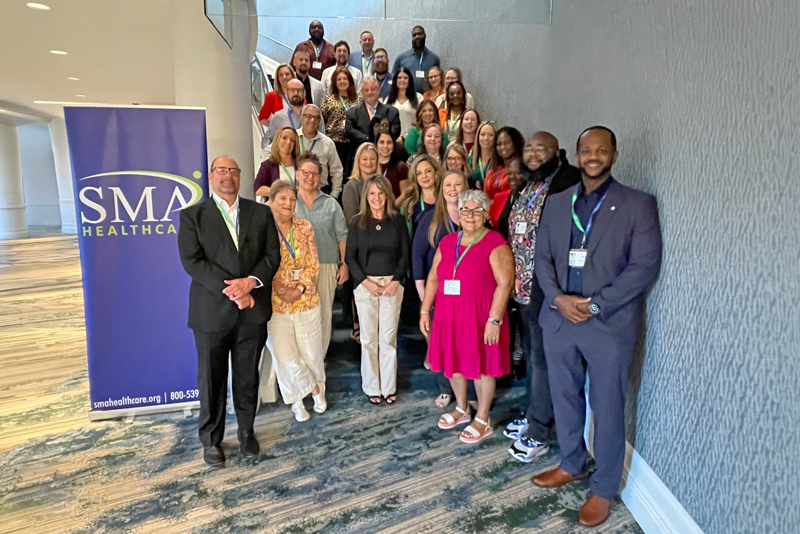
SMA Healthcare team members at BHCon Florida, the annual Florida Behavioral Health Conference organized by Florida Behavioral Health Association.
Recruitment in a Competitive Labor Market
Recruiting behavioral healthcare team members has never been easy, but the post-pandemic labor market has added new challenges. Competition from hospitals, private practices, remote jobs, and other industries has drawn many qualified professionals away from community-based care.
At SMA, recruitment innovation starts with three core strategies:
- Pipeline Partnerships: SMA partners with local universities, community colleges, and vocational programs to build clinical internship opportunities and pathways. Students are introduced to behavioral health careers early and receive mentorship that encourages long-term retention. In 2025, 8% of SMA interns transitioned into full-time positions after graduation, a direct return on investment in future talent.
- Community-Based Recruitment: Recognizing the importance of lived experience, SMA recruits directly from the communities it serves. Peer specialists, individuals with personal recovery experience, are integrated into clinical teams. SMA has 33 peer specialists embedded across programs, bringing both cultural competency and firsthand lived experience.
- Meaningful Employer Branding: Recruitment campaigns are designed to highlight SMA as a mission-driven organization where team members make a direct impact. Social media, job boards, and digital platforms are used to spotlight employee stories, day-in-the-life features, and testimonials about the rewards of working in behavioral health. SMA launched a digital campaign, “Why SMA?”, which shares team member testimonials and highlights the impact of behavioral healthcare work. Why SMA? New Video Series Introduction
This branding approach increased web traffic to the SMA Careers application portal by 34.6%, with video views totaling 20,171 across Facebook and Instagram.
Retention and Burnout Prevention
Recruitment is only half the battle. Nationally, behavioral healthcare turnover rates reach up to 40% annually (Pathman et al., 2025), driven by burnout, compassion fatigue, and lower compensation compared to other healthcare sectors. SMA has prioritized retention strategies that invest in team members’ well-being and career growth.
- Resilience and Wellness Programs: SMA offers health and lifestyle campaigns through SMA Wellness education. Additionally, to encourage preventive health, team members who complete a qualifying preventive care visit (physical, screening, etc.) are entered into prize drawings for Apple Watches, Fitbits, AirPods, gift cards, and other prizes. To further promote health, a Wellness Rewards program is offered that rewards enrollees for completing preventive care visits, getting recommended hours of sleep, completing a certain number of steps in a day, getting a flu shot, etc. Currently, 38% of employees are enrolled and participate in the program.
- Career Ladders and Growth Opportunities: SMA has developed clear progression frameworks, such as for client support specialists and clinicians. Team members can see the steps needed to advance, receive training aligned with those steps, and are supported by leadership in their professional development. In 2025, 203 employees were promoted, transferred, or moved up on the career ladder. 102 of these team members advanced via career ladder to the next position in their respective areas, providing opportunities for growth and decreasing turnover.
- Leadership Development and Continued Education: Annually, SMA offers multiple opportunities for leadership development and expansion of skills through hosting continuing medical education (CME) sessions and offering an ADEPT Leadership Accelerating Leadership Impact program. The ADEPT System is a 3-month course designed to grow leadership skills and support interaction with team members from various programs across the 6-county agency. To date, 84 employees have completed the ADEPT program, advancing their leadership skills and professional development.
Training for Emerging Care Models
The behavioral health landscape is shifting rapidly. The rollout of the 988 Suicide & Crisis Lifeline, the expansion of integrated care, and the growth of mobile response teams are reshaping how care is delivered. Preparing the workforce for these emerging models requires proactive adaptable training.
At SMA, innovation in training includes:
- Clinical Training & Skill Expansion: Clinicians receive training across multiple program types and clinician specialties, tailoring skill development to industry and community demands. With a shortage of clinicians and qualified supervisors to mentor future providers in the field, SMA began offering an annual Qualified Supervisor course, providing staff with the educational requirements necessary to become a Qualified Supervisor in Florida. This not only expands Qualified Supervisors for interns at partnering universities but also addresses the behavioral health workforce shortage by supporting new talent and pre-licensed professionals new to the field.
- Annual Conference Training & Collaboration: Every year, SMA sends team members to participate in the Florida Behavioral Health Association’s annual conference to learn and collaborate with other behavioral health providers. SMA also participates through presentation sessions at the conference to share programmatic success or innovative practices. In 2025, SMA’s Jeremiah Alberico, Terence Thomas, and Robin Lanier, along with Deborah Velez with the Marion County Hospital District presented, “Pathways to Healing: Navigating a One-Stop Shop for Substance Use and Mental Health Treatment” at the conference, sharing collaborative strategies to improve treatment access with other professionals.
- Mental Health Symposium: The SMA Foundation hosts an annual Mental Health Symposium, “Who is Jay?” providing team members and the community with speakers and training sessions tailored to current and emerging needs in behavioral healthcare. Team members can earn continued education units (CEUs) for their licensure and educational requirements, while learning about relevant trends and best practices in behavioral healthcare.
Compensation and Financial Sustainability
For behavioral health providers, the conversation about workforce sustainability should not begin and end with wages. SMA has adopted a broader definition of compensation as one that values purpose, professional identity, and overall employment experience alongside pay.
- Tuition Reimbursement: SMA is committed to supporting the growth and advancement of its team. From 2023-2025, SMA helped 70 employees with tuition reimbursement, reducing their financial burden and strengthening retention. For team members continuing education or maintaining licensure, credential reimbursement is also provided. From 2023-2025, 266 employees were reimbursed for credentialing efforts, providing another benefit for professional development.
- Tenure Bonuses and Recognition: SMA offers a tenure bonus program tied to work anniversaries, offering milestone incentives at 3, 5, and 10 years of service. Team members are also invited to a celebratory luncheon, honoring their professional accomplishments and commitment to SMA. In 2025, 182 employees were recognized for their years of service, totaling 1,233 years.
SMA Healthcare’s workforce development strategies demonstrate a comprehensive approach to strengthening the behavioral health workforce. By prioritizing recruitment, retention, training, and sustainability with evolving community needs, SMA illustrates how organizational innovation can drive systematic impact. These efforts not only address current workforce shortages but also build long-term sustainability through professional pathways, continuous learning, and a culture of equity and excellence. As behavioral health challenges continue to expand nationwide, SMA’s model offers a replicable framework for developing resilient and mission-driven teams that advance quality and access to care delivery.


Brooke Goodenow, MS, is the Process Improvement & Research Manager and Haley Pegram, MS, is a Grant Evaluator at SMA Healthcare. For questions about this article, please contact Brooke Goodenow at bgoodenow@smahealthcare.org.
References
National Center for Health Workforce Analysis. (2023, December). Behavioral Health Workforce 2023 Brief. Health Resources and Services Administration. https://bhw.hrsa.gov/sites/default/files/bureau-health-workforce/Behavioral-Health-Workforce-Brief-2023.pdf
Pathman, D. E., de Saxe Zerden, L., Konrad, T. R., Shafer, A. B., Harrison, J. N., Fannell, J., & Lombardi, B. M. (2025). Job assessments and the anticipated retention of behavioral health clinicians working in U.S. Health Professional Shortage Areas. BMC health services research, 25(1), 592. https://doi.org/10.1186/s12913-025-12698-6