
NAMI-NYC participant reflections illustrate why a peer-based approach matters. One participant shared that they did not know anyone in their life who had experience depression and that hearing a peer speak made them feel less isolated, saying, “I don’t have anyone who has depression around me, so hearing from you makes me feel like I’m not alone.” Another participant said that the presentation gave them new language to use with family members, stating “Very powerful and brave. This presentation has given me more dialogue on how to approach mental health with family.” These reactions are common across workplaces and demonstrate why storytelling can reach employees who may not engage in traditional training.
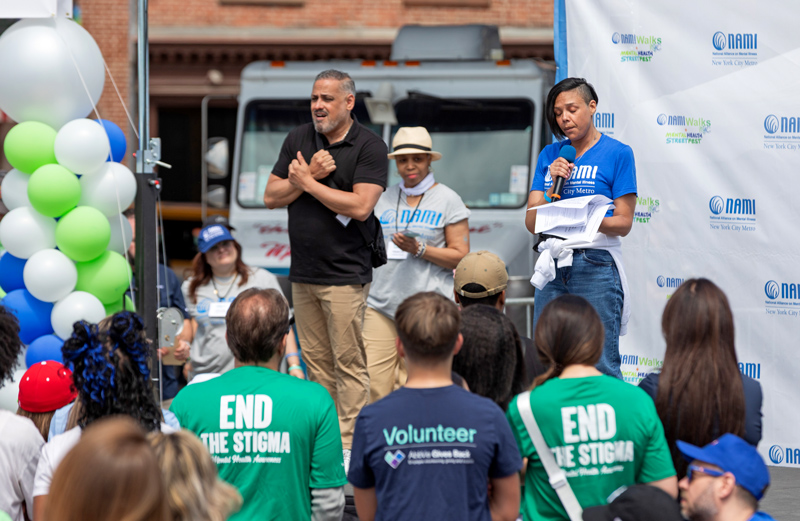
Peer-based storytelling is critical to individual recovery and creating healthier workplace environments. Centering lived experience, NAMI-NYC community member Sabrina shares about her mental health challenges as well as the loss of her son to suicide at NAMIWalks NYC + Mental Health Street Fest 2025. Credit: By Veronica Photography
Workforce wellbeing is a proven contributor to productivity and retention. National estimates suggest that disengagement and unaddressed mental health concerns result in substantial losses each year (Gallup). Individual skill building is important, but individual level strategies work best when managers and senior leaders reinforce healthy expectations and model open communication. For this reason, NAMI-NYC applies to a public health approach that addresses the individual, interpersonal, and organizational levels of a workplace. Peer-based presentations and storytelling are part of this framework.
Peer support refers to a range of activities and interactions among people with shared experiences of living with a mental health condition, substance use disorders, or both (SAMHSA). This shared experience increases trust and helps normalize conversations about mental health. NAMI-NYC’s peer-based programs, including In Our Own Voice, Ending the Silence, and Family & Friends, often serve as a starting point for employers seeking to invest in their workforce. Each of these presentations can be customized to specific workplaces from hospitals and universities to community organizations and Fortune 500 companies. Many employers incorporate peer-based elements into larger training series, including sharing stories of lived experience or intentionally offering time for meaningful discussion among attendees during sessions.
These presentations help shift workplace culture by creating space for vulnerability and shared understanding. At a multinational beauty company, NAMI-NYC delivered a five-part workplace resilience training series. Senior leaders began each session with their own stories about burnout and recovery. Employees reported that hearing these personal experiences increased their trust and their willingness to discuss mental health more openly. As a result, the company expanded both individual level wellbeing programs and broader organizational initiatives.
Peer-based presentations and storytelling also increase help-seeking and help-supporting behaviors. This recognition reduces hesitation to speak up or access support. After a NAMI-NYC presentation, employees at a global financial services firm requested monthly What’s on Your Mind sessions, where employees connect to supportive mental health and wellness resources, as well as build community. At a leading technology services company, peer presentations led employees to advocate for Mindful Mondays, a weekly guided meditation series that reinforces the importance of rest. These examples show how peer-based programs can encourage employees to connect with professional or community-based support outside of the workplace (Greenwood).
Reducing stigma and increasing hope are additional benefits. One attendee shared that the honesty of the presenter made their day brighter and reduced feelings of isolation, saying, “Thank you for the honesty and sharing. This made my day a little brighter and made me feel less alone.” A family member reported that the presentations helped them understand that tools exist to support caregivers, saying, “This seminar gave me hope there are tools are out there to help family members understand mental illness.” Independent evaluations of In Our Own Voice showed a significant reduction in stigma among participants (Corrigan, Kanter, Perlick).
Peer storytelling also supports supervisors and leaders who may feel uncertain about how to approach employees who seem to be struggling. Many leaders rely on assumptions or media portrayals of mental illness. After NAMI-NYC delivered peer-based presentations at a U.S. law firm, managers and partners reported a greater understanding of how to recognize signs of mental health challenges in their colleagues and have the tools to support them early on to decrease the risk of crisis. Feedback showed that a key barrier for many managers was not knowing the language to use. Hearing peers share their experiences helped bridge that gap.
Peer-based storytelling strengthens individual recovery and contributes to healthier workplaces. It increases connection, supports early help-seeking, reduces stigma, and builds a sense of community. When organizations incorporate real stories of lived experience into their wellbeing efforts, employees feel seen, leaders gain practical tools, and the workplace moves closer to a culture where mental health is acknowledged and supported.


Maggie G. Mortali, MPH, is CEO, and Jennifer Da Silva, MPA, is Director of Marketing and Communications at NAMI-NYC. To learn more about peer-based presentations, visit naminyc.org/workplace.
Sources
Corrigan, P.W. et al. (2010). Changing Stigmatizing Perceptions and Recollections About Mental Illness: The Effects of NAMI’s In Our Own Voice. Community Mental Health Journal. Vol. 46. https://link.springer.com/article/10.1007/s10597-009-9287-3
Employee Wellbeing Is Key for Workplace Productivity. Gallup. https://www.gallup.com/workplace/215924/well-being.aspx.
Greenwood, K. (2023). Leaders: Sharing Your Own Mental Health Story Can Help You Become a Better Ally. SHRM. https://www.shrm.org/executive-network/insights/leaders-sharing-mental-health-story-can-help-become-better-ally.
Kanter, J. et al. (2008). The Impact of In Our Own Voice on Stigma. American Journal of Psychiatric Rehabilitation. 11(4). https://www.tandfonline.com/doi/full/10.1080/15487760802397660
Perlick, D. et. al. (2011). In Our Own Voice-Family Companion: Reducing Self-Stigma of Family Members of Persons With Serious Mental Illness. Psychiatric Services. 62(12). https://psychiatryonline.org/doi/full/10.1176/appi.ps.001222011
Peer Support. (2017). SAMHSA. https://www.samhsa.gov/sites/default/files/programs_campaigns/brss_tacs/peer-support-2017.pdf
State of the Global Workplace 2025: Understanding Employees, Informing Leaders. Gallup. https://www.gallup.com/workplace/349484/state-of-the-global-workplace.aspx



The Impact of Peer-Based Storytelling on Workplace Mental Health is a wonderful idea and when I have heard it done well it is very impressive. I am sure this already exists but would think well written stories experiences, that can shared in an organize manner, may be as powerful or even better as they can be shared more widely. I once had a client who was a high school student suffering from very scary visual and auditory hallucinations. The paper she wrote about this was an amazing example of an author painting a picture for you. This “picture” was extremely scary and disturbing but it was the best example in writing that I have ever seen of a “psychotic episode”. Unfortunately, she didn’t want to publish. I am an administrative and clinical social worker working in the field for almost 30 years.