-
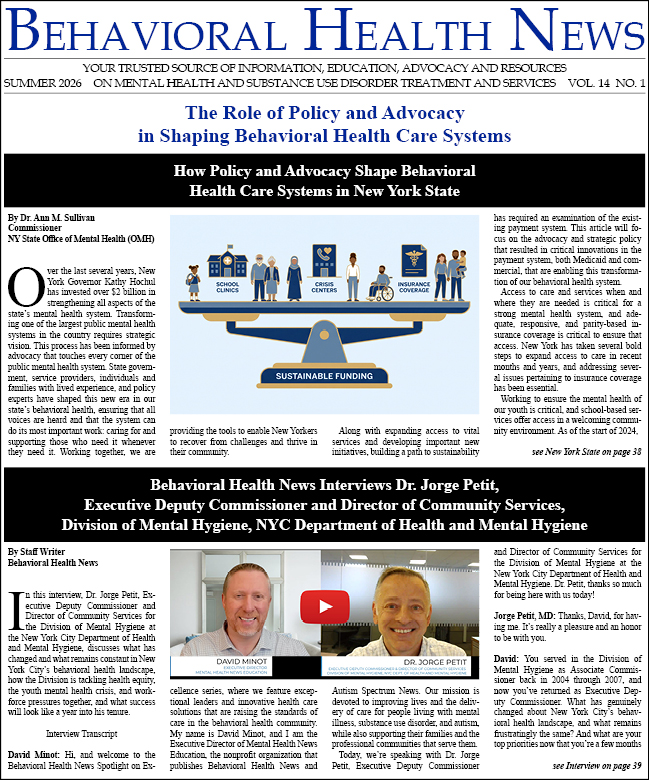
Behavioral Health News Spotlight on Excellence: An Interview With Dr. Jorge Petit, Executive Deputy Commissioner and Director of Community Services, Division of Mental Hygiene, NYC Department of Health and Mental Hygiene
Overview In this interview, Dr. Jorge Petit, Executive Deputy Commissioner and Director of Community Services for the Division of Mental Hygiene at the New York City Department of Health and Mental Hygiene, discusses what has changed and what remains constant in New York City's behavioral health...
-
Mentorship and Leadership in Advancing Behavioral Health Equity
Growing up in Jamaica, Queens, in a working-class family, I learned early that one’s circumstances do not define one’s potential. My grandparents instilled in me the value of perseverance and the belief that education is a powerful equalizer. I was driven not only to advance myself, but also to...
-
Overcoming Barriers to Integrating Peer Support in Mental Healthcare Systems
Peer support is one of the most promising approaches in behavioral health, demonstrating measurable improvements in recovery outcomes for people living with serious mental illness. Yet despite decades of research and growing policy support, peer specialists remain underutilized across many...
-
Integrating Peer Professionals in Complex Behavioral Health Systems
NYC Health + Hospitals, the nation’s largest municipal health care system and New York City’s largest behavioral health provider, serves individuals with complex behavioral health and social needs including homelessness, justice involvement, and chronic medical conditions. In this landscape,...
-
Peer Support in Practice: Workplace Strategies and Professional Development
The field of peer support is quickly gaining prominence and visibility across the domains of behavioral health and substance use services. Georgia was the first state to provide Medicaid-billable mental health peer services in 1999 - it was not until 2012 that Medicaid billing was authorized for...
-
Peer Services in Behavioral Health: New York State Leading the Way
Individuals with lived experience with mental illness have a unique perspective that can play a crucial role in helping others on the path to recovery. A key facet of reaching and forming bonds with individuals seeking support is the strong connection peer support workers offer. We have made...
-
Strengthening Behavioral Health Through Peer Services: Advancing Recovery Across the Continuum of Care
Recovery from addiction is often strengthened through connection with others who have lived experience. Across New York State, peer professionals - individuals with lived recovery experience - are playing an increasingly important role in behavioral health services. Through strategic policy...
-
Beyond Boundaries: Oh, the Places Peer Support Can Go!
Peer support has always been bigger than the box systems tried to paint it in. Long before it was codified, credentialed, or added into service plans, it was ordinary folk reaching for one another—standing in the front, behind and to the side of each other sharing hard-earned wisdom, offering...
-
Addressing Workplace Stigmatization of Peer Colleagues Through Institutional Courage
It is well documented that people with mental illness and substance use disorders (MI/SUD) are stigmatized across all levels of society. So, it is not a surprise that peer support specialists regularly experience stigmatization in the workplace, including negative messages from colleagues about...
-
Implementation of Peer Support Roles in Street Medicine and Outreach: Challenges and Possibilities
“We’re not here to belittle you. We’re not here to down talk you. We’re not here to tell you what you should or shouldn’t be doing because that’s not our place.” - Lavaughn Johnson, Peer Navigator at ReVive Center for Housing and Healing At the intersection of homelessness and...